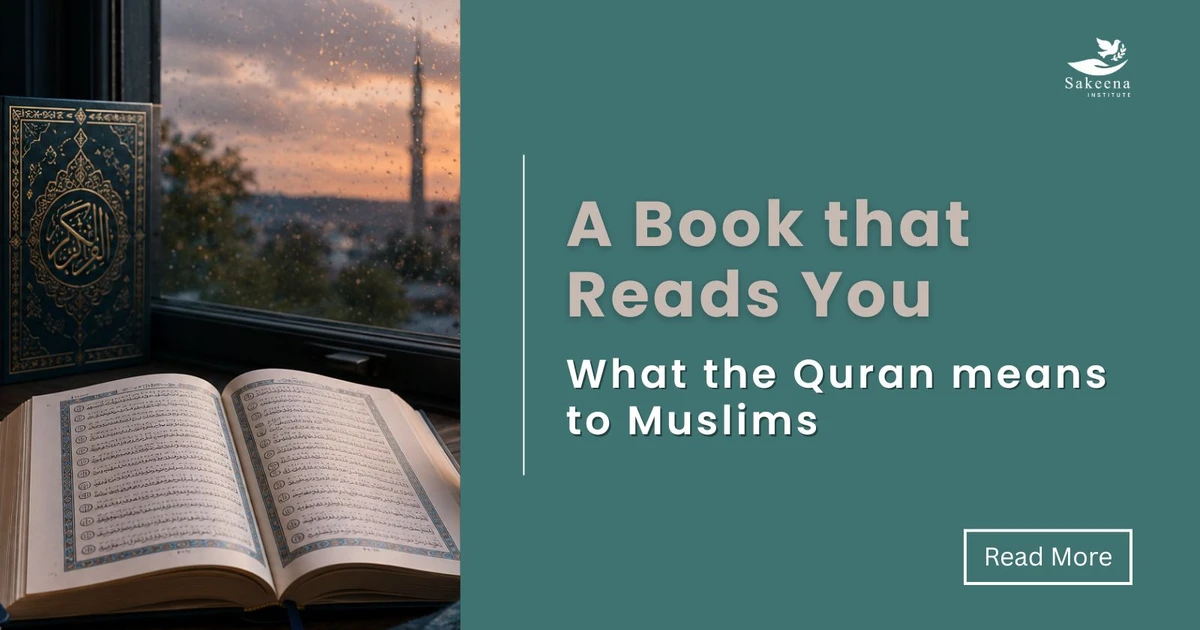

There are certain questions that seem almost impossible to answer, not because the answer is unknown, but because no collection of words could ever do it justice. Asking what the Qur'an means is one of those questions. It is easy enough to describe what the Qur'an is: The final revelation sent by Allah, His preserved speech and the ultimate source of guidance for mankind.
Yet none of these descriptions truly capture what the Qur'an does to the heart of the one who sincerely lives with it. There is a difference between defining something and experiencing it, and the Qur'an belongs firmly in the latter category.
The Qur'an possesses a quality unlike any other book. It does not simply offer information or tell stories of nations that came before us; rather, it reaches into the hidden recesses of the heart, illuminating places that have long been buried beneath grief, doubt, fear, and distraction. Every ayah seems to arrive with perfect precision, as though it knows exactly which wound requires healing and which uncertainty requires reassurance.
A person may read the same passage countless times throughout their life, only to discover that it speaks to them in an entirely different way during seasons of hardship, gratitude, or repentance. The words themselves never change, yet the One who revealed them knows every condition of every heart that turns back to Him.
Perhaps this is why the Qur'an has often been described as light. Light does not force itself upon darkness through struggle or conflict; it merely appears, and darkness has no choice but to retreat. Likewise, the Qur'an gently replaces confusion with certainty, despair with hope, and restlessness with tranquility until the believer begins to realize that true peace was never found in changing circumstances, but in drawing nearer to Allah through His words. What begins as recitation gradually becomes companionship, and what begins as a daily habit slowly transforms into the very thing that sustains the soul.
For this reason, the Qur'an is far more than a sacred text placed upon a shelf or recited during moments of worship. It is a constant companion, a source of direction, and the strongest connection a servant can have with their Creator. It is the rope that Allah commands us to hold firmly, the light that guides through every darkness, and the mercy that accompanies the believer from this life until the next. Its pages contain guidance for every generation because the One who authored them created every human heart that would ever read them.
Perhaps the greatest miracle of the Qur'an is that every reader comes to it carrying different burdens, yet each leaves having found exactly what they needed. The grieving discover patience, the anxious find reassurance, the sinner encounters hope, and the seeker is guided towards certainty. No human author could ever write a book capable of speaking so personally to millions of people across centuries while never changing a single word. Only Allah, the Creator of every soul, could reveal a Book that continues to read its reader long after the reader believes they are the one doing the reading.
The remarkable nature of the Qur'an is that it refuses to remain a distant text. Every other book waits patiently for its reader to interpret it, but the Qur'an has a way of interpreting the one who opens it. It exposes hidden attachments before they become idols. It uncovers diseases of the heart before they consume it. It reminds the forgetful, comforts the broken, humbles the proud and awakens the heedless. There are moments when a believer opens the mushaf searching for answers, only to find that Allah was addressing a question they had not yet found the words to ask.
This is because the Qur'an was never intended merely to be understood by the intellect. It was revealed to transform the heart. Knowledge alone does not necessarily change a person, but divine speech has the power to reshape perspectives, soften character and redirect an entire life. Many people spend years trying to fix themselves through books, podcasts and endless self-improvement techniques, yet the One who created the human soul revealed a Book specifically designed to nurture, refine and heal it. The Qur'an does not simply teach us how to live; it teaches us how to return to the One for whom we were created.
One of the most beautiful aspects of living with the Qur'an is discovering that it grows alongside the believer. As children, we may marvel at the stories of Nūḥ, Mūsā or Yūsuf عليهم السلام. As adults, we begin to recognize ourselves within those stories. We understand the loneliness of Nūḥ as he called his people for centuries. We appreciate the patience of Yaʿqūb when loss became his closest companion. We admire the unwavering trust of Mūsā standing before an impossible sea. We are humbled by the sincerity of Maryam as she faced accusations she could never have anticipated. The stories remain exactly as they always were, yet experience opens new doors of reflection with every passing year.
There is also something profoundly comforting in knowing that every emotion a believer experiences has already been acknowledged within the Qur'an. Fear, grief, joy, hope, regret, uncertainty, gratitude and longing all find their place within its pages. The Qur'an never asks people to pretend they are free from human emotion. Rather, it teaches them where to direct those emotions. It redirects fear towards Allah instead of creation, hope towards His mercy instead of worldly outcomes, and love towards what will ultimately bring a person closer to Him. In doing so, it does not remove emotion from the believer; it purifies it.
Perhaps this is why so many people find themselves returning to the Qur'an during life's defining moments. It is opened beside hospital beds and graves. It is recited before journeys, after loss, during sleepless nights and in moments of immense gratitude. When words from people begin to lose their ability to comfort, the words of Allah remain sufficient. Long after conversations end and advice is forgotten, a single ayah often lingers within the heart, quietly carrying a person through difficulties they never imagined they would survive.
Yet the relationship with the Qur'an is not reserved only for times of hardship. To know the Qur'an only when life becomes difficult is to miss one of its greatest gifts. It is equally a companion in moments of joy, reminding the believer that every blessing has a Giver and every success is an opportunity for gratitude rather than pride. It teaches contentment before loss ever arrives and strengthens faith before trials ever appear. In this way, the Qur'an prepares the heart for every season before it reaches it.
The more one reflects upon the Qur'an, the more one begins to appreciate that every page ultimately points to the same destination: knowing Allah. Every command reveals His wisdom. Every prohibition reflects His mercy. Every promise inspires hope, and every warning stems from His desire to save His servants from destruction. The Qur'an is not merely a collection of laws or narratives; it is an invitation to know the One who spoke every word. Through its verses, Allah introduces Himself by His beautiful names and perfect attributes until love, awe and reliance naturally begin to settle within the heart.
Perhaps that is what the Qur'an ultimately means. It is Allah speaking directly to His servants, inviting them back to Him again and again, no matter how many times they wander. It is a mercy that never expires, a conversation that never grows old and a companion that never abandons the one who sincerely seeks it. Every recitation is another opportunity to listen, every reflection another opportunity to draw nearer, and every verse another reminder that the distance between a servant and their Lord has never been measured by geography, but by the openness of the heart.
To ask what the Qur'an means is therefore to ask what light means to someone who has spent years in darkness, what water means to the one dying of thirst or what home means to the weary traveler who has wandered for far too long. It is guidance for the lost, healing for the wounded, certainty for the doubtful and peace for the restless. Above all, it is the speech of Allah—an immeasurable gift that no human language can fully describe, only a heart can truly come to know.