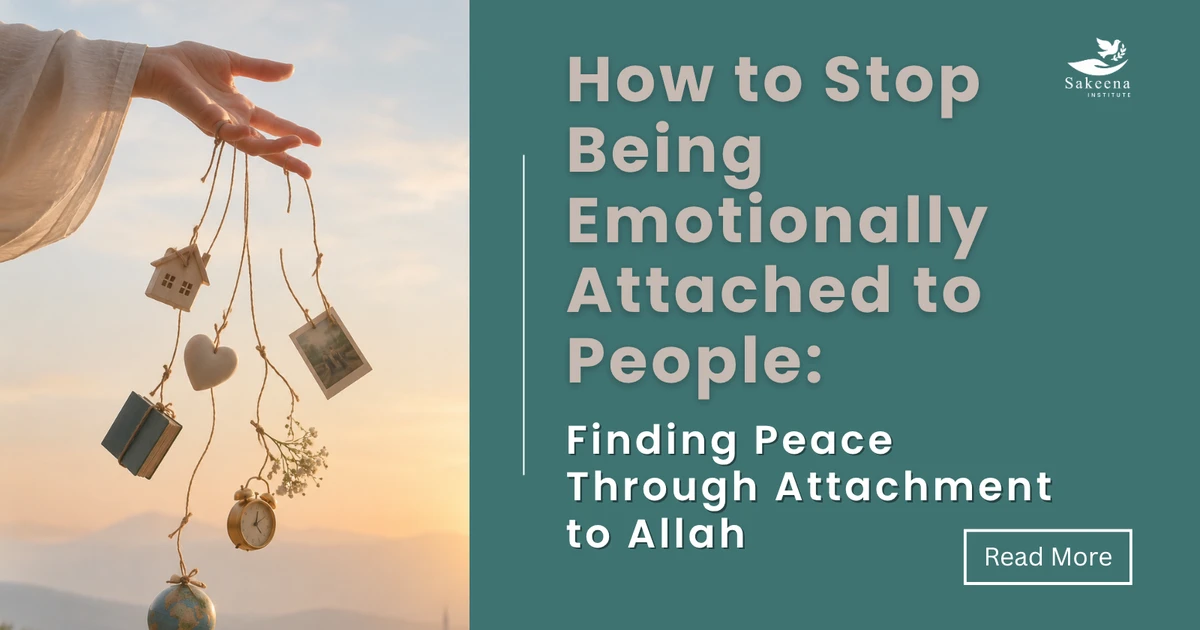

Life has a way of teaching us how deeply we can become attached to things we were never meant to hold forever. We become attached to people, to their presence, to their words, and to the comfort we feel when they are near. We become attached to plans we have carefully made, outcomes we have prayed for, and versions of the future that we have imagined in our hearts. Sometimes, we become so attached to the way we want life to unfold that even a small change in our circumstances can leave us feeling lost, anxious, or unable to find peace.
Islam does not teach us to stop loving people or to become indifferent to the blessings Allah has placed in our lives. Rather, it teaches us to love with a heart that knows where its ultimate security belongs. The problem is not that we love deeply, but that we sometimes begin to seek from creation the permanence, reassurance, and peace that only the Creator can truly provide. When our hearts become dependent on things that are constantly changing, our peace becomes vulnerable to every change that life brings. However, when our deepest attachment is to Allah, we learn to navigate the changing circumstances of this world without allowing them to determine the state of our hearts.
Allah reminds us in the Qur'an that the nature of this world is temporary, saying:
كُلُّ مَنْ عَلَيْهَا فَانٍ وَيَبْقَىٰ وَجْهُ رَبِّكَ ذُو الْجَلَالِ وَالْإِكْرَامِ
"Everyone upon the earth will perish, and there will remain the Face of your Lord, Owner of Majesty and Honor." (Qur'an 55:26–27)
This verse invites us to reflect on a truth that our hearts often struggle to accept: everything in creation is temporary, while Allah, the Most High, is everlasting. The people we love are blessings, but they are not permanent possessions. Our achievements, homes, relationships, and worldly comforts are gifts entrusted to us for a time, rather than guarantees that life will always remain the same.
Remembering this reality does not make our love meaningless. Instead, it teaches us to appreciate our blessings without demanding that they remain unchanged forever, allowing us to experience gratitude without becoming consumed by the fear of loss.
Attachment to Allah: The Foundation of Inner Peace in Islam
The peace we seek cannot be built upon circumstances that we cannot control. It must be rooted in something that does not change with the arrival of hardship, the departure of a person, or the disappointment of an unmet expectation. This is one of the profound lessons of attachment to Allah in Islam, because the heart that knows its Lord has a place to turn even when everything around it feels uncertain.
Allah says:
أَلَا بِذِكْرِ اللَّهِ تَطْمَئِنُّ الْقُلُوبُ
"Unquestionably, by the remembrance of Allah hearts are assured." (Qur'an 13:28)
Notice that Allah does not tell us that our hearts will find lasting reassurance through having everything we desire, receiving approval from everyone we love, or securing a future in which nothing painful ever happens. He directs us instead to His remembrance, because the heart was created with a need that worldly possessions and relationships cannot fully satisfy.
When we remember Allah, speak to Him through du'a, return to Him in prayer, and place our trust in His wisdom, we gradually learn that our well-being does not have to depend entirely on what happens around us. We can grieve without losing hope, love without becoming consumed by fear, and pursue our goals without believing that our lives will be ruined if those goals are not fulfilled.
This is not a transformation that happens overnight, nor does attachment to Allah mean that a believer will never experience anxiety, sadness, or longing. Rather, it means that these emotions no longer have to leave us feeling completely abandoned, because we know that our relationship with Allah remains the place to which we can continually return.
Love People, But Do Not Make Them the Source of Your Peace
One of the most beautiful aspects of Islam is that it encourages us to love generously while teaching us not to make creation the ultimate destination of our hearts. We are commanded to honor our parents, maintain family ties, fulfill the rights of our spouses, show mercy to others, and treat people with kindness. These relationships are not obstacles to our relationship with Allah; when approached with sincerity, they can become means of drawing closer to Him.
However, there is a difference between loving someone deeply and believing that we cannot be okay unless that person behaves exactly as we wish. There is a difference between appreciating someone's presence and making their attention the measure of our worth. When we place this kind of weight upon another human being, we may unintentionally expect them to provide a sense of security that no human being can guarantee.
People have their own limitations, responsibilities, weaknesses, and changing circumstances. Even those who sincerely love us may disappoint us, misunderstand us, or become unable to offer the reassurance we need at a particular moment. If our hearts depend entirely on their responses, we may begin to experience ordinary human limitations as threats to our entire emotional world.
Attachment to Allah allows us to approach our relationships differently. We can love our families without expecting them to fulfill every emotional need, care for our spouses without making their moods responsible for our happiness, and appreciate our friends without fearing that every distance signals abandonment. We can fulfill the rights of others while remembering that our deepest need for guidance, mercy, and spiritual reassurance must be directed toward Allah.
The goal is not to need nobody, but to recognize that nobody besides Allah is meant to carry the weight of our ultimate dependence.
Tawakkul: Letting Go of What You Cannot Control
A peaceful heart is not one that has successfully controlled every outcome; it is one that has learned to place its trust in Allah while fulfilling its responsibilities. This is the essence of tawakkul in Islam, a form of reliance that allows us to take the necessary steps toward what is good without becoming enslaved to the results.
Allah says:
وَمَن يَتَوَكَّلْ عَلَى اللَّهِ فَهُوَ حَسْبُهُ
"And whoever relies upon Allah, then He is sufficient for him." (Qur'an 65:3)
Consider how much emotional energy we spend attempting to control things that were never entirely within our hands. We replay conversations, anticipate every possible disappointment, worry about what another person might think, and attempt to predict how every situation will unfold. We sometimes mistake this constant mental effort for responsibility, believing that if we worry enough, we can somehow protect ourselves from pain.
Yet worry cannot guarantee that the people we love will never leave, that our plans will never fail, or that our future will unfold according to our preferences. We are responsible for our intentions, our choices, our efforts, and the rights we owe to others, but the final outcomes belong to Allah.
Practicing tawakkul means doing what is within our ability and then entrusting what remains to the One whose knowledge encompasses what we cannot see. It means making du'a for what we desire while trusting that Allah knows the consequences of what we desire better than we do ourselves. It means understanding that a closed door is not necessarily evidence of rejection, just as an open door is not necessarily proof that something will ultimately be good for us.
When we learn to surrender our need to control every outcome, we create room for a quieter kind of peace, one that does not require certainty about tomorrow because it rests upon trust in the One who knows tomorrow completely.
How to Become More Attached to Allah in Daily Life
Developing a heart that relies upon Allah requires more than understanding the idea intellectually; it requires returning to Him repeatedly through the ordinary moments of daily life. We strengthen our attachment to Allah through salah, Qur'an, dhikr, du'a, repentance, gratitude, and sincere efforts to obey Him, allowing our relationship with Him to become a living reality rather than something we remember only when life becomes difficult.
Begin by noticing the moments when your peace becomes dependent on something outside your control. Perhaps you feel anxious when someone does not respond to your message, discouraged when a plan changes, or frightened when the future seems uncertain. Instead of judging yourself for these feelings, use them as reminders to return your heart to Allah. Make du'a, remember His names, and ask Him to grant you what is good while protecting you from becoming excessively attached to what may not be good for you.
Make the Qur'an a regular companion, even if you begin with a small portion each day. Speak to Allah in sujood about the things that occupy your heart, including the fears you struggle to explain to other people. Practice gratitude for the blessings you have today without demanding that tomorrow must look exactly the same, and remind yourself that your worth is not determined by another person's approval or by the success of your plans.
Most importantly, learn to distinguish between asking Allah for something and believing that you cannot find peace without it. You can sincerely ask for a marriage filled with love, children who are righteous, financial stability, meaningful work, and the fulfillment of your hopes. Islam does not require you to abandon your desires. It teaches you to pursue them through permissible means while leaving room in your heart for Allah's wisdom if the outcome differs from what you imagined.
The more consistently you return to Allah, the more you can begin to experience the world as a collection of blessings to appreciate rather than possessions you must desperately protect.
A Heart Attached to Allah Can Love Without Fear
Perhaps the greatest freedom a believer can experience is the ability to love something deeply while remembering that it belongs to Allah before it belongs to us. We begin to understand that the people in our lives are trusts, our opportunities are provisions, and our circumstances are part of a journey whose full wisdom we may not see until much later.
This understanding does not remove grief from the human experience, and it does not mean that losing something precious will never hurt. The prophets themselves experienced profound sorrow, and the Qur'an gives us examples of believers who endured separation, uncertainty, and hardship while remaining devoted to Allah. Faith does not make the heart incapable of pain; it gives the heart a direction in which to turn when pain arrives.
Ultimately, finding peace through attachment to Allah means learning that we do not have to possess everything we love, understand everything that happens, or control every part of our future to live with contentment. We can welcome blessings with gratitude, endure difficulties with patience, and continue making sincere efforts while knowing that our lives are held within the knowledge and wisdom of Allah.
Love the people Allah has placed in your life, but do not forget the One who placed them there. Appreciate your blessings, but do not allow the fear of losing them to prevent you from enjoying them. Pursue your dreams, but do not let an uncertain outcome convince you that your life is beyond Allah's care.
When the heart learns to turn toward Allah above all else, it begins to discover a peace that does not depend on keeping the world exactly as it is, because its deepest source of reassurance is no longer found in what may change, but in its relationship with the One who never ceases to be its Lord.