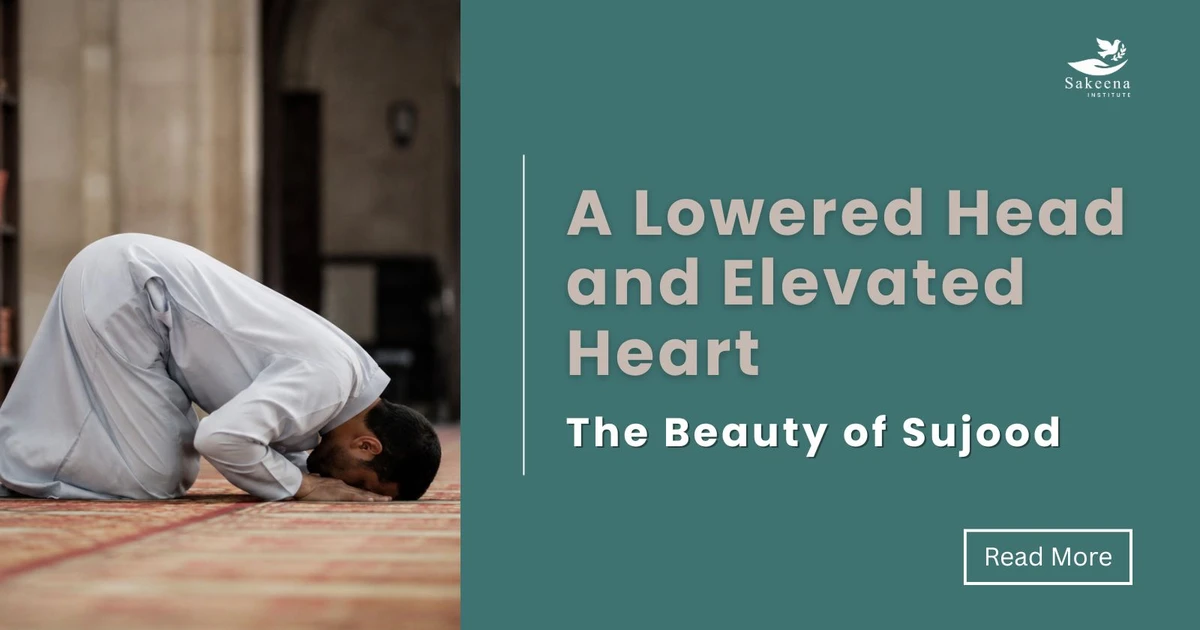

Among the many movements within prayer, sujood stands apart as the most psychologically profound. It is the only position in which the human being places the highest part of the body (the head) onto the ground, embodying complete physical humility. Yet, within Islamic understanding, it is simultaneously the moment of greatest spiritual elevation. This contrast is not merely symbolic. It reflects a deeper reality about the human soul and its relationship with its Creator.
Allah captures the essence of this state in a concise yet powerful command:
كَلَّا لَا تُطِعْهُ وَاسْجُدْ وَاقْتَرِبْ
“No! Do not obey him. But prostrate and draw near (to Allah).” Quran 96:19
This verse establishes a direct connection between sujood and nearness. In Islamic psychology, nearness to Allah is not defined by physical distance, but by the alignment of the heart, mind, and soul with divine truth. Sujood becomes the ultimate act through which this alignment is achieved, as the believer disengages from external distractions and reorients inwardly toward purpose and submission.
From a psychological perspective, sujood functions as a moment of cognitive and emotional grounding. The human mind, often overwhelmed by stimuli, responsibilities, and internal dialogue, finds in sujood a structured pause. The act of lowering oneself disrupts patterns of mental agitation and redirects attention toward stillness. This is not accidental. Rather, it reflects the design of acts of worship in Islam as tools for regulating the nafs (self) and restoring balance.
The Prophet Muhammad ﷺ emphasized the significance of this position when he said:
أَقْرَبُ مَا يَكُونُ الْعَبْدُ مِنْ رَبِّهِ وَهُوَ سَاجِدٌ فَأَكْثِرُوا الدُّعَاءَ
“The closest a servant is to his Lord is when he is in prostration, so increase in supplication.” Sahih Muslim
This closeness is not just an idea. It is something that is truly felt and experienced. In sujood, the barriers created by ego, distraction, and worldly preoccupation begin to dissolve. The believer is no longer performing for an audience, nor responding to external expectations. Instead, there is a return to an unfiltered state of sincerity, where supplication emerges with honesty and depth.
This explains why the words spoken in sujood often carry a different weight. They are not shaped by social context or refined for presentation. Rather, they emerge from a place of psychological vulnerability, which in Islamic thought is not weakness, but a gateway to authenticity. The nafs, when stripped of its defenses, becomes more receptive to guidance and more capable of truth.
Interestingly, what appears outwardly simple, the act of looking at the ground, coincides with an inward expansion of awareness. While the eyes are fixed on something mundane, the heart engages with meanings far beyond the physical environment. This duality highlights a key concept in Islamic spirituality: that true perception is not limited to sight, but extends to insight. Sujood, therefore, is not about what is seen, but about what is understood and felt.
Moreover, sujood aligns the human being with a universal rhythm of submission. The Quran repeatedly reminds us that all of creation exists in a state of glorification:
وَإِن مِّن شَيْءٍ إِلَّا يُسَبِّحُ بِحَمْدِهِ
“There is not a thing except that it glorifies Him with praise.” Quran 17:44
The believer, in sujood, is synchronized with a broader cosmic order in which everything fulfills its purpose through submission to Allah. This realization can produce a profound sense of belonging and clarity, reducing feelings of isolation and existential confusion.
At a deeper level, sujood also facilitates identity formation. Modern psychology often emphasizes the importance of self-awareness in developing a stable sense of identity. In Islam, this awareness is achieved not through introspection alone, but through connection with the Creator. When the believer enters sujood, external labels and roles momentarily lose their significance, allowing for a clearer understanding of the self in relation to Allah. This re-centering provides direction, grounding decisions and aspirations in something more enduring than fleeting circumstances.
Ultimately, sujood is not merely a ritual movement within prayer. It is an experience that integrates the physical, psychological, and spiritual dimensions of the human being. It teaches that true elevation is not achieved through dominance or control, but through surrender. It offers a space where clarity replaces confusion, sincerity replaces pretense, and peace replaces restlessness.
For this reason, the invitation to sujood is not simply an obligation. It is an opportunity. An opportunity to pause, to realign, and to access a state of peace that cannot be replicated elsewhere. In a world defined by constant motion and noise, sujood remains one of the few moments where stillness is not only possible, but transformative.
Perhaps that is why its conclusion is so certain: what is found in sujood is not easily found anywhere else.
The beauty of sujood cannot be explained, only felt.