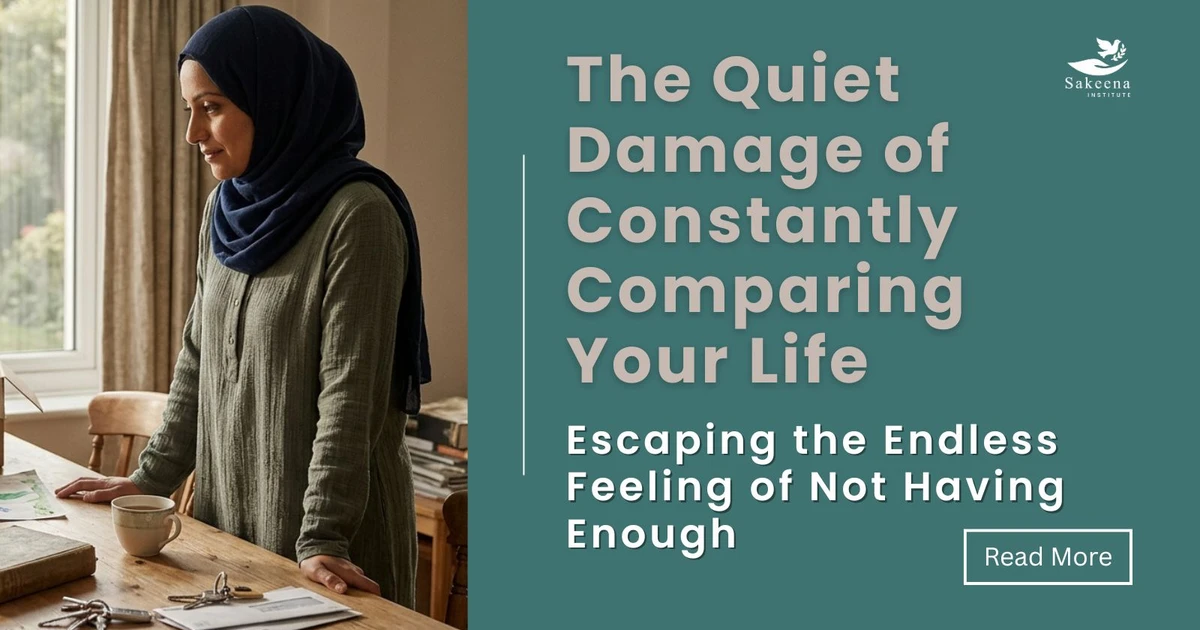

There is a strange way comparison enters our lives. It rarely announces itself as something harmful. It can begin with something as innocent as admiring another person's life, appreciating something beautiful, or wondering what it would be like to experience something we do not yet have. But slowly, almost imperceptibly, admiration can turn into dissatisfaction. We begin looking at what Allah has given someone else and, without realizing it, use their life as a measuring scale for our own. We look at their home, their marriage, their children, their friendships, their career, their appearance, their achievements, or even the way they seem to carry themselves through life, and then return to our own circumstances with a strange sense that something is missing. The unsettling part is that our circumstances may not have changed at all. What changed was our gaze.
We live in a time when comparison has become almost impossible to escape. Other people's lives are constantly placed in front of us, often in their most beautiful and carefully selected moments, while we experience our own lives in their entirety: the beauty alongside the boredom, the answered prayers alongside the unanswered ones, the peaceful mornings alongside the difficult evenings, the moments of confidence alongside the moments when we question everything. We know the full story of our own lives, yet we are often comparing it to a few carefully presented chapters of someone else's. We see their destination while standing in the middle of our own journey, and then wonder why our lives do not seem as beautiful as theirs.
Allah, in His wisdom, warned us about this very tendency within the human heart when He says, “And do not wish for that by which Allah has made some of you exceed others.” (Qur’an 4:32). There is something deeply protective about this command because Allah knows how easily the heart can become preoccupied with portions that were never written for it. We begin to look at what someone else has and wonder why it was not given to us, forgetting that Allah distributes according to a wisdom far greater than our own understanding. Their provision was written for them, just as ours was written for us. Their circumstances are part of their test, just as ours are part of ours. What we see as an enviable blessing may carry responsibilities and difficulties that we have never been asked to carry, while what we consider ordinary in our own lives may contain blessings that another person would quietly pray for.
The danger of comparison is not simply that it makes us jealous. Its deeper damage is that it makes us incapable of recognizing what we already have. The Prophet ﷺ said, “Look at those who are below you and do not look at those who are above you, for it is more suitable that you do not belittle the blessing of Allah upon you.” (Sahih al-Bukhari; Sahih Muslim). Notice that the Prophet ﷺ connected looking constantly at those above us with belittling the blessings of Allah. This is what comparison does so quietly. It does not necessarily remove a blessing from our lives; instead, it changes our perception of that blessing until something precious begins to feel insufficient.
Think about how quickly we become accustomed to the things we once prayed for. There may be a time in our lives when we begged Allah for something with a sincerity and desperation that we can barely remember now. We imagined that receiving it would change everything, and when Allah finally gave it to us, we were overwhelmed with gratitude. Yet time passed, the extraordinary became familiar, and eventually we began looking toward the next thing. What once felt like a tremendous gift became part of the background of our lives. Then we saw someone else receiving something we did not have, and suddenly the blessing we had once considered an answer to our prayers seemed smaller. Nothing had been taken from us, but comparison had taught us to stop seeing it.
Perhaps this is why gratitude requires more than simply saying alhamdulillah. Gratitude requires a person to actually notice. It requires us to slow down enough to recognize the mercy woven into the ordinary details of our lives. We can become so accustomed to having a roof over our heads, people who love us, food available when we are hungry, a body that carries us through the day, the ability to pray, the ability to open the Qur'an, the opportunity to repent, or simply another morning in which Allah has allowed us to wake up, that these things no longer feel remarkable. Yet familiarity does not make a blessing less valuable. It only makes us less attentive to it.
Comparison also creates an exhausting inner dialogue because there is never a point at which the heart can finally declare itself ahead. There will always be someone more accomplished, more beautiful, wealthier, more knowledgeable, more admired, more socially connected, more successful, or further along in some aspect of life. Even when we eventually obtain the thing we once envied, there will almost certainly be another person who has something else we do not. If we allow comparison to become our measuring scale, contentment will always remain just beyond our reach because the standard keeps moving. We can spend years chasing a feeling of being “enough” without realizing that enough was never something another person's life could give us.
Islam does not ask us to stop improving ourselves or to become indifferent to excellence. There is a beautiful distinction between seeing goodness in another person and resenting that goodness because it reminds us of what we lack. We can admire someone else's knowledge and ask Allah to increase us in knowledge. We can see someone's generosity and desire to become more generous. We can appreciate someone's strong relationship with the Qur'an and allow it to inspire us to strengthen our own. The problem begins when inspiration becomes dissatisfaction, when “May Allah bless them” quietly becomes “Why did Allah give them that and not me?” The first response allows another person's blessing to become a reason for our own growth; the second allows it to become a source of discontent with Allah's decree.
Perhaps we also need to reconsider what it means to be “ahead” in life. The world gives us very obvious measurements of success. We are taught to notice the degree, the salary, the house, the appearance, the wedding, the number of children, the career, the followers, the accomplishments, and the experiences. But Allah gives us an entirely different scale. He tells us, “Indeed, the most noble of you in the sight of Allah is the most righteous of you.” (Qur’an 49:13). The person who appears ordinary to the world may be extraordinary in the sight of Allah, while the person whose life appears enviable may be struggling with a heart that nobody can see. What ultimately matters is not how impressive our lives look beside someone else's, but what our lives are producing within us in terms of īmān, taqwā, sincerity, patience, gratitude, repentance, and closeness to Allah.
This is why perhaps the healthiest comparison is not between our life and another person's life at all, but between who we are today and who we were before. Are we becoming softer toward people? Are we quicker to forgive? Are we more conscious of Allah when nobody is watching? Do we return to Him more quickly after falling into sin? Has our relationship with the Qur'an deepened? Are we learning to respond to hardship with more patience and to blessings with more gratitude? These are the changes that may never appear in a photograph, yet they are the changes that matter eternally.
There is also something deeply comforting about remembering that Allah never asked us to live a life that belongs to someone else. He did not give us someone else's circumstances and then ask us to compete with them. He gave each of us a particular set of blessings, responsibilities, limitations, relationships, opportunities, and trials through which we are meant to worship Him. What is easy for one person may be difficult for another. What one person receives early, another may receive later. One person's test may be abundance while another's is deprivation; one may be tested through being seen while another is tested through being overlooked. We cannot judge the quality of a life simply by looking at what it contains, because we cannot see what Allah is asking that person to do with what they have been given.
And perhaps this is where comparison becomes especially dangerous: it can make us resent the very chapter Allah has chosen to grow us through. We begin wishing our life looked different without asking what Allah is trying to teach us through the life we actually have. We become so focused on another person's chapter that we stop reading our own. Yet every chapter has something to teach us. A season of waiting may teach patience. A season of responsibility may teach us sacrifice. A season of simplicity may teach us contentment. A season in which we are not receiving everything we want may teach us that our relationship with Allah cannot depend upon getting our way.
None of this means that we cannot desire more. There is nothing wrong with making duʿā for a better home, a loving marriage, children, financial ease, knowledge, opportunities, or any other halal blessing. We can hope for change while remaining grateful for what already exists. We can work toward a different future without despising our present. Gratitude does not require us to stop dreaming; it simply prevents our dreams from convincing us that our current blessings are worthless.
Sometimes we need to remember who we were when we first asked Allah for the life we now have. We may discover that there are things around us today that our former selves would have considered extraordinary. There are prayers Allah answered that we have forgotten to thank Him for because we became accustomed to their answers. There are hardships He carried us through that we rarely remember because the pain has faded. There are doors He closed that we once cried over and now understand were not meant for us. There are people, opportunities, forms of safety, moments of peace, and countless unseen protections that we may never fully comprehend in this life.
Perhaps gratitude is partly the art of remembering.
Remembering that what feels ordinary today may once have been something you desperately wanted. Remembering that the life you are tempted to compare with someone else's is itself a life someone else may be praying for. Remembering that Allah's generosity is not measured by whether your portion looks like another person's portion. And remembering that another person's blessing does not make yours smaller.
The heart becomes much lighter when it stops keeping score. We do not have to constantly ask who is ahead, whose life is better, who received more, or why our journey looks different. We can simply ask Allah to bless what He has given us, to place barakah within it, and to make us people who recognize His mercy while it is still in our hands.
So perhaps, the next time you find yourself looking at someone else's life and feeling that strange heaviness within your chest, pause before you decide that something is missing. Ask yourself whether something has actually been taken from you, or whether you have simply been looking away from your own blessings for too long. Step back from the comparison, return your gaze to what Allah has entrusted to you, and allow yourself to notice what has been there all along.
You may find that your life did not suddenly become beautiful because someone else's became less beautiful. It was beautiful before you compared it.
You simply stopped looking at it with gratitude.