
There is a particular kind of exhaustion that comes from feeling responsible for everything. Not just the things that are actually within your responsibility, but everything that might happen, everything that could go wrong, everything other people might feel, and every possible version of the future that you can imagine. The mind begins to live several steps ahead of the present, constantly predicting, preparing, checking, and worrying. You try to think your way into certainty, as though if you analyze something enough, you can prevent it from going wrong. You try to protect the people you love by imagining every possible danger. You replay decisions because perhaps there was something you missed. You think about tomorrow because perhaps worrying today will make tomorrow safer. And without realizing it, you begin carrying a weight that was never placed on your shoulders to begin with.
There is something profoundly comforting about remembering that Allah never asked you to hold everything together.
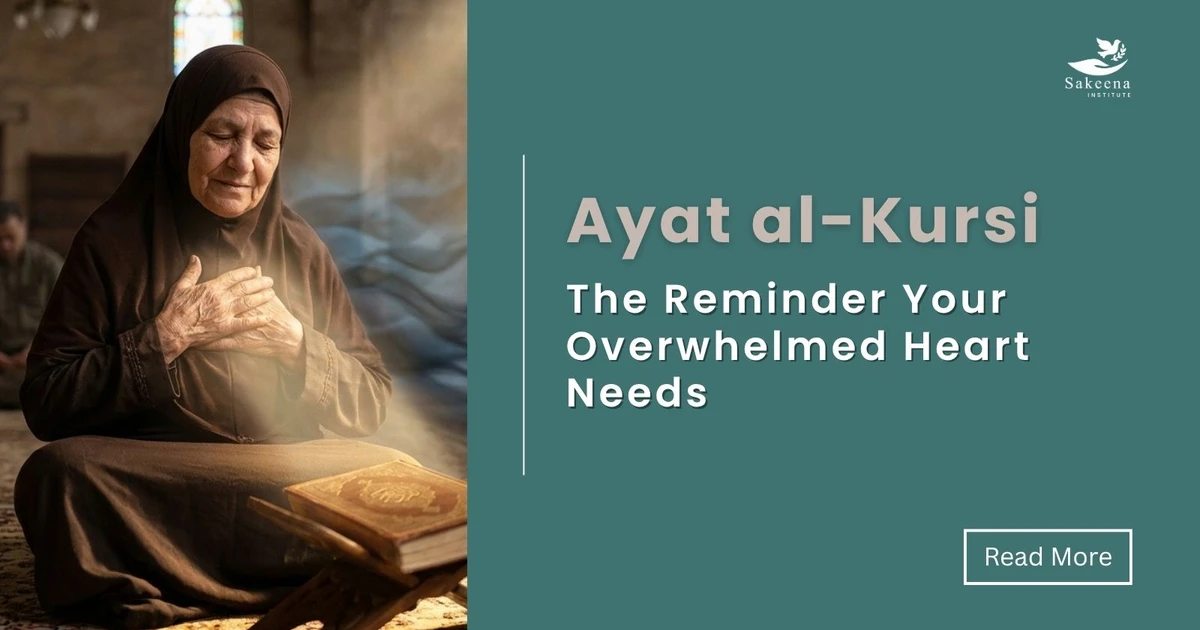
In fact, one of the most beautiful reminders of this reality is found in an ayah many of us have memorized since childhood: Ayat al-Kursi. We often recite it for its tremendous virtue and as part of our daily remembrance, but there is something else worth slowing down for: what happens to the heart when it actually reflects upon what it is saying. Ayat al-Kursi is not a description of us. It is a description of Allah. And perhaps that is precisely what an overwhelmed heart needs—to stop staring at the limitations of itself and spend a few moments contemplating the perfection of its Lord.
﴿اللَّهُ لَا إِلَٰهَ إِلَّا هُوَ الْحَيُّ الْقَيُّومُ﴾
“Allah—there is no deity except Him, the Ever-Living, the Sustainer of all.” [Qur’an 2:255]
The ayah begins by directing the heart toward Allah: Al-Hayy, Al-Qayyum. He is the Ever-Living, whose life is perfect and without end, and Al-Qayyum, the One who sustains and maintains all that exists. Everything depends upon Him, while He depends upon no one. Every created thing is limited, temporary, vulnerable, and in need. We become tired. We forget. We sleep. We become distracted. We cannot see what is happening in another room, let alone what is happening tomorrow. We cannot even fully understand what is happening inside our own hearts, yet somehow we spend so much of our lives behaving as though everything depends on us.
Then Allah tells us:
﴿لَا تَأْخُذُهُ سِنَةٌ وَلَا نَوْمٌ﴾
“Neither drowsiness overtakes Him nor sleep.”
There is a reality hidden in this verse that the anxious heart desperately needs to remember: Allah does not need to rest from taking care of His creation.
You do.
You were created with limitations. You need sleep. You need food. You need moments away from responsibility. Your attention has limits, your knowledge has limits, your strength has limits, and your ability to control events has limits. But Allah's care is not restricted by any of these things. While you sleep, Allah remains awake. While you are unaware, Allah knows. While you are unable to protect someone you love, Allah is not unable. While you are uncertain about what tomorrow will bring, tomorrow is already completely known to Him.
How much of our worry comes from forgetting this distinction?
We see something we cannot control and immediately begin trying to control it through thought. We think about it while driving, while eating, while working, and sometimes even when we are supposed to be sleeping. We confuse worrying about something with doing something about it. But thinking about a situation for another three hours does not necessarily give us any additional ability to change it. Sometimes all it does is exhaust the person who is thinking about it.
Ayat al-Kursi interrupts this illusion of control by reminding us who actually possesses complete knowledge and complete power.
﴿لَهُ مَا فِي السَّمَاوَاتِ وَمَا فِي الْأَرْضِ﴾
“To Him belongs whatever is in the heavens and whatever is on the earth.”
Everything belongs to Him.
The people you love belong to Him. Your future belongs to Him. Your opportunities belong to Him. Your health, your home, your work, your relationships, your plans, and the things you are terrified of losing—all of them ultimately belong to Him.
This does not mean that we become careless or abandon responsibility. Islam does not teach us to stop taking the means. We lock the door, seek treatment when we are ill, prepare for an exam, communicate when something needs to be resolved, make plans, work hard, and fulfill the responsibilities Allah has actually placed upon us. But there is a difference between taking responsibility and believing everything depends on you.
One is obedience.
The other is a burden you were never created to carry.
Allah continues:
﴿يَعْلَمُ مَا بَيْنَ أَيْدِيهِمْ وَمَا خَلْفَهُمْ﴾
“He knows what is before them and what is behind them.”
You don't.
And that is okay.
You do not know what will happen next month. You do not know which door will open or close. You do not know the wisdom behind every event that enters your life. You do not know how today's difficulty will look five years from now. Sometimes you don't even know why Allah has allowed something to happen in the first place.
But your lack of knowledge does not mean that the situation is unknown.
It is unknown to you. It is not unknown to Allah.
There is a tremendous difference.
We often experience uncertainty as though uncertainty itself were evidence of danger. When we don't know what is going to happen, the mind tries to fill the gap. It creates possibilities, then possibilities about those possibilities, until a situation that has not even happened begins to produce very real fear in the present. We try to eliminate uncertainty by thinking harder, but there will always be things beyond our knowledge.
Ayat al-Kursi does not promise us that we will know everything.
It reminds us that Allah does.
And perhaps that is enough.
Then comes one of the most humbling statements in the ayah:
﴿وَلَا يُحِيطُونَ بِشَيْءٍ مِنْ عِلْمِهِ إِلَّا بِمَا شَاءَ﴾
“And they encompass not a thing of His knowledge except what He wills.”
There is something freeing about accepting how little we know. Not because knowledge is unimportant, but because recognizing our limits allows us to stop demanding from ourselves what only Allah possesses. We want to know why something happened, what will happen next, how someone will respond, whether our decision will work, and what the future will look like. But the human being was never given access to the entire picture.
Sometimes faith means moving forward without having the entire picture.
You take the step you are able to take, with the knowledge you have been given, while trusting the One who sees everything you cannot.
And then the ayah reaches its final words:
﴿وَلَا يَئُودُهُ حِفْظُهُمَا﴾
“And preserving them does not tire Him.”
This may be one of the most beautiful reminders for the person who feels responsible for keeping everything and everyone safe.
Preserving the heavens and the earth does not tire Allah.
Think about how quickly we become exhausted trying to preserve our own small corner of the world. We worry about our families, our marriages, our children, our parents, our careers, our futures, and the things we cannot bear to lose. We want to protect everyone we love from pain, disappointment, illness, and hardship. But there are limits to what a human being can prevent.
Allah has not asked you to become the protector of everything you love.
He has asked you to worship Him, take the means, fulfill your responsibilities, and place your trust in Him.
There is a difference between saying, “I don't care what happens,” and saying, “I care deeply, but I know this is ultimately in Allah's hands.” Tawakkul is not indifference. It is caring without believing that your own control is the foundation upon which everything rests.
Perhaps this is why reflecting upon Ayat al-Kursi can be such a powerful act of returning the heart to its proper place. It takes our attention away from the smallness of ourselves and directs it toward the greatness of Allah. It reminds us that He does not sleep, His knowledge has no limits, everything belongs to Him, and preserving His creation does not exhaust Him. Meanwhile, we are reminded—implicitly—of our own limitations.
And perhaps there is mercy in those limitations. You were not created to know everything. You were not created to prevent everything. You were not created to protect everyone. You were not created to control every outcome. You were created to worship Allah.
So take the means. Make the du‘a. Do what is within your responsibility. Have the conversation. Make the effort. Prepare as best you can. And then recognize the boundary between what Allah has entrusted to you and what belongs entirely to Him.
The next time your mind begins trying to solve tomorrow before it has arrived, perhaps return to Ayat al-Kursi—not merely as words you have memorized, but as truths your heart needs to hear. Allah is Al-Hayy. Allah is Al-Qayyum. He does not sleep. Everything belongs to Him. He knows what you cannot know. His knowledge encompasses what you cannot see. And preserving His creation does not tire Him.
You can rest.
Not because everything is guaranteed to happen according to your plan, but because the One who holds what you cannot hold is Allah.
And you were never meant to hold everything together.