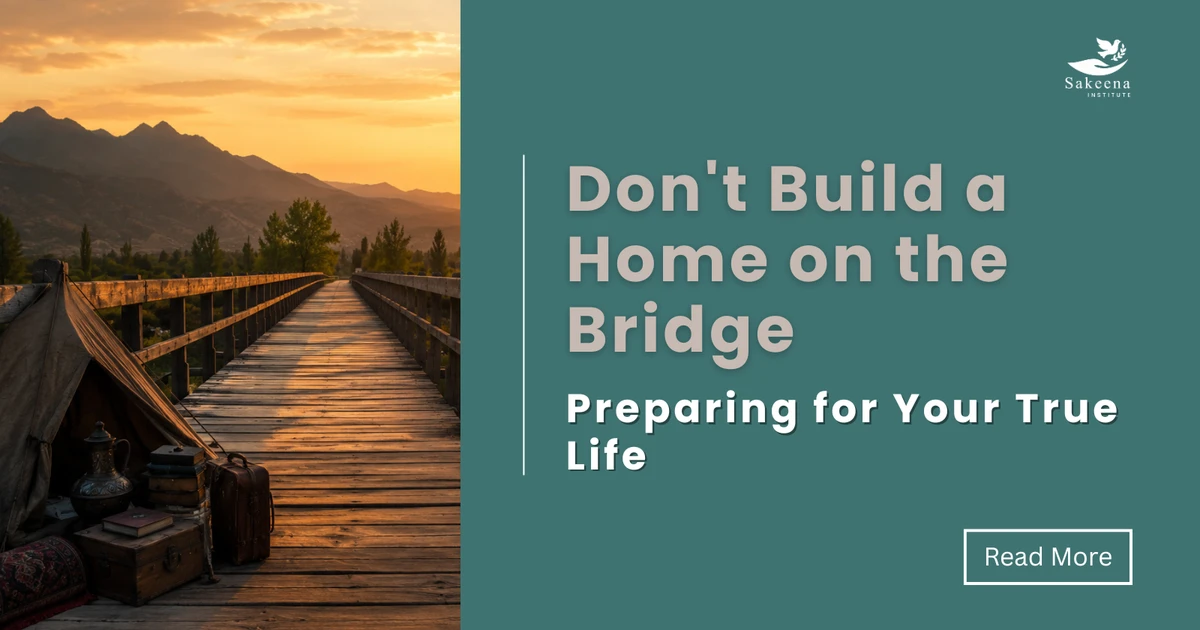

Imagine a traveler moving across lands. This traveler decides to build a home and invest in all kinds of items to build his home during his journey when he reaches a bridge.
There is a destination he is meant to reach, but instead, he makes a decision to get a tent and buy luxurious things. The traveler settles on that bridge and makes a home out of it.
That is exactly what we, as Muslims, do sometimes. We make a home out of something that was only ever meant to be temporary, and we settle in this life as it if were the final destination, although it is only a bridge to the hereafter.
The prophet PBUH teaches us this in a hadith:
«كُنْ فِي الدُّنْيَا كَأَنَّكَ غَرِيبٌ، أَوْ عَابِرُ سَبِيلٍ»
Be in this world as though you were a stranger or a traveler passing through.
A stranger or a traveler passing through. The prophet PBUH teaches us to not get attached to this dunya and treat it as our home. And yet, if anyone were to take one look at Muslims in this day and age, and their spending habits…the truth is, our mentality is far from the teachings of this hadith.
We have made the bridge our final resting place and we forget that we are all going to leave it sooner or later. As a matter of fact, there is a beautiful ayah that puts this idea into perspective.
يَقُولُ يَا لَيْتَنِي قَدَّمْتُ لِحَيَاتِي
"He will say, 'Oh, I wish I had sent forth (good deeds) for my true life.'"
(Surah Al-Fajr 89:24)
This teaches us that real life is actually not the one we are living now. This worldly life is temporary, a journey that quickly comes to an end. The everlasting life is the life of the Hereafter. Once we internalize this truth, many things start to fall into place.
Perhaps this is why the Qur'an constantly reminds us of the temporary nature of this world. Allah does not tell us to abandon it, nor does He prohibit us from enjoying the blessings He has placed within it. Rather, He teaches us to hold this world in our hands, not in our hearts. There is a profound difference between benefiting from something and becoming attached to it.
When this life becomes our ultimate goal, every loss begins to feel unbearable. A missed opportunity feels like the end of the world. Financial hardship becomes an identity rather than a temporary trial. We become devastated when our plans do not unfold exactly as we imagined because we have unknowingly placed our hope in things that were never meant to last.
Islamic psychology teaches us that the human heart is always attached to something. If it is attached to what is temporary, it will experience constant instability because everything in this world changes. Wealth comes and goes. Health fluctuates. Relationships evolve. Status fades. Beauty diminishes. Youth disappears. The heart that depends on these things for its peace will inevitably rise and fall with them.
Allah, however, invites us to attach our hearts to what never changes. He is Al-Bāqī, the Everlasting. His mercy does not diminish. His wisdom never fails. His promises never change. When the heart anchors itself to Allah instead of the dunya, it discovers a stability that no worldly circumstance can provide.
This does not mean that we stop pursuing our goals or working hard. The Prophet ﷺ himself worked, traded, married, raised a family, and led a community. The Companions built businesses, cultivated farms, and accumulated wealth. But there was one critical difference: they never confused the means with the destination. Their possessions remained in their hands, while their hearts remained with Allah.
A useful question to ask ourselves is this: If Allah were to take this blessing away tomorrow, would I lose my peace along with it? If the answer is yes, then perhaps the heart has become more attached to the gift than to the Giver.
This perspective changes the way we approach every aspect of life. Success becomes an opportunity to thank Allah rather than a source of pride. Failure becomes a lesson rather than a definition of our worth. Wealth becomes a trust to spend wisely rather than something to cling to. Even hardship takes on a different meaning, because we know it is preparing us for a home that is infinitely greater than this one.
The Qur'an repeatedly shifts our gaze from what is temporary to what is eternal.
مَا عِنْدَكُمْ يَنفَدُ وَمَا عِندَ اللَّهِ بَاقٍ
"Whatever you possess will come to an end, but what is with Allah is everlasting."
(Surah An-Nahl 16:96)
Everything we spend so much time worrying about will one day disappear. Every possession will eventually belong to someone else. Every title will be forgotten. Even our bodies, which we spend years trying to perfect, will return to the earth. The only things that accompany us beyond the grave are our faith and our deeds.
This realization is not meant to make us pessimistic. On the contrary, it is one of the greatest sources of freedom.
Imagine how much lighter life becomes when you no longer expect this world to give you what it was never created to provide. You stop demanding permanence from what Allah created to be temporary. You stop expecting complete happiness from a place that was designed as a test. You stop measuring your worth by possessions, achievements, or the opinions of people because you know that none of these will remain.
The believer lives with purpose because every moment carries eternal significance. A smile given sincerely for Allah's sake. A prayer offered in the quiet of the night. A small charity that no one else notices. Patiently restraining anger. Visiting a sick relative. Raising children upon faith. All of these are investments in the life that never ends.
In many ways, the Hereafter is already shaping the way we live today. Every choice is either bringing us closer to Allah or distracting us from Him. Every day is an opportunity to send something ahead before we arrive there ourselves.
Perhaps this is why Ibn ʿUmar رضي الله عنه, after narrating the Prophet's ﷺ advice, would say:
"When evening comes, do not expect to live until the morning, and when morning comes, do not expect to live until the evening. Take advantage of your health before your sickness, and your life before your death."
He understood that a traveller does not waste time decorating the road. He prepares for the place where he intends to stay.
The tragedy is not that we own beautiful things. The tragedy is when beautiful things begin to own us. When our schedules revolve around earning more but leave little room for worship. When we spend hours perfecting our homes while neglecting the state of our hearts. When we carefully plan our retirements but rarely prepare for the meeting with Allah.
Every traveler eventually reaches the end of the bridge. On that day, no one will ask how luxurious our tent was or how comfortable our temporary stay had become. The only question will be what we sent ahead.
The bridge was never meant to become our home.
It was only ever meant to lead us to it.