
There are journeys we take because we have somewhere to go, and then there are journeys that change something within us. Hajj is unlike any journey the heart has known. It is not simply a journey across countries, nor is it merely a collection of rituals performed over a number of days. Hajj is an invitation from Allah, a journey in which the servant leaves behind the familiarity of home, the comfort of routine, the clothes that distinguish one person from another, and many of the distractions that quietly occupy the heart, only to stand before Allah as a servant among millions of servants. It is a journey of returning, not merely to Makkah, but to the One who created the heart in the first place.
Allah says, “And proclaim to mankind the Hajj; they will come to you on foot and on every lean camel; they will come from every distant pass.” (Qur’an 22:27). There is something deeply moving about this description. Across generations, people have continued to answer this call, travelling from distant lands with different languages, cultures, histories, and circumstances, yet arriving with the same essential purpose: to worship Allah. Some come with years of longing behind them, some with tears they have carried quietly for a long time, some with hopes they have never spoken aloud, and some simply grateful that Allah allowed them to be among those who answered His invitation.
Perhaps one of the most beautiful realities of Hajj is that the journey begins long before the pilgrim reaches the Ka‘bah. It begins with longing. A person may hear the words “Hajj” many times throughout their life, but there can come a moment when those words suddenly feel personal, when the heart begins to wonder what it would be like to stand before the House of Allah, to see with one's own eyes the place toward which Muslims have turned in prayer for centuries. Then, somehow, what once seemed distant begins to become possible. Plans are made, preparations begin, and the servant discovers that what felt like an impossible dream may actually be an invitation that Allah has written for them.
The Qur’an describes Hajj as something that contains benefits for those who undertake it, saying, “That they may witness benefits for themselves and mention the name of Allah on known days.” (Qur’an 22:28). These benefits are not limited to what can be measured or immediately understood. Hajj has a way of revealing the heart to itself. When the usual comforts are stripped away, when sleep is interrupted, when crowds become overwhelming, when plans change and patience is tested, the servant begins to see what lives within. Hajj teaches that worship is not only about how we feel when everything is easy. It is also about remaining connected to Allah when we are tired, uncomfortable, uncertain, or stretched beyond what we expected of ourselves.
The story of Hajj is also deeply connected to the story of Ibrahim عليه السلام and his family, a family whose lives were shaped by extraordinary trust in Allah. When Ibrahim was commanded to leave Hajar and their infant son Isma‘il in the barren valley of Makkah, there was no visible source of water, no established city surrounding them, and no ordinary explanation for how they would survive. Yet Hajar trusted the command of Allah. When she asked Ibrahim whether Allah had commanded him to leave them there, and he indicated that He had, her response reflected the depth of her certainty: “Then He will not neglect us.”
That trust became part of the sacred history of Hajj. Every time pilgrims walk between Safa and Marwah, they remember a mother running in search of relief for her child. What began as an act of desperation became an act of worship remembered by generations of believers. Zamzam appeared where there seemed to be nothing, teaching the believer that Allah can bring provision from places we cannot see and open doors through means we could never have anticipated.
Hajj therefore carries a powerful message about tawakkul. We often imagine that trusting Allah means knowing how everything will work out, but the stories connected to Hajj show something deeper. Ibrahim did not know what the future would look like when he left his family in the valley. Hajar did not know where water would come from when she began searching. Yet they moved forward with Allah at the centre of their hearts. Sometimes faith does not give us a map of everything that lies ahead. Sometimes faith simply gives us enough certainty to take the next step.
Then comes the Ihram, when the pilgrim enters a state in which many of the distinctions that normally separate people begin to disappear. The powerful and the powerless, the wealthy and the poor, the famous and the unknown, all stand before Allah as servants. The simple garments of Ihram remind the pilgrim of something that is easy to forget in ordinary life: whatever society may call us, whatever we may own, whatever position we may hold, our deepest identity is that of a servant of Allah.
The Talbiyah becomes the voice of the journey: “Labbayka Allahumma labbayk. Labbayka la sharika laka labbayk. Innal-hamda wan-ni‘mata laka wal-mulk, la sharika lak.” The servant is essentially saying, “Here I am, O Allah. Here I am. You have no partner. Here I am. Surely all praise, blessing, and dominion belong to You.” There is something profoundly humbling about repeating these words while surrounded by countless other pilgrims. It is an answer to Allah's call, but it is also a declaration of where the heart belongs.
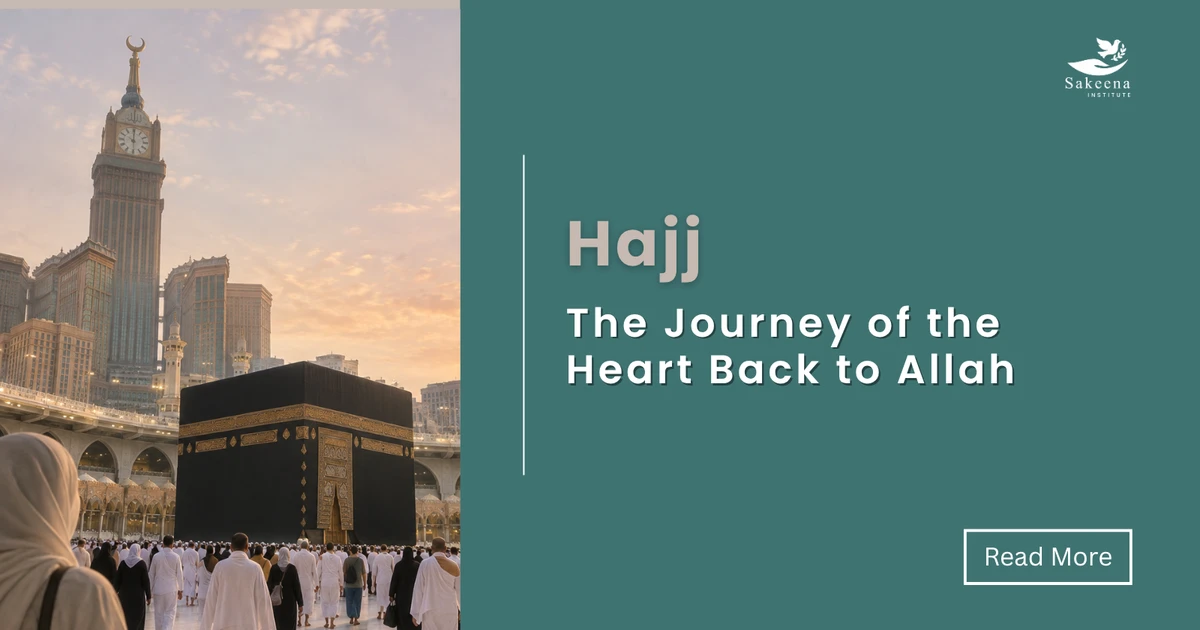
At the Ka‘bah, the pilgrim encounters a scene that Muslims have imagined throughout their lives. People circle the House of Allah, moving together in worship, their individual stories temporarily woven into one act of devotion. The Ka‘bah itself is not worshipped; Allah alone is worshipped. Yet the House serves as a physical centre toward which millions of hearts have turned in prayer. The pilgrim who performs tawaf is reminded that the centre of life should not ultimately be the self, wealth, status, comfort, or the approval of people. There is a centre greater than all of these, and that centre is Allah.
Hajj also teaches the believer that worship is not confined to moments of spiritual emotion. There are moments of beauty, but there are also moments of waiting, walking, exhaustion, heat, crowds, and uncertainty. These experiences become part of the worship because the believer is learning to seek Allah not only through moments that feel spiritually powerful, but through patience, obedience, humility, and endurance. The pilgrimage becomes a school of the soul, teaching a person that closeness to Allah is not always accompanied by comfort.
Perhaps this is why the Day of ‘Arafah carries such significance. The pilgrims stand together, asking Allah, remembering Him, seeking His forgiveness, and turning to Him with their hopes and fears. There is something deeply human about standing before Allah with nothing to hide and nowhere else to turn. The servant comes with sins, regrets, unanswered questions, private struggles, hopes for the future, and wounds that no one else may know about. Yet Allah already knows every detail. Hajj becomes an opportunity to surrender all of it to Him.
The Prophet ﷺ said, “The performance of ‘Umrah during Ramadan is equal to the performance of Hajj with me,” and he ﷺ also taught that an accepted Hajj has a tremendous reward. In another well-known hadith, he said, “Whoever performs Hajj and does not commit obscenity or wrongdoing will return like the day his mother gave birth to him.” (Sahih al-Bukhari, Sahih Muslim). The imagery is extraordinary: to return with a heart cleansed through repentance and worship, carrying a new beginning that only Allah could give.
Yet perhaps the most important question is not what happens when the pilgrim reaches Makkah, but what happens after returning home. Hajj is not meant to become a beautiful memory that remains behind in the Haram. Its lessons are meant to travel home with the pilgrim. If Hajj teaches humility, then humility should become visible afterward. If it teaches patience, patience should become more present in the home. If it teaches reliance upon Allah, then anxiety should gradually meet a heart that remembers who controls its affairs. If it teaches repentance, then returning to old sins without struggle should no longer feel acceptable.
The greatest transformation may therefore be quiet. It may look like a person becoming gentler with their family, more sincere in their worship, quicker to forgive, less attached to worldly status, more generous with what Allah has given them, and more conscious that every breath is an opportunity to return to Him. The journey ends geographically when the pilgrim leaves the sacred places, but spiritually, it can continue for the rest of their life.
Hajj reminds us that every believer is ultimately travelling toward Allah. We may not all travel to Makkah at the same time, and we may not all be given the same opportunities or circumstances, but every heart is on a journey. One day, every worldly distinction will disappear completely, and we will stand before Allah with nothing except what we brought from this life.
Perhaps this is why the call of Hajj touches something so deep within the believer. It reminds us where we came from, Who we belong to, and where we are ultimately going. It teaches us through Ibrahim, Hajar, Isma‘il, the Prophet Muhammad ﷺ, and generations of believers that surrender to Allah is never wasted, that obedience can open doors we cannot see, and that what appears to be a difficult path may be carrying us toward a mercy we could never have imagined.
Hajj is a journey of the body, but even more profoundly, it is a journey of the heart. It teaches the servant to say, with the tongue and then with the entire life, “Labbayka Allahumma labbayk” — here I am, O Allah. And perhaps the deepest hope of the pilgrim is that after answering Allah's call in Makkah, they will spend the rest of their life continuing to answer Him wherever they are.