
There are certain verses in the Qur'an that one reads and understands immediately, and there are others that seem to invite a lifetime of contemplation. Their meanings are not hidden because they are difficult, but because they are vast. Every return to them reveals another layer, another connection, another subtle reminder that had escaped us before.
Ayat al-Nur, the Verse of Light in Surat al-Nur, is undoubtedly one of these remarkable verses. It has inspired some of the greatest discussions in the history of tafsīr, with scholars devoting pages upon pages to its meanings, each uncovering dimensions that enrich rather than replace those that came before. It is a verse that speaks simultaneously about Allah, revelation, guidance, faith, the human heart, and the path that leads a servant from darkness into light.
Allah says:
اللَّهُ نُورُ السَّمَاوَاتِ وَالْأَرْضِ ۚ مَثَلُ نُورِهِ كَمِشْكَاةٍ فِيهَا مِصْبَاحٌ ۖ الْمِصْبَاحُ فِي زُجَاجَةٍ ۖ الزُّجَاجَةُ كَأَنَّهَا كَوْكَبٌ دُرِّيٌّ يُوقَدُ مِن شَجَرَةٍ مُّبَارَكَةٍ زَيْتُونَةٍ لَّا شَرْقِيَّةٍ وَلَا غَرْبِيَّةٍ يَكَادُ زَيْتُهَا يُضِيءُ وَلَوْ لَمْ تَمْسَسْهُ نَارٌ ۚ نُّورٌ عَلَىٰ نُورٍ ۗ يَهْدِي اللَّهُ لِنُورِهِ مَن يَشَاءُ ۚ وَيَضْرِبُ اللَّهُ الْأَمْثَالَ لِلنَّاسِ ۗ وَاللَّهُ بِكُلِّ شَيْءٍ عَلِيمٌ
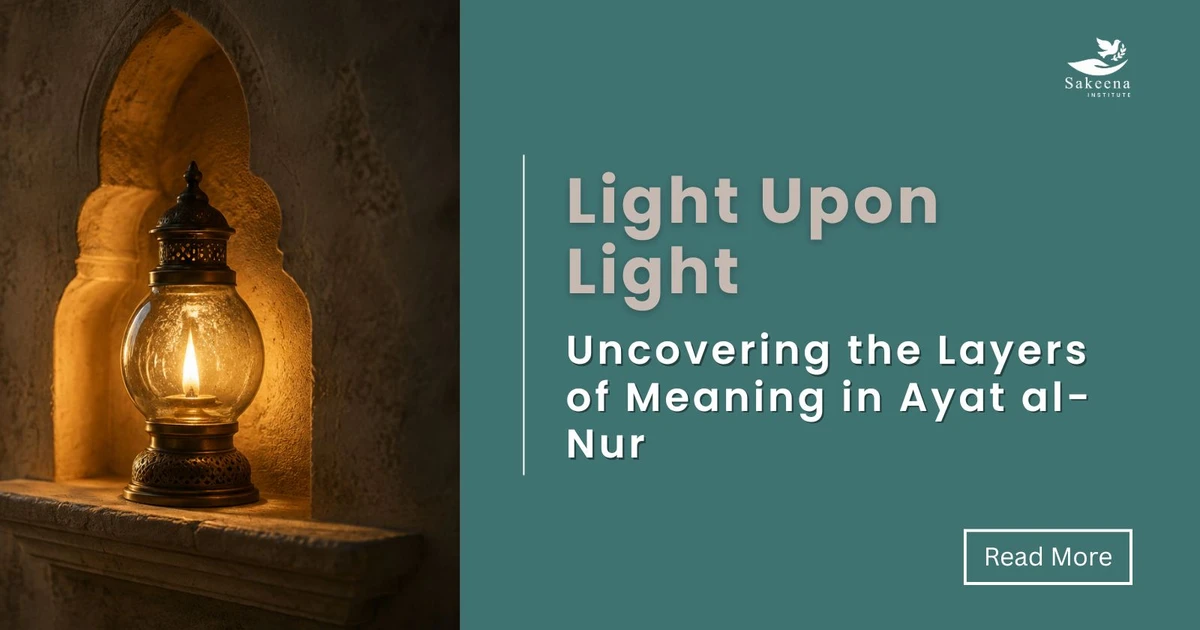
"Allah is the Light of the heavens and the earth. The example of His light is like a niche within which is a lamp; the lamp is within glass, the glass as though it were a brilliant star, lit from the oil of a blessed olive tree, neither of the east nor of the west, whose oil would almost glow even if untouched by fire. Light upon Light. Allah guides to His Light whom He wills. Allah sets forth examples for mankind, and Allah is Knowing of all things." (24:35)
Allah: The Source of All Light
The verse opens with one of the most profound descriptions of Allah in the entire Qur'an: "Allah is the Light of the heavens and the earth." The scholars were careful to explain that this does not mean light in the physical sense that we know, for Allah is unlike His creation. Rather, as Ibn Kathīr explains, Allah is the One who illuminates the heavens and the earth through His guidance, His revelation, and His perfect governance. It is by His light that truth becomes distinguishable from falsehood, certainty from doubt, and guidance from misguidance. Just as the eye cannot perceive the world without physical light, the heart cannot perceive reality without the light that comes from Allah.
This opening statement immediately broadens our perspective. We often think of light as something that helps us navigate roads or brighten our homes, yet Allah reminds us that the greatest darkness is not the darkness of night but the darkness of a heart separated from its Creator. A person may possess intelligence, wealth, influence, and every worldly opportunity, yet still wander aimlessly if deprived of divine guidance. Conversely, another may possess very little of this world yet walk with remarkable certainty because Allah has illuminated their heart with faith. The verse therefore begins not by speaking about lamps or niches, but by directing our attention to the ultimate source from which every form of true illumination originates.
The Niche: A Heart Prepared for Guidance
Having established the source of light, Allah then presents an intricate parable: "The example of His light is like a niche within which is a lamp." Classical scholars differed slightly regarding precisely what "His light" refers to in this comparison. Some held that it refers to the light of guidance that Allah places within the believer. Others explained that it refers to the Qur'an itself, while others combined these meanings, observing that revelation, faith, and the believing heart are inseparable. These interpretations do not contradict one another. Rather, together they paint a richer picture, showing how revelation descends from Allah, settles within the believing heart, and transforms the life of the believer.
The niche, or mishkāt, was a recess carved into the wall of a home specifically designed to hold a lamp. It was not decorative. It had a purpose: to concentrate and amplify the light so that it spread throughout the room. Ibn al-Qayyim reflects that the believing heart resembles this carefully prepared niche. It is not an empty cavity but a place created to receive something precious. Just as a niche without a lamp remains dark despite being perfectly constructed, the human heart remains restless until it is filled with the guidance for which it was created.
This is perhaps one of the most beautiful realities hidden within the parable. Allah did not create our hearts to be sustained by careers, achievements, relationships, or worldly success alone. These blessings have their place, but none of them were designed to become the heart's ultimate source of light. The heart was fashioned for something greater: to know Allah, to remember Him, and to be illuminated by His revelation. When it seeks fulfillment elsewhere, it often experiences a quiet emptiness that nothing in this world seems capable of filling.
The Lamp and the Glass: Faith That Illuminates
Inside this niche burns a lamp. Many scholars explained that this lamp represents faith itself, or the revelation that gives birth to faith. Yet Allah does not stop there. He tells us that the lamp is enclosed within glass, and then describes that glass as though it were a brilliant shining star.
The image becomes increasingly vivid. The lamp provides the flame, but the glass both protects it and magnifies its brilliance. Ibn al-Qayyim beautifully compares this glass to the believer's heart after it has been purified through remembrance, sincerity, repentance, and obedience. A heart clouded by arrogance, envy, heedlessness, or constant attachment to worldly distractions resembles dusty or cracked glass. The light is still present, but it struggles to shine with clarity. As the heart becomes purified, however, it begins to transmit the light of revelation more completely, until faith is no longer confined to one's private worship but becomes visible in one's patience, character, generosity, and dealings with creation.
This perhaps explains why some believers leave such a lasting impression on those around them without ever seeking attention. Their words carry sincerity because they emerge from a heart that has long been polished by worship. Their calmness during hardship, their gentleness with others, and their unwavering trust in Allah become reflections of the light they carry within. Long before they preach, they illuminate.
The Blessed Olive Tree: The Purity of Revelation
Allah then describes the source of the lamp's fuel as coming from a blessed olive tree, neither of the east nor of the west. Al-Ṭabarī and al-Qurṭubī mention several explanations for this beautiful expression. One understanding is that the tree grows in an open place where it receives sunlight throughout the day, producing the purest and finest oil possible. Others viewed the description more symbolically, emphasizing that divine guidance is untouched by the limitations and biases that characterize human thought. Either way, the message remains striking: the fuel sustaining this light is exceptionally pure.
There is profound comfort in this. Human philosophies change from generation to generation. Moral standards rise and fall with societies. What one era celebrates, another abandons. Revelation, however, is not subject to fashion or opinion because its source is Allah Himself. The believer who nourishes their heart with the Qur'an is drawing from a source whose purity has never diminished and whose guidance will never become obsolete.
Oil That Almost Shines by Itself
Allah then adds a detail that has captivated generations of scholars: "Its oil would almost glow even if untouched by fire." The image is almost beyond imagination. The oil is so pure that it appears ready to radiate light before the flame even reaches it.
Many scholars connected this to the concept of the fitrah, the natural disposition upon which every human being is created. Allah has already placed within the human soul an innate recognition of truth, a natural inclination toward its Creator. Revelation does not create this disposition from nothing; rather, it awakens, nourishes, and perfects what was already placed there by Allah. Ibn al-Qayyim beautifully explains that when the light of revelation meets the light of the sound fitrah, the result is exactly as Allah describes: "Light upon Light."
Light Upon Light
This famous phrase has inspired countless reflections throughout Islamic scholarship. Some scholars explained it as the light of revelation combined with the light of faith. Others described it as the light of knowledge joined with the light of righteous action, or the light of certainty strengthened by continuous remembrance of Allah. Al-Saʿdī observes that every act of obedience increases the believer's light, while every sincere effort to seek Allah adds another layer of guidance to the one already present. The expression therefore conveys growth rather than stagnation. Faith is not a single spark granted once in a lifetime; it is a light capable of increasing throughout one's entire journey to Allah.
Perhaps this is why the Qur'an repeatedly speaks of believers emerging from darkness into light rather than from darkness into a single moment of illumination. Guidance unfolds gradually. Every prayer offered with presence, every verse reflected upon, every sin sincerely abandoned, every act of charity given for Allah's sake becomes another means by which the heart grows brighter. The believer does not simply possess light; they continually walk toward more of it.
Guidance Is Always a Gift
Yet after presenting this breathtaking description, Allah gently reminds us of something essential: "Allah guides to His Light whom He wills." The entire parable culminates in this statement because it protects the believer from pride. Guidance can never be claimed as a personal achievement. One may study extensively, possess remarkable intelligence, or spend years surrounded by knowledge, but none of these guarantee a heart that is truly illuminated. Guidance remains a gift that Allah bestows out of His mercy.
For this reason, the Prophet ﷺ—whose heart was the most illuminated of all hearts—would repeatedly supplicate, "O Turner of the hearts, keep my heart firm upon Your religion." If the Messenger of Allah ﷺ continually asked his Lord for steadfastness, then every one of us should recognize our own constant need for that same divine assistance. The greatest scholars never considered themselves beyond misguidance; rather, the more they understood this verse, the more earnestly they asked Allah never to allow the light within their hearts to diminish.
Carrying the Light
Perhaps this is ultimately what makes Ayat al-Nur so deeply personal. It is not merely a magnificent literary parable, nor only a theological statement about Allah's guidance. It is an invitation for every believer to examine the condition of their own heart. Is it prepared to receive the light of revelation? Has its glass become clouded by heedlessness, or is it being polished through remembrance and repentance? Is it drawing its nourishment from the pure source of Allah's Book, or from the ever-changing lights offered by the world?
The Qur'an consistently reminds us that the heart is the centre of our relationship with Allah, and Ayat al-Nur gives us one of its most beautiful portraits. It teaches us that faith is not merely information stored in the mind but illumination that transforms the entire person. It shapes the way we see, the way we respond to hardship, the way we speak to others, and the way we journey through life. When revelation settles within a heart that is sincere and receptive, the result is exactly as Allah describes: light layered upon light, guidance increasing upon guidance, until the believer walks through a world filled with darkness while carrying within them a light that can never be extinguished except by turning away from its Source.
May Allah make our hearts among those that receive His light with humility, preserve it with gratitude, and reflect it through beautiful character and sincere worship. May He make the Qur'an the lamp of our hearts, the remover of our worries, and the light by which we walk until the day we meet Him, when the believers will be greeted with a light that runs before them—a light that began, by His mercy alone, with a single spark placed within a heart that turned towards its Lord.