
Introduction: A Faith That Can Be Seen in the Way We Treat People
What does it truly mean to be a person of good character? Is it simply to speak politely, avoid arguments, offer a smile, and know how to behave in public, or is there something deeper taking place within a person who has learned to treat others with gentleness, humility, and respect? In Islam, good manners are not merely social skills that make life more pleasant or qualities that help us earn the admiration of others. They are an expression of faith, a reflection of what the heart has come to understand about Allah, and a form of worship that can transform even the most ordinary interactions into opportunities for reward. A person may be recognized for their knowledge, their worship, or their devotion to the Qur’an, yet one of the clearest places to observe the fruits of that devotion is in the way they treat the people around them, especially when there is nothing to gain from being kind.
Islam does not separate our relationship with Allah from our relationships with His creation. The prayers we perform, the verses we recite, and the acts of worship we observe are meant to cultivate a heart that becomes more conscious of its Lord, and that consciousness should eventually find its way into our words, reactions, decisions, and treatment of others. This is why good manners occupy such an important place in the Islamic tradition, because they reveal whether the values we profess have begun to shape the person we are becoming. It is possible to speak beautifully about patience while being harsh with our families, to share reminders about mercy while refusing to forgive a mistake, or to pursue religious knowledge while looking down upon someone who knows less than we do. These contradictions remind us that religious growth is not measured only by what we know or what we perform, but also by what our knowledge and worship produce within us.
The Prophet ﷺ: A Model of Beautiful Character
When Allah describes His Messenger ﷺ in the Qur’an, He highlights a quality that stands at the heart of his mission: “And indeed, you are of a great moral character” (Qur’an 68:4). This description is remarkable because the Prophet ﷺ was not merely a teacher who instructed people to behave well; he embodied the character he taught, demonstrating what mercy, patience, humility, honesty, and compassion look like when they become a way of life. His greatness was evident in his worship and his courage, but it was also evident in his gentleness with children, his kindness toward the vulnerable, his patience with those who misunderstood him, and his ability to correct people without humiliating them.
When Aisha رضي الله عنها was asked about the character of the Prophet ﷺ, she explained that his character was the Qur’an, as recorded in Sahih Muslim. In other words, the teachings he received were not confined to his speech; they were visible in the way he lived. The Qur’an's commands to show mercy, restrain anger, speak truthfully, forgive others, and respond to wrongdoing with what is better became qualities that people could witness in their daily dealings with him. His example teaches us that the purpose of learning revelation is not simply to become someone who can explain its meanings, but to become someone whose presence reflects its guidance.
The Prophet ﷺ also said, “The best of you are the best to their families, and I am the best of you to my family,” reported by al-Tirmidhi. This hadith directs our attention toward a particularly revealing measure of character: the way we behave with those who know us most intimately. It is relatively easy to appear patient before guests, generous among friends, or polite with people whose approval we value, but our character is often tested most deeply when we are tired, disappointed, stressed, or surrounded by people who are unlikely to leave simply because we have treated them poorly. The home, therefore, is not separate from our spiritual journey; it is one of the places where that journey becomes most visible.
Good Manners Begin With the Heart
Although manners are expressed through outward behavior, their roots reach much deeper than appearances. A person may learn the correct phrases to use, smile at the appropriate moments, and behave courteously in public while carrying pride, resentment, or contempt within the heart. Such behavior may create a pleasant impression, but Islamic character asks us to pursue something more sincere: a heart that genuinely recognizes the dignity of others and does not consider itself inherently superior to them.
Allah tells us in the Qur’an, “And do not turn your cheek in contempt toward people and do not walk through the earth exultantly. Indeed, Allah does not like everyone self-deluded and boastful” (Qur’an 31:18). The following verse instructs us to be moderate in our walk and lower our voices, showing how humility should influence even the ordinary ways we carry ourselves. The lesson is not that a Muslim must become timid, erase their personality, or avoid speaking confidently, but that confidence should never require the humiliation of another person. True dignity does not depend on making someone else feel small.
One of the most subtle tests of character is how we respond when someone knows less than we do, earns less than we do, has made a mistake we would never make, or possesses qualities we believe ourselves to lack. Pride can quietly turn knowledge into a reason for contempt, wealth into a reason for distance, and religious devotion into a reason for judging others. Yet the more a person understands their own dependence upon Allah, the less reason they have to look down upon His servants. Whatever good we possess is a blessing entrusted to us, not evidence that we are independently superior.
This is why humility is not simply a pleasant personality trait; it is an acknowledgment of reality. We are all recipients of blessings we did not create for ourselves, all vulnerable to mistakes we may not yet recognize, and all in need of the mercy of Allah. Remembering this does not prevent us from correcting wrongdoing or maintaining healthy boundaries, but it changes the spirit in which we do so. We can disagree without becoming cruel, correct without becoming condescending, and protect ourselves without treating another human being as though they have no worth.
The Weight of a Word
Among the most important aspects of Islamic manners is the way we use our tongues, because words have a remarkable ability to shape another person's experience long after a conversation has ended. A sentence spoken carelessly may remain in someone's memory for years, while a few words of encouragement can give a struggling person the strength to continue. We often underestimate the impact of our speech because words leave our mouths so quickly, but their consequences may continue long after we have forgotten saying them.
The Prophet ﷺ said, “Whoever believes in Allah and the Last Day should speak good or remain silent,” a hadith recorded in Sahih al-Bukhari and Sahih Muslim. This instruction provides a powerful standard for everyday communication, inviting us to consider not only whether our words are technically true, but whether speaking them is appropriate, beneficial, and necessary. Honesty does not require us to voice every opinion that enters our minds, just as frustration does not give us permission to use another person's weaknesses against them. There are moments when a gentle explanation is needed, moments when silence prevents unnecessary harm, and moments when a sincere apology can repair damage that pride would otherwise allow to grow.
Good manners also require us to pay attention to the difference between correcting someone and embarrassing them. If our intention is genuinely to help, we should care about how our advice is received, not merely about proving that we are right. A correction delivered with humiliation may cause a person to become defensive or ashamed, whereas one offered privately and compassionately may help them recognize their mistake without feeling that their dignity has been taken away. The truth does not become less truthful when it is delivered gently, and gentleness does not become weakness simply because it refuses to wound.
Our digital lives deserve the same attention. A comment written in seconds can become a source of humiliation, an unverified story can damage a reputation, and a private message shared without permission can betray a trust. The fact that someone is absent from the screen does not make them absent from our moral responsibility. The Muslim's manners should remain recognizable whether speaking face-to-face, writing in a family group chat, responding to criticism online, or discussing someone who cannot defend themselves.
Mercy in the Smallest Interactions
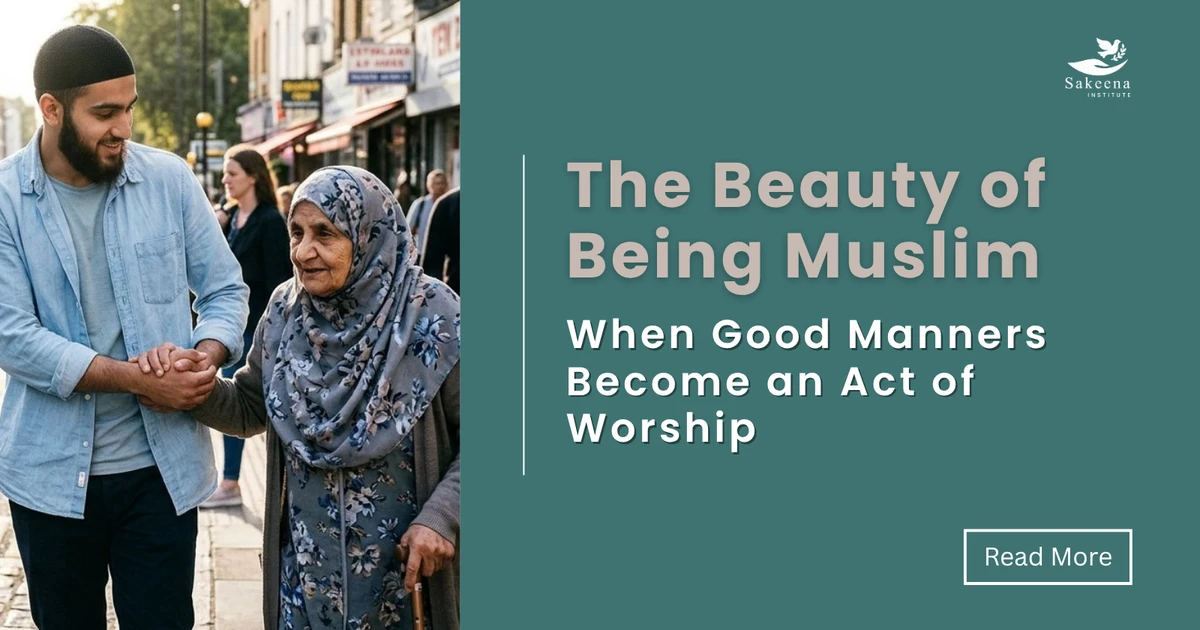
Sometimes we imagine that beautiful character requires extraordinary opportunities: a chance to help someone in crisis, donate a significant amount of money, or perform an act of kindness that everyone will remember. Yet much of a person's character is formed through moments so ordinary that nobody else may notice them. It appears in allowing someone to finish speaking without interrupting, thanking a person whose work is often taken for granted, greeting others warmly, keeping a promise even when fulfilling it becomes inconvenient, and offering patience to someone who is having a difficult day.
The Qur’an praises those who restrain their anger and pardon people, describing them among the people of excellence (Qur’an 3:134). Restraining anger does not mean pretending that hurtful behavior is acceptable or denying that we have been wounded. Rather, it means refusing to allow a powerful emotion to make every decision on our behalf. We can acknowledge our anger without allowing it to become cruelty, and we can express disappointment without deliberately seeking to make another person suffer. Sometimes excellence means responding with kindness; at other times, it means stepping away until we can speak with fairness instead of allowing an argument to turn into a competition over who can inflict the deepest wound.
There is also a beautiful distinction between being pleasant when life is easy and maintaining good character when it is difficult. Anyone may find it simple to smile when they feel appreciated, but patience becomes more meaningful when we are exhausted and still choose not to lash out at someone who has done nothing wrong. Generosity becomes more sincere when we give without needing recognition, and forgiveness becomes more difficult, yet more significant, when we must surrender the satisfaction of repeatedly reminding someone of their mistake. These moments are not always dramatic, but they offer opportunities to seek the pleasure of Allah precisely because we may have to struggle against our own immediate desires.
At the same time, good manners should never be confused with allowing people to exploit us. Islam does not require a person to remain in harmful circumstances, tolerate abuse, or abandon legitimate rights simply to appear patient. We can establish boundaries respectfully, refuse an unreasonable request without insulting the person who made it, and seek justice without allowing our pursuit of it to turn into oppression. Beautiful character is not the absence of strength; it is strength guided by justice, wisdom, and consciousness of Allah.
When Worship Transforms Character
If good manners are such an essential part of faith, what should we do when we recognize that our character does not always reflect the person we hope to become? The answer is not to despair, nor to assume that our shortcomings make every act of worship meaningless, but to treat those shortcomings as invitations to sincere self-examination and growth. Spiritual development is a lifelong process, and recognizing a flaw can itself become the beginning of change when it leads us to seek forgiveness, repair the harm we have caused, and make a genuine effort not to repeat it.
We can begin by paying attention to the moments when our manners are most likely to deteriorate. Perhaps we become impatient when we are hungry, defensive when someone corrects us, dismissive when we feel intellectually superior, or harsh with those closest to us because we assume they will understand. Recognizing these patterns allows us to prepare for them instead of repeatedly excusing them. We can pause before responding, seek refuge in Allah from the whispers that intensify our anger, apologize without attaching a list of excuses, and ask Allah to help us cultivate the qualities we find difficult to practice.
It is equally important to remember that good character is not simply a matter of suppressing undesirable behavior; it involves cultivating better qualities until they gradually become more natural. A person who struggles with impatience can practice listening more carefully, someone who tends toward criticism can train themselves to notice what others do well, and someone who finds it difficult to apologize can learn to value reconciliation more than the temporary comfort of protecting their ego. Every sincere effort matters, even when progress is gradual, because the goal is not to construct an appearance of perfection but to become more truthful in our relationship with Allah and more beneficial in our dealings with His creation.
The connection between worship and character should also encourage us to examine ourselves without becoming harsh toward others. It is easy to notice the faults of people whose manners disappoint us, but much harder to recognize the ways our own behavior causes pain. Instead of using religious knowledge as a measuring stick with which to rank everyone around us, we can allow it to become a mirror that helps us see where we need to improve. The more sincerely we pursue our own refinement, the less time we may have for unnecessary judgment and the more compassion we may develop for people who are struggling with shortcomings of their own.
Conclusion: Let Your Character Tell the Story of Your Faith
In the end, good manners in Islam are not a decorative addition to a religious life that would otherwise be complete. They are part of the life of faith itself, expressed through the way we speak, the way we listen, the way we respond when disappointed, and the way we treat people who cannot offer us anything in return. They remind us that worship is not confined to the moments when we stand before Allah in prayer, because the consciousness cultivated in those moments should accompany us when we return to our families, our workplaces, our friendships, and the countless ordinary encounters that make up our days.
The Prophet ﷺ said that the heaviest thing placed on the believer's scale on the Day of Resurrection will be good character, as reported in Sunan al-Tirmidhi. This is a profound reminder that the qualities we sometimes dismiss as small matters may carry immense significance before Allah. A restrained word, an honest apology, a moment of patience, a kindness offered without an audience, and a decision to protect someone's dignity may appear ordinary to the world, yet none of these efforts is insignificant when performed sincerely for His sake.
Perhaps one of the most meaningful questions we can ask ourselves is not simply whether the people around us know that we are Muslim, but whether they experience something of Islam's mercy through their interactions with us. Do our families feel safe speaking honestly with us? Do our words preserve the dignity of those who disagree with us? Can people trust our promises, our honesty, and our treatment of their weaknesses? When we make mistakes, are we willing to admit them and repair what we have damaged?
We will not answer every one of these questions perfectly, and the purpose of asking them is not to burden ourselves with an impossible standard. Rather, they remind us of the beautiful opportunity contained within every new day: to let our faith shape not only what we believe, but also how we live. May Allah beautify our hearts with sincerity, our tongues with truth, our actions with mercy, and our character with the qualities beloved to Him, until our manners become a quiet reflection of the faith we carry within us.