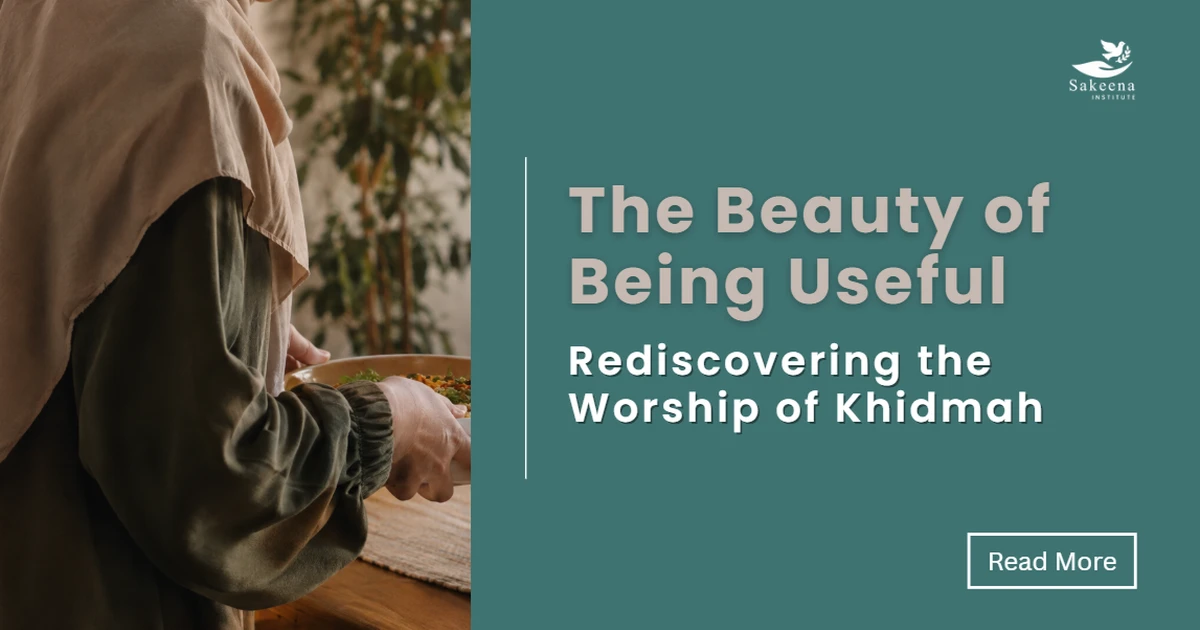

There is a particular kind of worship that can be so ordinary that we almost forget to recognize it as worship. It does not always involve sitting with a Qur’an, attending a lecture, or spending a long time in prayer. Sometimes it looks like preparing a meal for someone who has had a difficult day, washing the dishes when everyone else has gone to sleep, helping an elderly person carry something heavy, making space for someone who needs to talk, taking care of a responsibility that nobody else noticed, or simply asking yourself what would make another person’s day a little easier. These things can seem small when viewed individually, but Islam teaches us that the value of an action is not determined by how impressive it appears to people. An ordinary act, when offered sincerely to Allah, can become an act of worship.
This is part of the beauty of khidmah, the idea of serving and benefiting others. Khidmah is more than simply helping people when it is convenient or doing favors for those we love. It is a way of approaching life with the awareness that Allah has given each of us abilities, resources, time, knowledge, strength, and opportunities that can be used to bring goodness to those around us. It is the willingness to step outside of our own immediate concerns and ask, with sincerity, “How can I be of benefit here?” In a world that constantly encourages us to think about what we deserve, what we are missing, and what others should be doing for us, khidmah gently redirects the heart toward a different question: what can I give?
The Qur’an repeatedly calls believers toward this outward-looking kind of goodness. Allah says, “And cooperate in righteousness and piety” (Qur’an 5:2), reminding us that righteousness is not something we pursue entirely on our own. Our lives are intertwined, and part of our responsibility as believers is to become a source of benefit to the people Allah has placed around us. The Prophet ﷺ reinforced this meaning when he said, “Allah is in the aid of His servant as long as the servant is in the aid of his brother” (Sahih Muslim, 2699). There is something deeply reassuring in this hadith because it changes the way we understand what happens when we spend ourselves helping others. We may feel that we are giving away our time, energy, money, or effort, but the Prophet ﷺ teaches us that the servant who concerns himself with helping others places himself under the aid of Allah.
This is one of the reasons khidmah can become such a powerful form of tazkiyah. The human being naturally gravitates toward being served. We like to be considered, accommodated, thanked, and appreciated, and there is nothing inherently wrong with enjoying kindness from others. Yet the nafs can gradually become accustomed to asking, “What about me?” Khidmah trains the heart to ask a different question. It teaches us to notice what other people need even when they have not asked, to give without constantly calculating what we will receive in return, and to do things that may never be acknowledged by anyone other than Allah.
That last part is particularly important because much of the service we perform in our daily lives is invisible. A person may cook a meal that everyone enjoys without anyone thinking about the time it took to prepare it. Someone may clean the house and have to clean it again the following day. A mother may spend years caring for her children without receiving a fraction of the recognition that her work deserves. A husband or wife may quietly take on responsibilities to make life easier for their family, while the other person may never fully realize what was sacrificed. A person may listen to a struggling friend for an hour, offer encouragement, or make du‘a for them privately, and the friend may never know the extent of the care behind it.
These moments can be frustrating if our motivation is recognition, because people are imperfect at noticing what others do for them. But they can become profoundly beautiful when our motivation is Allah. Allah tells us, “Indeed, Allah does not allow the reward of the doers of good to be lost” (Qur’an 9:120). Nothing sincere disappears with Allah. The meal that nobody thanked you for, the cleaning that had to be repeated, the favor that was forgotten, the money you gave quietly, the time you sacrificed, and the difficult conversation in which you chose patience over irritation are all known to Him. One of the greatest freedoms of sincere service is realizing that your reward does not have to come from the person you served.
The Prophet ﷺ himself embodied this spirit in a way that should reshape our understanding of dignity and service. When Aisha رضي الله عنها was asked what the Prophet ﷺ would do in his home, she described him as being “in the service of his family,” and when the time for prayer came, he would leave for the prayer (Sahih al-Bukhari, 676). This is a remarkable image when we consider who the Prophet ﷺ was. He was the Messenger of Allah, the leader of the Muslim community, the teacher of the Companions, and the greatest human being to walk upon the earth, yet his greatness did not make him feel too important to participate in the ordinary work of the home.
In fact, the Prophetic model gives us a completely different understanding of what it means to be a person of importance. Our modern culture often associates status with being served. The more important someone becomes, the more people are expected to accommodate them, anticipate their needs, and take responsibility away from them. The Sunnah gives us another picture: a person's greatness does not make service beneath them. Rather, the more a person understands their responsibility before Allah, the more willing they become to use what they have for the benefit of others.
This is why khidmah can be particularly transformative in the small, repetitive responsibilities of everyday life. It is easy to feel that spiritual life happens somewhere else, while the mundane tasks of daily living are simply interruptions that prevent us from doing something more meaningful. We may wish that we had more time for Qur’an, more time for learning, more time for worship, while feeling frustrated by cooking, cleaning, errands, work, family responsibilities, and the countless small things that seem to consume our days. Yet perhaps part of our spiritual growth is learning that Allah does not only ask us to worship Him in the moments we have deliberately set aside for worship. He also asks us to worship Him through the way we carry the responsibilities He has placed in our hands.
The kitchen can therefore become a place where sincerity is cultivated. Caring for one's family can become an expression of mercy. Helping a colleague can become sadaqah. Looking after one's parents can become a means of earning Allah's pleasure. Teaching someone something you know can become an ongoing source of reward. Visiting someone who is sick, carrying something for someone who cannot carry it themselves, helping a neighbor, making food for someone who is struggling, or simply taking a responsibility from another person's shoulders can all become opportunities for reward when they are done seeking Allah.
The Prophet ﷺ also taught us not to underestimate these seemingly small acts. He said, “Do not belittle any good deed, even if it is meeting your brother with a cheerful face” (Sahih Muslim, 2626). The hadith is a beautiful reminder that our relationship with Allah is not built only through the deeds that look impressive from the outside. Sometimes the smallest acts carry a sincerity that nobody else can see. A smile, a kind word, an offered hand, a prepared meal, or a moment of patience may appear insignificant to the person performing it, yet Allah knows exactly what was in the heart when it was done.
At the same time, understanding khidmah correctly does not mean believing that we must exhaust ourselves in order to be good Muslims. Islam does not teach a person to disregard their own legitimate needs or allow others to continually take advantage of them. Rest can be necessary, boundaries can be necessary, and there are times when saying no is the wiser and more responsible choice. The beauty of khidmah is not found in destroying yourself for other people; it is found in willingly using the blessings Allah has given you to bring benefit where you are able. There will be seasons in which you have much to give and seasons in which you are the one who needs to receive. Both are part of being human, and both can contain worship.
Perhaps, then, one of the greatest signs that khidmah is becoming part of a person's character is not that they suddenly begin doing extraordinary things for everyone around them, but that they become more attentive. They begin noticing. They notice when someone is tired, when a parent needs help, when a spouse has had a difficult day, when a friend has become unusually quiet, when there is something that needs to be carried, prepared, cleaned, taught, organized, or simply shared. Instead of waiting to be asked, they begin to recognize opportunities for goodness as they appear.
This way of living gradually changes the heart. We become less preoccupied with whether other people are doing enough for us and more concerned with whether we are doing what we can for them. We become less dependent on praise because we have learned to seek the pleasure of the One who sees what people overlook. We begin to understand that a meaningful life is not necessarily one in which we are constantly accomplishing impressive things, but one in which the things we do, however ordinary, are filled with purpose.
There is also something deeply beautiful about becoming the kind of person whose presence makes life easier for others. Not because we become indispensable, and certainly not because our worth depends on how much we do, but because Allah loves goodness and has given us the opportunity to participate in it. A person who serves others becomes a means through which Allah's mercy reaches people. Perhaps someone eats because you cooked. Someone rests because you took care of something they could not manage. Someone feels less alone because you listened. Someone learns because you taught them. Someone smiles because you were kind. We may never know the full effect of the good we do, but Allah knows.
And perhaps this is what makes khidmah so beautiful: it takes something as ordinary as serving another human being and connects it to something eternal. The dishes eventually become dirty again, the meal is eventually forgotten, the room eventually needs to be cleaned again, and the favor may eventually disappear from someone's memory. But the intention with which you served Allah does not disappear. What was done sincerely for Him remains with Him.
So perhaps we should begin looking at the ordinary responsibilities of our lives with different eyes. Instead of seeing every task as something that takes us away from worship, we can sometimes ask whether it can itself become worship. Instead of resenting every inconvenience, we can look for the opportunity hidden within it. Instead of asking whether anyone noticed what we did, we can remember that Allah did.
Khidmah is ultimately an invitation to become a person through whom goodness travels. It teaches us to carry what we can, give what we can, ease what we can, and serve where we can, not because we expect people to repay us, but because we know that every sincere act of goodness is seen by Allah. And perhaps one of the most beautiful ways to live is to become comfortable doing good things that may never make you look important in the eyes of people, because your heart has become content knowing that you are known by Allah.
The world may remember the extraordinary, but Allah does not overlook the ordinary when it is done for Him.