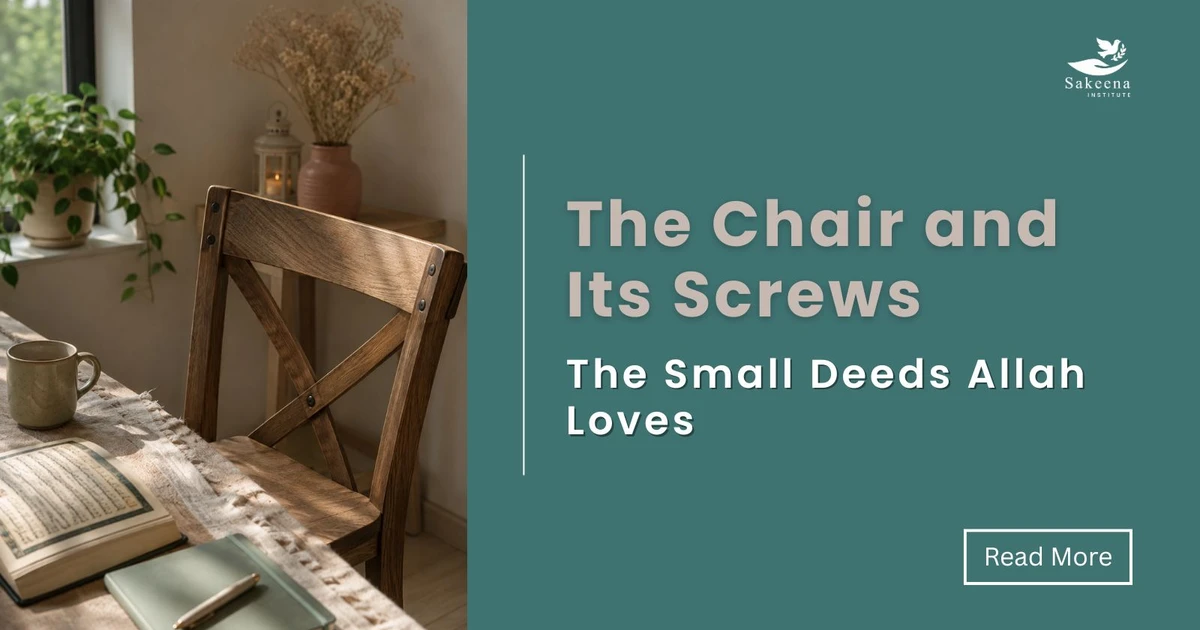

Ask anyone what the most important part of a chair is, and they will probably give you an answer without much hesitation. Some will say the legs, because they carry the weight. Others will say the seat, because that is where we actually sit. Someone else might point to the backrest, because it gives us support and allows us to lean back comfortably. Each answer makes sense. Each part has an obvious function, and without any one of them, the chair would not be quite the chair we know.
But very few people would point to the screws.
The screws are small, almost invisible, and easy to overlook. They do not make the chair beautiful. They are not the part we admire when we look at it. They do not carry the same visual importance as the legs or the seat. Yet remove them, one by one, and eventually the very parts we thought were most important begin to separate. The legs may still be strong, but they are no longer attached. The seat may still be perfectly shaped, but it can no longer hold us. The backrest may still be sturdy, but it has lost its place.
The chair was never held together by the parts we noticed most. It was held together by the things we barely noticed at all.
There is something deeply human in this.
We have a tendency to measure importance by visibility. We notice the person standing at the front of the room, but not the person who quietly prepared everything behind the scenes. We notice the major accomplishments, but not the countless ordinary habits that made them possible. We praise the beautiful outcome while forgetting the small, repetitive actions that held everything together long before the outcome became visible.
Even in our own lives, we often become preoccupied with the "big parts." We think about our purpose, our career, our marriage, our worship, our relationships, our ambitions. We ask whether we are doing enough, achieving enough, becoming enough. We look at the visible structure of our lives and wonder why something feels unstable, even though all the major pieces appear to be in place.
Perhaps sometimes the problem is not the chair.
Perhaps it is the screws.
The Qur'an repeatedly draws our attention to things that appear small but carry enormous weight. Allah says,
"So whoever does an atom's weight of good will see it."
فَمَن يَعْمَلْ مِثْقَالَ ذَرَّةٍ خَيْرًا يَرَهُ
(Qur'an 99:7)
An atom's weight is almost nothing to our eyes. It is not impressive. It is not something we would normally consider worth measuring. Yet Allah teaches us that nothing done for His sake is insignificant. The smallest deed can have a weight that we cannot perceive.
This changes the way we should look at our ordinary lives.
Perhaps the five minutes spent reading Qur'an when you felt too tired to read more are a screw. Perhaps the quiet apology you gave when your ego wanted to defend itself is a screw. Perhaps the glass of water you brought someone without being asked, the prayer you made for someone who will never know, the moment you lowered your voice instead of raising it, the morning dhikr you almost skipped but chose to complete—these may seem like tiny things.
But tiny does not mean unimportant.
A screw does not need to be large to hold something together.
There are seasons in life when we become discouraged because we cannot see the results we hoped for. We may feel as though we are doing so little. Our worship may not feel extraordinary. Our personal growth may seem painfully slow. Our relationships may not look like the picture we imagined. We may wonder whether the small things we keep trying to do are making any difference at all.
But perhaps we are looking at the wrong part of the chair.
We are looking for the legs.
We want the obvious evidence that everything is working: the transformation, the achievement, the breakthrough, the perfect routine, the visible success. We want to feel that something significant has happened.
Yet much of what sustains a person is remarkably ordinary.
It is waking up and trying again. It is making salah even when the heart feels distracted. It is choosing patience in a conversation that could easily become an argument. It is returning to Allah after a mistake instead of allowing shame to keep you away. It is keeping a promise. It is controlling a reaction. It is speaking well of someone when they are absent. It is doing something good when nobody is watching.
These are the screws.
They may never receive applause, but they keep the structure standing.
And perhaps this is one of the reasons sincerity is so precious. The screw does not care whether anyone sees it. Its value does not come from being admired. It simply does its job.
There is a profound lesson here for our relationship with Allah. Not everything valuable in the sight of Allah will look impressive in the sight of people. A deed may pass unnoticed by everyone around you while being immense in the sight of the One who knows the intention behind it.
The Prophet ﷺ taught that "actions are only by intentions" and that each person will have what they intended. The unseen dimension of an action can therefore be more important than its visible form. Two people may perform the same outward deed, while what gives that deed its true weight is hidden inside the heart.
The screw is hidden inside the chair.
And perhaps some of the most important parts of your life are hidden too.
Maybe you have spent months trying to build something and feel that nothing has changed. Maybe you are quietly working on your character, trying to become more patient, more grateful, more disciplined, more sincere. Maybe nobody has noticed the effort it takes for you to keep choosing what is right. Do not assume that because the progress is difficult to see, it is not happening.
A chair is not assembled in one dramatic moment. It is put together through small pieces being secured in the right places.
A life can be built the same way.
We sometimes imagine that becoming the person we want to be requires one enormous transformation. We wait for motivation to arrive, for the perfect routine to begin, for the perfect opportunity to appear. But perhaps lasting change is much quieter than that. Perhaps it is built through small decisions repeated until they become part of us.
One prayer. One page. One sincere repentance. One act of kindness. One restrained response. One moment of gratitude. One choice to trust Allah when we cannot yet see the outcome. One more screw. And then another.
Until one day, you look at the chair and realize that it is standing.
Not because one piece carried everything, but because countless small pieces were faithfully doing their part.
This is also why we should be careful about underestimating the people who seem to have the smallest roles in our lives. The person who reminds you to pray, the person who checks whether you have eaten, the person who makes du'a for you quietly, the person who creates a peaceful home, the person who listens when you need to speak—these contributions may not look dramatic from the outside.
But remove enough of the small things, and you begin to understand their significance.
Sometimes the people holding our lives together are the ones we rarely stop to thank.
And sometimes, we are those people for someone else without even realizing it.
There is comfort in this analogy because it frees us from the pressure to always be extraordinary. You do not have to be the entire chair. You do not have to carry every weight or become every important part at once. You simply need to faithfully fulfill the small role Allah has placed before you today.
Allah does not ask us to control the entire structure of our lives. He asks us to worship Him, to obey Him, to strive for what is good, and to trust Him with what lies beyond our control.
The Qur'an reminds us:
"And whoever is mindful of Allah, He will make for him a way out, and provide for him from where he does not expect."
وَمَن يَتَّقِ اللَّهَ يَجْعَل لَّهُ مَخْرَجًا وَيَرْزُقْهُ مِنْ حَيْثُ لَا يَحْتَسِبُ
(Qur'an 65:2–3)
Sometimes our responsibility is simply to keep fastening the screws while Allah takes care of the structure.
So the next time you look at a chair, look a little closer.
Notice the legs. Notice the seat. Notice the backrest. Notice everything your eyes naturally recognize as important.
And then remember the screws.
Remember that some of the things holding your life together may be the things you are most tempted to dismiss as insignificant. Remember that consistency can be more powerful than intensity, that sincerity can matter more than visibility, and that an action does not need to look impressive to be precious to Allah.
You may not be seeing the finished chair yet.
You may only be tightening one screw at a time.
Keep going. Because sometimes the most important part of the chair is the part nobody thinks to look at.
The screws, at the end of the day, hold it together.