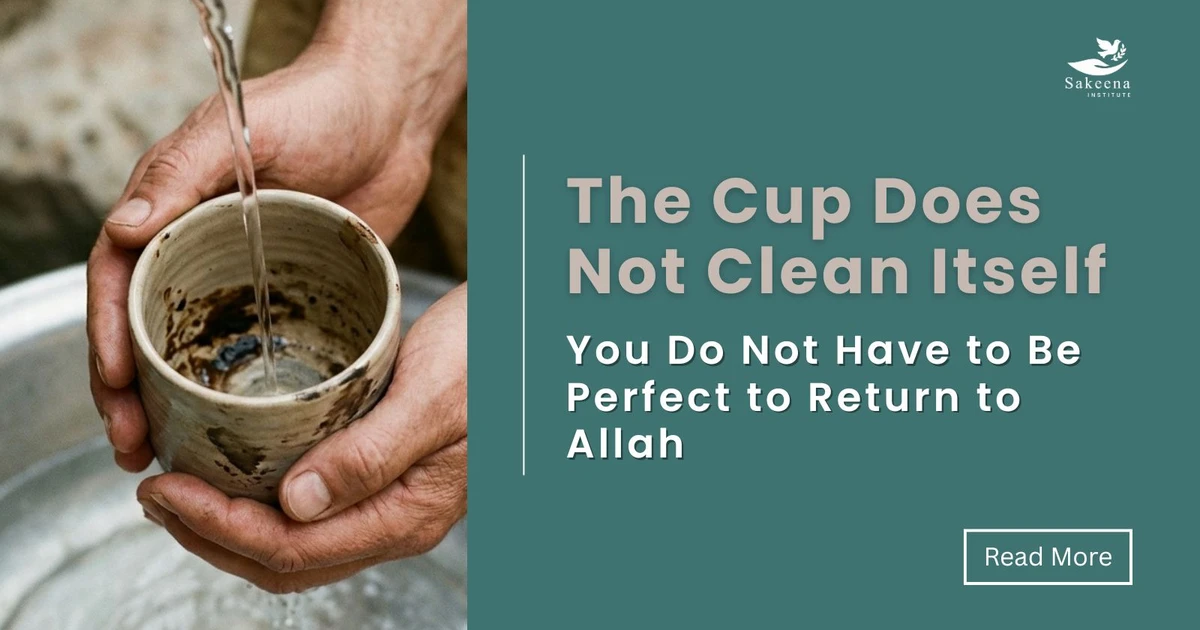

There is a strange habit we have with things that are dirty: we put them aside until we have the time and energy to clean them properly. A cup with something dried at the bottom gets left in the sink. A plate with food stuck to it is moved out of the way. We tell ourselves we will deal with it later, when we have enough time, enough water, enough patience. Yet the longer it sits there, the harder it becomes to clean. What was once a simple rinse now requires soaking, scrubbing and effort. And perhaps there is something quietly familiar about this in the way we sometimes treat our hearts. When we feel spiritually distant from Allah, when our prayers become inconsistent, when our Qur’an feels neglected, when our sins seem to have accumulated, we tell ourselves that we will return once we have ourselves together. We will start again when we feel sincere enough, disciplined enough, focused enough, worthy enough. We somehow imagine that we need to clean ourselves before we can come to the One who is capable of cleansing us.
But a dirty cup does not become clean by staying away from the water.
It has to be brought to it.
There is something deeply revealing about the way we approach our relationship with Allah after we have fallen short. When we are doing well, worshipping consistently and feeling close to Allah, turning to Him feels natural. We make duʿā’, open the Qur’an, pray extra prayers and speak to Allah about what is happening in our lives. But when we are struggling, we can become strangely reluctant to approach Him. We may miss prayers and then feel too ashamed to pray the next one properly. We may spend weeks neglecting the Qur’an and then think, “What is the point of opening it for only a few minutes?” We may fall into a sin and, instead of running toward Allah in repentance, we withdraw because we feel hypocritical asking Him for forgiveness while knowing we may struggle with the same weakness again.
This is precisely when we need Allah most.
Allah does not ask us to come to Him because we have already perfected ourselves. If perfection were the requirement for worship, none of us would have anywhere to begin. We come to Allah because we are needy. We pray because we need guidance. We make istighfār because we sin. We ask for strength because we are weak. We seek forgiveness because we make mistakes. The very things we sometimes see as reasons to stay away from Allah are often the reasons we should be turning toward Him more urgently.
The Prophet ﷺ taught that every son of Adam sins, and that the best of those who sin are those who repent. The statement is remarkably realistic. Islam does not build its understanding of human beings around the assumption that believers will never fall. Rather, it teaches us what a believer does when they fall. The goal is not to become a person who never needs forgiveness. The goal is to become a person who repeatedly returns to the One who forgives.
There is a profound difference between saying, “I am struggling, so I need to return to Allah,” and saying, “I am struggling, so I have no right to return to Allah.” The first is humility. The second is despair disguised as humility. Sometimes we think that staying away from Allah because we feel unworthy is somehow respectful, as though our distance proves that we understand the seriousness of our sins. But Allah does not want us to demonstrate our regret by remaining distant from Him. He wants us to demonstrate it by returning.
Imagine someone who has fallen into deep water and refuses the hand being extended to them because they feel embarrassed that they fell in. It sounds absurd. The fact that they are drowning is precisely why they need the hand. Yet spiritually, we sometimes do something remarkably similar. We fall into weakness and then withdraw from the very source of strength that could help us climb out. We wait until we feel spiritually clean before we begin praying properly again, as though prayer were a reward for having a clean heart rather than one of the means through which the heart is purified.
Allah says, “Indeed, prayer prohibits immorality and wrongdoing” (Qur’an 29:45). The prayer is not only for the person who already has everything under control. It is one of the means by which Allah helps us become better. The Qur’an is not only for the person whose heart is already soft. It is a source of guidance for the person whose heart needs guidance. Dhikr is not only for the person who feels spiritually alive. It is precisely what brings life back into a heart that has become distracted and hard.
This changes the way we should think about spiritual consistency. Sometimes we imagine consistency as never falling off. We picture the ideal believer as someone whose worship remains steady, whose motivation never disappears, whose heart is always eager and whose relationship with Allah feels continuously strong. But human beings fluctuate. There are days when worship feels easy and days when it feels heavy. There are seasons when the Qur’an feels close to the heart and seasons when concentration is difficult. There are moments when duʿā’ flows naturally and moments when all we can manage is a quiet, exhausted plea for Allah to help us.
Consistency does not necessarily mean that you always feel the same.
Sometimes consistency simply means that you keep coming back.
The person who falls and returns has not failed in the same way as the person who falls and decides never to stand again. A believer's journey is not measured only by how many times they remain upright. It is also measured by how many times they returned to Allah after falling. There is something beautiful about a servant who knows that no matter how many times they become weak, their direction remains the same.
Toward Allah.
Perhaps this is why we should be careful with the phrase, “I need to fix myself first.” There are certainly things we need to work on. Islam does not tell us to remain comfortable with our weaknesses. We should strive against our nafs, seek knowledge, discipline ourselves and leave what displeases Allah. But there is a danger in turning self-improvement into a prerequisite for worship. You do not need to become a completely different person before you pray. You pray while becoming different. You do not need to eliminate every weakness before making duʿā’. You make duʿā’ because you have weaknesses. You do not need to understand everything about your faith before opening the Qur’an. You open the Qur’an because you need guidance.
The water does not wait for the cup to become clean.
The cup becomes clean because it enters the water.
And perhaps we need to stop being so afraid of approaching Allah with imperfect hearts. We sometimes want to offer Allah a version of ourselves that is polished, disciplined and spiritually impressive. But Allah already knows the parts of us we hide from everyone else. He knows the thoughts we are ashamed of, the sins nobody saw, the prayers we struggled to concentrate through, the promises we made to ourselves and broke, the moments when our faith felt weak and the moments when we almost gave up. Nothing about us is hidden from Him. And despite knowing all of it, He continues to call us back.
Allah says, “And whoever does not repent—it is those who are the wrongdoers” (Qur’an 49:11). The command is not to remain trapped in shame. It is to repent. To return. To change direction.
There is also something beautiful about realizing that Allah does not require us to clean the entire cup in one moment. Perhaps this is where we become overwhelmed. We look at our lives and see everything that needs changing at once. We want to fix our prayers, our Qur’an, our character, our habits, our relationships, our intentions and our time management all at the same time. The weight of everything becomes so large that we do nothing. But perhaps the better approach is simply to begin.
Pray the next prayer. Open the Qur’an. Say istighfār. Make one sincere duʿā’. Leave one sin. Do one good deed. Then do it again tomorrow.
Allah loves deeds that are consistent, even if they are small. The journey back to Him does not need to begin with a dramatic transformation. Sometimes the most sincere return begins quietly, with a servant sitting alone after having been distant for a long time and simply saying, “Ya Allah, I am back.”
And perhaps that is enough to begin.
Not because the servant has suddenly become perfect, but because they have finally understood where cleansing comes from.
We are never going to reach a point where we no longer need Allah. That is not the destination. The destination is to become increasingly aware of how much we need Him. Every weakness should teach us dependence. Every mistake should teach us repentance. Every blessing should teach us gratitude. Every moment of distance should teach us the sweetness of returning.
If your heart feels stained by mistakes, do not let that feeling become a reason to hide from Allah. When your worship has become weak, do not wait until you feel spiritually strong before returning to it, because worship is not reserved for the moments when we feel our best; it is often what carries us through the moments when we feel our weakest. If you have sinned, let your sin lead you to repentance rather than allowing it to convince you that you are too far gone to return to the One who forgives. If you have been distant from Allah, then let that distance awaken in you a desire to draw closer, and if you have fallen, do not allow the fall itself to become your stopping point. Begin again, even if the beginning feels small and imperfect.
A cup does not wait until it is clean before it is placed into the water. It is placed into the water precisely because it is dirty and needs to be cleansed. In the same way, you do not need to become the person you wish to be before you turn back to Allah. You turn back to Him because you are still becoming that person, because you are still weak, still learning, still struggling and still in need of His guidance and mercy. Allah has not asked you to return only once you have solved everything within yourself; He has given you the door of tawbah so that, whenever you fall short, you have somewhere to go.
So return to Him—not when you have finally perfected yourself, not when you feel worthy enough to stand before Him, and not when you have managed to repair every part of your life, but now, with all the weakness and imperfection that you carry. Bring the heart that is struggling, the worship that needs rebuilding, the sins that need forgiveness and the intentions that need renewing. Bring all of it to Allah, because the One who created your heart knows how to cleanse it, restore it and bring it back to life.