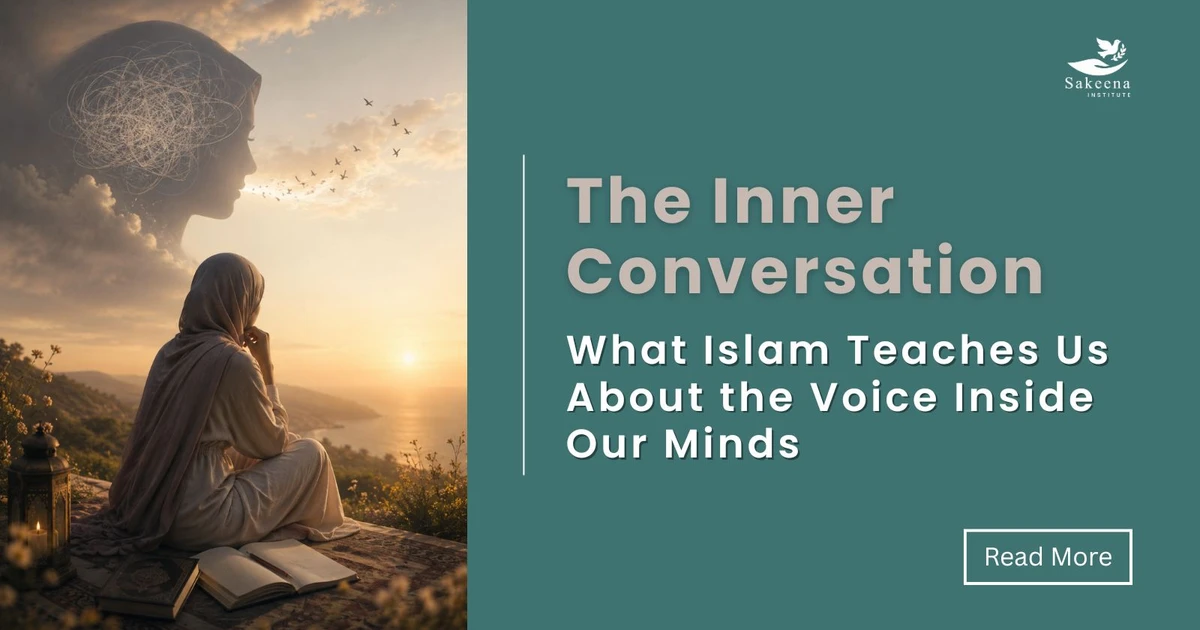

There is a conversation happening inside us far more often than we realise. We interpret what happens to us, we remember what has happened before, we imagine what might happen next, and somewhere between all of these thoughts, we begin to form beliefs about ourselves: I am not good enough. I always ruin things. People will eventually leave. I cannot change. I should have done better. What if everything goes wrong? Sometimes these thoughts are so familiar that we stop noticing them altogether. They become the background noise of our lives, quietly influencing our emotions, our decisions, our relationships and even the way we worship Allah.
Modern psychology has spent considerable time exploring this inner world: the way our thoughts shape our emotional responses, how repeated patterns become automatic, and how the stories we tell ourselves can influence the way we behave. Yet long before psychology gave names to these processes, the Qur’an was directing the believer towards something even deeper: an awareness of the nafs, the inner self, and the lifelong work of bringing it under the guidance of revelation.
Islam does not teach us to believe every thought that enters our minds. Nor does it teach us to become frightened of our own inner world. Instead, it teaches us to observe it, question it, purify it and ultimately orient it towards Allah. This is one of the most beautiful dimensions of tazkiyah: learning that there is a difference between what you feel, what you think, what your nafs desires and what is actually true.
You Are Not Every Thought You Think
One of the most freeing realisations a person can have is that a thought appearing in the mind does not automatically make it true. We can experience fear without being in danger, sadness without having lost everything, insecurity without being inadequate, and doubt without having lost our faith. The human mind is constantly interpreting the world, and those interpretations are not always accurate.
The Qur’an gives us a remarkable picture of the human soul:
وَنَفْسٍ وَمَا سَوَّاهَا فَأَلْهَمَهَا فُجُورَهَا وَتَقْوَاهَا قَدْ أَفْلَحَ مَن زَكَّاهَا وَقَدْ خَابَ مَن دَسَّاهَا
“And [by] the soul and He who proportioned it, and inspired it [with discernment of] its wickedness and its righteousness. He has succeeded who purifies it, and he has failed who corrupts it.”
— Qur’an 91:7–10
Notice the language of tazkiyah. Allah does not describe success as having a mind that never produces negative thoughts, a heart that never feels envy, or a personality that never struggles. Success is connected to what we do with the inner self. The existence of an impulse is not itself the measure of your character. What matters is whether you nurture it, obey it, challenge it or redirect it.
This changes the way we approach our inner struggles. Instead of thinking, Why am I having this thought? What is wrong with me that I feel this way?, we can begin asking, What is this thought telling me? Is it true? Where is it taking me? Does it bring me closer to Allah or further away from Him?
That is the beginning of inner awareness.
The Nafs Wants Relief, Not Always What Is Best
A fascinating thing about human behaviour is that we often choose what gives us immediate emotional relief even when we know it will not serve us in the long term. We procrastinate because avoiding the task temporarily removes the discomfort. We withdraw from a difficult conversation because silence feels safer. We scroll because distraction is easier than sitting with an uncomfortable emotion. We become defensive because admitting that we were wrong threatens the image we have of ourselves.
The Qur’an repeatedly draws our attention to the nafs because it is not simply a neutral passenger inside us. It has desires, tendencies and weaknesses that require cultivation.
Sometimes the nafs says, Protect yourself. Allah teaches you to forgive.
Sometimes it says, Make sure everyone sees your worth. Allah teaches you sincerity.
Sometimes it says, You deserve to respond because they hurt you. Allah teaches you restraint.
Sometimes it says, You cannot possibly survive without this person, this opportunity, this outcome. Allah teaches you tawakkul.
This is why spiritual growth cannot simply mean collecting more information. A person can know exactly what they should do and still struggle to do it because knowing and transforming are two different things. The knowledge enters the mind, but tazkiyah gradually reshapes the person.
The Qur’an Asks Us to Look Within
One of the most psychologically powerful verses in the Qur’an is found in Surah al-Hashr:
يَا أَيُّهَا الَّذِينَ آمَنُوا اتَّقُوا اللَّهَ وَلْتَنظُرْ نَفْسٌ مَّا قَدَّمَتْ لِغَدٍ ۖ وَاتَّقُوا اللَّهَ ۚ إِنَّ اللَّهَ خَبِيرٌ بِمَا تَعْمَلُونَ
“O you who have believed, fear Allah. And let every soul look to what it has put forth for tomorrow—and fear Allah. Indeed, Allah is Acquainted with what you do.”
— Qur’an 59:18
There is something deeply intentional about the command: “let every soul look.”
Islam does not encourage a life lived entirely on autopilot. The believer is invited to pause and examine. What am I becoming? What patterns am I repeating? What am I allowing to occupy my heart? What am I doing today that my future self will wish I had done differently? What am I sending forward to meet Allah?
This is muhasabah: taking account of oneself.
And importantly, muhasabah is not the same as self-hatred. It is not sitting alone and listing everything wrong with yourself until you feel worthless. Genuine self-accountability is much more hopeful than that because it assumes that change is possible. You look within not to condemn yourself, but to discover what needs to be corrected.
There is a profound difference between saying, “I am a terrible person because I keep doing this,” and saying, “This is a weakness in me that I need to work on.” The first statement turns a behaviour into an identity. The second recognises the behaviour while leaving the door open for transformation.
Change Begins From Within
Allah says:
إِنَّ اللَّهَ لَا يُغَيِّرُ مَا بِقَوْمٍ حَتَّىٰ يُغَيِّرُوا مَا بِأَنفُسِهِمْ
“Indeed, Allah will not change the condition of a people until they change what is in themselves.”
— Qur’an 13:11
This verse is often quoted as a motivational statement about achieving our goals, but its spiritual meaning reaches much further. There are circumstances we cannot control, people we cannot change and outcomes that belong entirely to Allah. Yet there remains an inner territory that we are responsible for: our intentions, responses, choices, attitudes and relationship with our Lord.
Sometimes we pray for our circumstances to change while Allah is inviting us to begin with ourselves.
We ask Allah to give us peace, while we continue feeding the thoughts that destroy our peace. We ask for better relationships, while refusing to examine our own reactions. We ask for discipline, while repeatedly negotiating with every uncomfortable feeling. We ask Allah to bring us closer to Him, while allowing our attention to be consumed by everything except Him.
This does not mean that every difficulty is our fault. It does not mean that hardship disappears if we simply “think positively.” Islam is far more realistic than that. The believer can be tested by circumstances entirely outside their control. But even within circumstances we did not choose, there is often an inner response that we can slowly learn to place under the guidance of Allah.
When the Mind Becomes a Mirror
Perhaps one of the most beautiful aspects of Islamic psychology is that it does not separate the inner self from action. What lives inside us eventually leaves traces on the outside.
A heart consumed by comparison will eventually struggle with gratitude. A person who constantly expects rejection may interpret neutral situations as rejection. Someone who cannot tolerate being wrong may turn every disagreement into a threat. Someone who believes their worth depends entirely on achievement may never feel that they have done enough.
This is why the Qur’an does not merely tell us what to do. It repeatedly calls us to examine what is happening within us.
The goal is not perfection. The goal is purification.
A believer may still feel jealousy but learn not to nurture it. They may still become angry but learn not to let anger dictate their behaviour. They may still feel fear but refuse to allow fear to become their lord. They may experience sadness without concluding that Allah has abandoned them. They may fail without turning failure into an identity.
This is what spiritual maturity can look like: not the absence of difficult emotions, but the ability to respond to them with guidance.
You Can Change the Conversation
Perhaps you have spent years speaking to yourself in a way you would never speak to someone you love. Perhaps every mistake becomes evidence against you, every delay becomes proof that you are behind, and every weakness becomes a reason to believe that you will never change.
Islam invites us into another way of relating to ourselves. We acknowledge our shortcomings without becoming defined by them. We repent without believing that repentance is pointless. We recognise our weaknesses without forgetting the mercy of the One who knows them better than we do.
The next time a painful thought enters your mind, you do not have to immediately accept it or fight it. Pause. Notice it. Ask where it came from and whether it is consistent with what Allah has taught you. Then choose your response.
If your mind says, “I will never change,” remember that Allah is the One who transforms hearts.
If it says, “I have ruined everything,” remember that the door of tawbah remains open.
If it says, “I am not enough,” remember that your worth was never meant to be measured by the approval of creation.
And if it says, “I cannot handle what is ahead,” remember that you were never asked to control tomorrow. You were asked to walk towards Allah today.
The inner conversation matters because what we repeatedly tell ourselves can shape what we repeatedly become. But the believer is not helpless before the mind, the nafs or the past. Allah has given us revelation, reason, conscience, repentance and the ability to choose again.
Perhaps that is why the Qur’anic journey of the soul is not described as becoming someone who never struggles. It is described as purification. Again and again, we return to Allah, examine what is within us, correct what needs correcting, and continue walking.
Because the goal was never to become a person who has no inner battle.
The goal was to become a person who knows where to take the battle.
And that is back to Allah.