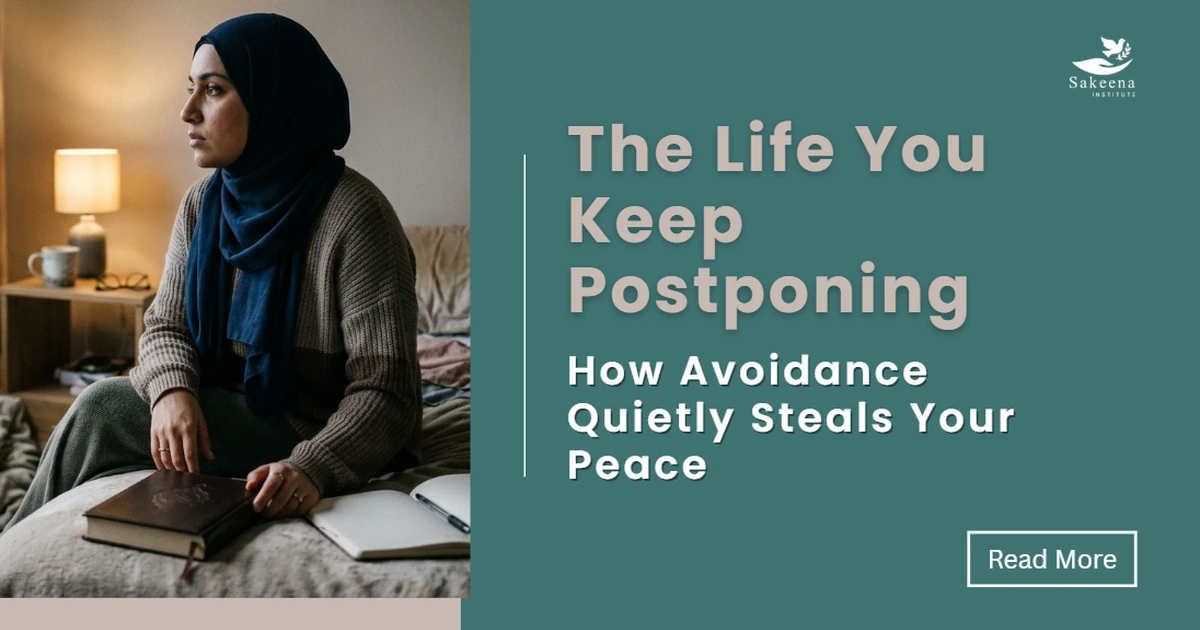

There is a particular kind of exhaustion that does not come from doing too much, but from constantly avoiding what your heart knows it needs to face.
You postpone the conversation because you do not feel ready for it. You delay the decision because you are afraid of choosing wrongly. You keep telling yourself that you will return to the Qur’an when life becomes calmer, that you will repair the relationship when you feel less hurt, that you will finally begin the project when you have more energy, and that you will deal with the grief when you have enough strength to carry it. At first, postponing feels like relief because you have successfully moved the uncomfortable thing out of sight. Yet what we repeatedly push away does not necessarily disappear. Sometimes, it simply moves deeper inside us, quietly occupying space that was meant for peace.
This is one of the ways avoidance can affect the heart.
From an Islamic psychological perspective, avoiding something difficult is not always a sign of laziness, weakness, or a lack of faith. Sometimes avoidance is the mind’s attempt to protect itself from something it perceives as overwhelming. When an emotion feels too painful, a responsibility feels too large, or a truth feels too frightening, we naturally look for distance. We distract ourselves, become excessively busy, scroll endlessly, sleep more than usual, overthink instead of act, or convince ourselves that we simply need “more time.”
There is nothing strange about wanting relief from pain.
Allah created us with an inclination to protect ourselves from what hurts, and Islam does not demand that we pretend pain does not exist. The Qur’an itself gives us the language of human vulnerability. Ya‘qub عليه السلام grieved so deeply over the loss of Yusuf عليه السلام that Allah tells us, “His eyes became white from grief, for he was [a man] of sorrow.” (Qur’an 12:84). His grief was not a spiritual failure. His love was not a weakness. His pain did not mean that he had lost his trust in Allah.
The question, therefore, is not whether you experience difficult emotions. The question is what you do with them.
There is a difference between giving yourself time to heal and indefinitely running away from what needs healing.
Sometimes we call avoidance “patience” because facing something feels too uncomfortable. Sometimes we call it “tawakkul” because taking action feels frightening. Sometimes we even call it “acceptance” when, underneath it all, we have simply become too exhausted to try again.
But tawakkul does not mean refusing to take the next step because you cannot see the whole staircase. Tawakkul means trusting Allah while taking the step that He has placed within your ability.
The Prophet ﷺ taught us this balance beautifully when he said, “Be keen on that which benefits you, seek help from Allah, and do not be helpless.” (Sahih Muslim 2664).
Notice the order.
Seek what benefits you. Seek Allah’s help. Do not surrender yourself to helplessness.
There is something deeply empowering about this prophetic guidance because it does not ask you to control everything, nor does it allow you to convince yourself that nothing is within your control. You are responsible for your effort, not for the outcome. You are responsible for turning toward Allah, not for knowing exactly how everything will unfold.
This distinction can change the way we approach the parts of life we have been avoiding.
Perhaps there is an apology you have been delaying because you are afraid of how the other person will respond. Perhaps there is a habit you know is harming your relationship with Allah, but confronting it means admitting that you have become attached to something you once thought you could easily leave. Perhaps there is a responsibility in your home, studies, work, marriage, or family that you keep postponing because beginning feels much more intimidating than imagining.
The longer we avoid something, the larger it can become in our minds.
A small task can become “I have so much to do.” One difficult conversation can become “Our relationship is broken.” One missed opportunity can become “I always ruin everything.” One period of spiritual weakness can become “I am no longer the person I used to be.”
This is where the mind can turn one moment into an identity.
You did not pray with the same concentration today, and suddenly you think, “I am becoming distant from Allah.” You struggled to cook, clean, study, work, or care for yourself this week, and suddenly you think, “I am lazy.” You made a mistake in your marriage, and suddenly you think, “I am a terrible wife.” You experienced sadness for longer than you expected, and suddenly you conclude that something must be fundamentally wrong with you.
But Allah does not ask you to define yourself by your worst moment.
Allah says:
فَإِنَّ مَعَ الْعُسْرِ يُسْرًا إِنَّ مَعَ الْعُسْرِ يُسْرًا
“For indeed, with hardship [will be] ease. Indeed, with hardship [will be] ease.”
(Qur’an 94:5–6)
The repetition itself is comforting. Hardship does not receive the final word.
Yet sometimes the ease Allah sends requires us to participate in the process of moving toward it.
You may pray for peace while avoiding the conversation that could bring clarity. You may ask Allah to strengthen your relationship while refusing to acknowledge what has been hurting it. You may ask for barakah in your time while repeatedly giving your best hours to distractions. You may ask Allah to heal your heart while refusing to sit with the grief that needs to be processed.
We should never underestimate the difference between asking Allah to remove a difficulty and asking Him to give us the courage to walk through it.
There are things Allah may remove from your life, and there are things He may transform you enough to carry.
That is why healing in Islam is not simply about feeling better. It is about becoming more truthful with yourself, more dependent upon Allah, more capable of responding rather than reacting, and more willing to take the means that lead toward what is good.
This is also why small acts matter.
If returning to the Qur’an feels overwhelming, do not turn the entire Qur’an into a mountain that you must climb before you are allowed to feel close to Allah again. Open it and read a page with presence. If your home feels overwhelming, do not wait until you can clean everything perfectly before beginning. Choose one corner and restore it with ihsan. If a relationship needs repair, do not wait until you have found the perfect words. Begin with honesty, gentleness, and a sincere intention to make things better. If you have neglected your body, your responsibilities, or your emotional wellbeing, begin with the smallest sustainable act that moves you toward care rather than punishment.
Allah says:
لَا يُكَلِّفُ اللَّهُ نَفْسًا إِلَّا مَا آتَاهَا
“Allah does not require of any soul beyond what He has given it.”
(Qur’an 65:7)
Your responsibility today is not to solve your entire life.
It is to respond faithfully to what Allah has placed in front of you today.
This is where Islamic psychology offers a profoundly different understanding of progress. Progress is not always dramatic. Sometimes it is simply the moment you stop abandoning yourself whenever something becomes difficult. Sometimes it is choosing to make the phone call you have been avoiding, getting out of bed when your mind tells you that there is no point, opening the Qur’an after a long period of neglect, admitting that something hurt you instead of pretending it did not, or finally seeking appropriate help for something you have been carrying alone.
None of these actions may feel impressive.
But Allah sees the direction of your heart.
And perhaps that is what you need to remember most: you do not have to become a completely different person before you are worthy of beginning again.
Allah says:
إِنَّ اللَّهَ لَا يُغَيِّرُ مَا بِقَوْمٍ حَتَّىٰ يُغَيِّرُوا مَا بِأَنْفُسِهِمْ
“Indeed, Allah will not change the condition of a people until they change what is in themselves.”
(Qur’an 13:11)
The verse is not telling you that every difficulty is your fault, nor is it saying that you can control every circumstance through effort alone. Rather, it reminds us that there is an inner realm in which we have responsibility: our choices, our responses, our intentions, our willingness to return, and our willingness to take the means available to us.
You may not be able to change what happened.
You may not be able to control another person.
You may not know what tomorrow holds.
But you can choose whether today you will take one step toward Allah, toward healing, toward responsibility, and toward the person you are becoming.
Do not wait until you feel completely ready.
Sometimes readiness comes after the first step, not before it.
And if you have spent months or even years avoiding something, do not let shame become another reason to continue avoiding it. Shaytan can use guilt to make us believe that because we have delayed returning, we have somehow missed our opportunity to return. But the door of Allah is not closed because you have taken too long to knock.
The Prophet ﷺ narrated from his Lord:
“O son of Adam, if your sins were to reach the clouds in the sky and then you asked My forgiveness, I would forgive you.”
(Jami‘ al-Tirmidhi 3540)
Allah does not require you to arrive at His door with a perfect history.
He asks you to return.
So perhaps the thing you have been postponing does not need another month of thinking about it. Perhaps it needs a sincere du‘a, followed by one small act of courage.
Make the call.
Open the Qur’an.
Have the conversation.
Begin the task.
Ask for help.
Make tawbah.
Rest when you genuinely need rest.
Then begin again.
You do not have to fix your entire life tonight. You only need to stop running from the next step Allah has placed within your reach.
Because sometimes the peace we keep asking Allah for is waiting on the other side of the obedience, honesty, courage, or action we have been postponing.