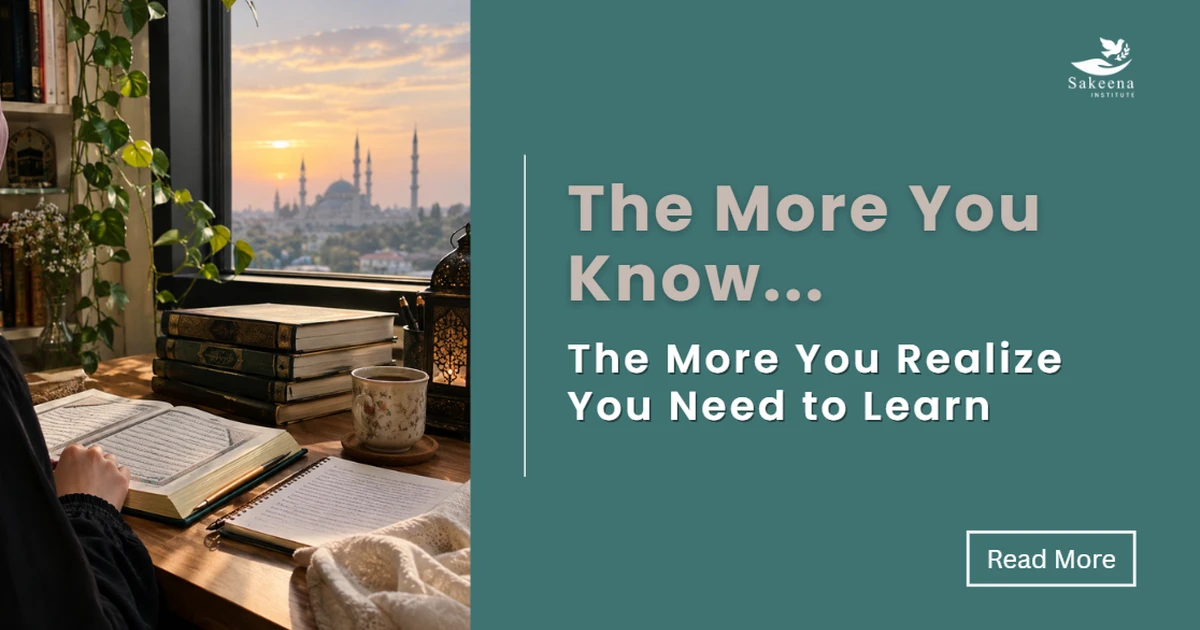

There is something remarkable about knowledge: the more you genuinely learn, the more you begin to realize how much you still do not know. In a world where information is constantly at our fingertips, it can be easy to mistake exposure for understanding. We listen to a lecture, read a few books, memorize some verses, follow knowledgeable people online, and gradually begin to feel that we have learned enough. Yet the pursuit of knowledge in Islam was never meant to be a temporary phase that we complete before moving on to “real life.” It is a lifelong journey that continually shapes the way we understand our faith, ourselves, the world around us, and our relationship with Allah.
The Qur’an itself places tremendous value on knowledge. Allah asks, “Are those who know equal to those who do not know?” (Qur’an 39:9), reminding us that knowledge creates a distinction in the way a person sees and lives. The first revelation itself began with the command, “Read in the name of your Lord who created” (Qur’an 96:1), establishing from the very beginning that learning, reading, understanding, and seeking truth are deeply connected to the life of a believer. Knowledge is not simply something that makes us more educated or articulate; beneficial knowledge changes the way we worship Allah, make decisions, understand His revelation, interact with people, and navigate the difficulties of life.
One of the most important reasons to pursue knowledge is that sincerity alone does not always tell us what to do. A person can have a beautiful intention and still act incorrectly because they do not know what Allah has actually commanded. We can sincerely want to become better Muslims while misunderstanding what spiritual growth requires from us. We may think we are being patient when we are actually avoiding something difficult, believe we are practicing humility when we are neglecting our responsibilities, or assume that something is part of the religion simply because we have heard it repeated many times. Good intentions are precious, but they need guidance. Knowledge gives sincerity a direction and allows our desire to please Allah to become grounded in revelation rather than assumption.
This is why the Prophet ﷺ said, “Whomever Allah intends good for, He gives him understanding of the religion.” (Sahih al-Bukhari, 71; Sahih Muslim, 1037). The hadith gives knowledge a profound place in the life of a believer. Understanding the religion is not merely an academic achievement or something reserved for scholars; it is part of the goodness Allah grants to those for whom He intends good. The more we understand our deen, the more capable we become of worshipping Allah with clarity rather than simply following habits that we inherited or information that we happened to encounter.
Knowledge also transforms ordinary acts of worship into acts that carry greater meaning. There is a difference between someone who performs salah because they know it is obligatory and someone who has spent time learning what they are actually saying, why they stand before Allah, what sujood represents, and how the Prophet ﷺ prayed. The physical movements may appear almost identical, yet knowledge can completely transform the heart behind them. The same applies to fasting, charity, dhikr, du'a, and recitation of the Qur’an. The more we learn about the worship Allah has prescribed, the more we begin to understand its wisdom and purpose, and our worship becomes something we participate in with greater awareness rather than something we simply repeat.
Seeking knowledge also protects us from one of the greatest dangers of our time: becoming confident about things we have never properly learned. We live in an age where an answer to almost any question can be found within seconds, but accessibility does not automatically produce understanding. A short video can present an opinion as though it were an established fact, a quotation can circulate without its source, and a religious statement can be repeated so many times that people eventually assume it must be authentic. Allah teaches us a different approach: “And do not pursue that of which you have no knowledge.” (Qur’an 17:36). This verse encourages a person to develop intellectual humility and to recognize the responsibility that comes with speaking about matters of faith. Before repeating something, we should be willing to ask where it came from, whether it is authentic, whether we understand its meaning correctly, and whether the person presenting it has the knowledge to speak about it.
This is particularly important when it comes to our relationship with the Qur’an and Sunnah. Loving the Qur’an does not mean that every interpretation we come across is correct, and loving the Prophet ﷺ does not mean that every statement attributed to him is authentic. Loving our religion should make us more careful with it, not less. The more a person learns, the more they begin to appreciate the depth of scholarship that exists within Islam and the importance of learning from qualified teachers and reliable sources rather than assuming that confidence, popularity, or eloquence is the same as knowledge.
Perhaps even more beautiful is the way genuine knowledge produces humility. We might initially imagine that learning more will make a person feel superior, but authentic knowledge should have almost the opposite effect. The more a person studies, the more clearly they see the vastness of what remains unknown. Allah says, “And mankind have not been given of knowledge except a little.” (Qur’an 17:85). No matter how much a person has learned, there will always be more to discover, understand, revisit, and contemplate. This is why one of the most dangerous attitudes a student of knowledge can develop is the feeling that they have finally “arrived.”
The story of Musa عليه السلام beautifully demonstrates this humility. Despite being a prophet and messenger of Allah, Musa عليه السلام was instructed to travel in order to meet a servant of Allah who had been given knowledge that Musa did not possess. Musa did not allow his position or knowledge to prevent him from becoming a student. He travelled, asked, listened, and learned. There is something deeply humbling in this story for anyone who believes they have already learned enough. If a prophet could approach someone else with the humility of a learner, then none of us should feel embarrassed to say, “I do not know,” to ask questions, to return to the basics, or to learn something from someone who knows what we do not know.
This is also why learning should not become something we only pursue when we are struggling. We often turn to knowledge when we encounter a problem and need an immediate answer, but the believer should cultivate a relationship with knowledge before the crisis arrives. Learning about tawakkul before facing a difficult test, learning about patience before becoming overwhelmed, learning about the rights of family members before entering marriage, learning about the heart before struggling with envy or resentment, and learning the foundations of worship before becoming accustomed to practicing incorrectly can fundamentally change the way we respond when life eventually tests us.
At the same time, seeking knowledge does not mean that we need to know everything. The vastness of Islamic knowledge can sometimes make the idea of learning feel overwhelming, especially when we see scholars who have spent decades studying subjects we are only beginning to discover. We may think, “There is so much I do not know. Where could I possibly begin?” But the answer is not to give up because the journey is long. We begin where we are, with what Allah has made accessible to us, and we continue gradually. We learn what every Muslim needs to know about their faith and worship, we strengthen our relationship with the Qur’an and Sunnah, we seek reliable teachers, we read, we ask questions, and we allow our knowledge to grow over time.
Perhaps one of the most beautiful aspects of this journey is that knowledge does not have an expiration date. You can revisit the same Qur’anic verse years later and discover something you never noticed before. A hadith you once heard may take on an entirely different meaning after you experience a particular season of life. A subject you once found difficult may become clearer after years of learning. This is because beneficial knowledge does not simply accumulate information in the mind; it develops the person. As we grow, the way we understand what we have learned can grow with us.
Allah taught His Prophet ﷺ a remarkable supplication: “And say, ‘My Lord, increase me in knowledge.’” (Qur’an 20:114). It is striking that Allah taught us to ask for an increase in knowledge rather than to reach a point where we believe we have enough. There will always be more to learn about our Creator, His Book, the Sunnah of His Messenger ﷺ, the human heart, our responsibilities, and the world Allah has placed us within. The goal is not to become the person who knows the most or to collect knowledge as a way of gaining status. The goal is to become a person whose knowledge brings them closer to truth, increases their humility, improves their worship, and leads them to act upon what they have learned.
So keep learning, even when you feel that you should already know. Keep asking questions, even when you are afraid that they are simple. Keep returning to the Qur’an, keep studying the Sunnah, keep learning from people of knowledge, and remain humble enough to change your understanding when stronger evidence teaches you something new. You do not need to know everything to begin, and you will never reach a point where there is nothing left to learn. What matters is that you continue walking the path.
Because perhaps the beauty of knowledge is not that it eventually allows us to say, “Now I know everything.” Perhaps its greatest gift is that it teaches us to say, with greater humility every day, “My Lord, increase me in knowledge.”