
We spend much of our lives trying to remain in control. We plan our days, organise our responsibilities, anticipate what might go wrong, and search for solutions before problems even arrive. When uncertainty enters our lives, the mind often responds by trying to regain control: thinking through every possibility, replaying what has already happened, and imagining what might happen next. Yet Islam repeatedly teaches the heart a truth that the mind can struggle to accept: not everything is ours to control. We are responsible for our choices and our efforts, but the outcome belongs to Allah.
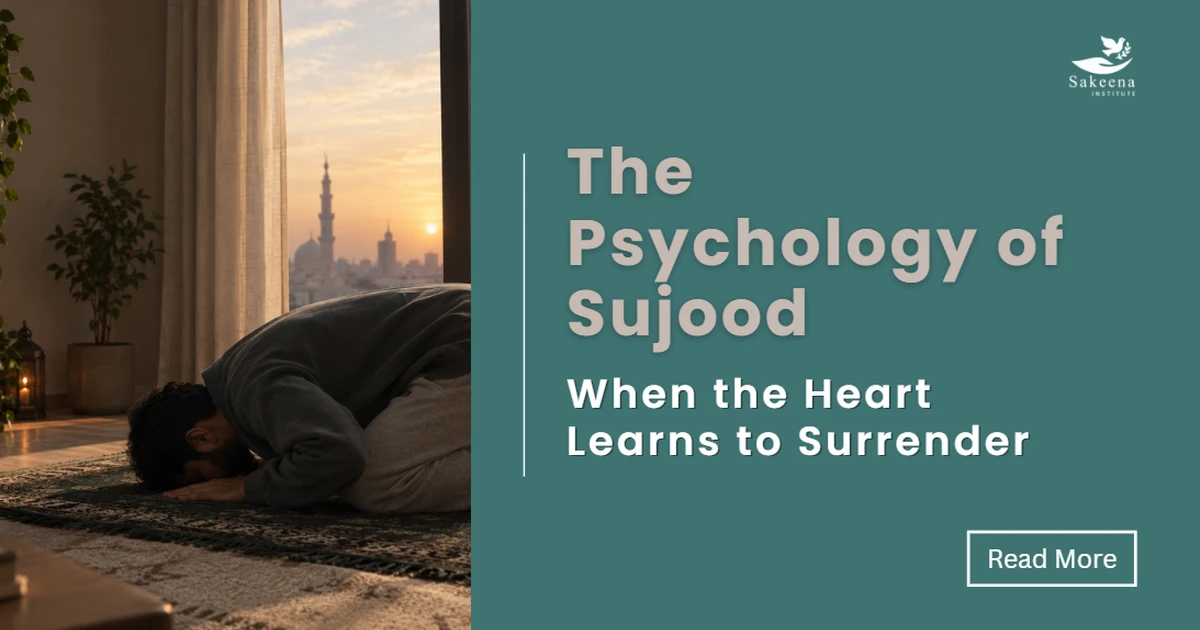
Sujood is one of the most profound places where this lesson becomes physical. The believer places the most honoured part of the body, the forehead, upon the ground before Allah. In that moment, the servant is not standing over his circumstances trying to master them. He is bowing before the One who already knows them completely. Allah says, “Prostrate and draw near.” (Qur’an 96:19). The physical act of lowering oneself becomes an expression of spiritual nearness, reminding us that closeness to Allah is not found through asserting our independence from Him, but through recognising our complete dependence upon Him.
This has an important connection to psychology because human beings are not minds separated from bodies. Our physical states and emotional experiences continually influence one another. Posture, breathing, movement, stillness, and bodily awareness can all affect how we experience ourselves internally. This does not mean that sujood should be reduced to a psychological exercise, because sujood is first and foremost an act of worship and submission to Allah. However, part of the wisdom of worship is that what transforms the soul can also have meaningful effects on the way we experience our emotional lives.
Consider what happens to the mind when we are overwhelmed. A single concern can become an entire chain of thoughts. We begin with one problem, then imagine another possibility, then another, until we are mentally living inside situations that have not even happened. At other times, the mind remains attached to something that has already passed, repeatedly returning to a conversation, a mistake, a loss, or a decision and wondering how things might have been different. The body may be sitting in one place, but the mind is somewhere else entirely.
Sujood interrupts this movement. It brings the servant back to the present moment and places him before Allah. The forehead touches the ground, the body becomes still, and the believer remembers who is actually in control. The problem may still exist when the prayer ends, but the believer has encountered it from a different position. Instead of carrying the entire burden as though everything depends upon him, he has placed it before the One whose knowledge encompasses what he cannot see.
The Prophet ﷺ said, “The closest that a servant is to his Lord is while he is prostrating, so increase supplication therein.” (Sahih Muslim, 482). This makes sujood a uniquely intimate moment of du‘a. It is a place where the believer does not need to hide the contents of his heart. He can bring his fear, sadness, confusion, gratitude, hopes, and deepest desires before Allah.
This is particularly meaningful when we consider how often people feel the need to appear as though they are coping. We may become accustomed to presenting ourselves as strong even when we are exhausted, reassuring others that everything is fine when internally we feel unsettled, or avoiding difficult emotions because acknowledging them can feel uncomfortable. But Allah does not need us to perform strength before Him. He already knows what is hidden within the heart.
The Qur’an repeatedly directs the believer toward Allah with his inner struggles rather than teaching him to deny them. Ya‘qub عليه السلام said, “I only complain of my suffering and my grief to Allah.” (Qur’an 12:86). His grief was real, but his grief had a direction. He did not deny what he felt, nor did he allow his pain to become disconnected from his relationship with Allah. Sujood gives the believer a regular opportunity to do something similar: to bring what hurts into the presence of the One who hears every whispered prayer.
This is where sujood becomes closely connected to tawakkul. Tawakkul does not mean abandoning effort or refusing to take practical steps. The believer still works, plans, seeks treatment, asks questions, repairs relationships, studies, earns a living, and takes the means available to him. But tawakkul means recognising that effort and outcome are not the same thing. We are responsible for what Allah has placed within our capacity, while the final result remains with Him.
That distinction can be deeply important for emotional wellbeing. Much of our distress comes from attempting to control what was never placed under our control in the first place. We cannot control another person's choices. We cannot guarantee a particular outcome. We cannot rewrite the past. We cannot know everything that Allah has concealed from us. We can make responsible choices, but we cannot command the future.
Sujood repeatedly teaches the heart to release this illusion of total control.
When the believer says “Subhana Rabbiyal-A‘la”, glorifying his Lord, the Most High, while his own forehead is upon the ground, he is reminded of his proper place before his Creator. His worth does not come from being superior to other people. His security does not come from controlling every circumstance. His identity does not depend entirely upon productivity, achievement, appearance, or recognition. Before all of these things, he is a servant of Allah.
This can offer an important corrective to a culture that often measures human value through performance. We are constantly encouraged to achieve more, improve more, accomplish more, and become more. There is nothing inherently wrong with growth or ambition, but when a person's entire sense of worth becomes dependent upon what he produces, success can become frightening and failure can become devastating.
Sujood reminds us of an identity that exists before every achievement: ‘Abdullah, the servant of Allah.
The servant does not become more worthy because he had a productive day, nor does he become worthless because he struggled. He does not become beloved to Allah because he managed to control every part of his life. He returns to Allah in ease and difficulty, strength and weakness, clarity and confusion.
And this return happens repeatedly.
Five daily prayers create a rhythm in which the believer repeatedly stops whatever he is doing and turns toward Allah. Within those prayers, sujood becomes one of the moments of greatest closeness. The person who began the day anxious can return at Dhuhr. The person who became frustrated during the afternoon can return at ‘Asr. The person carrying sadness into the evening can return at Maghrib. The circumstances may not have changed, but the heart has been given another opportunity to place them before Allah.
This repetition is significant. Deep patterns within us are rarely changed through one powerful moment alone. They are shaped through repeated practices, repeated choices, and repeated reminders. Every sujood can become another small lesson in surrender: I will do what is within my responsibility, and I will leave what is beyond my responsibility to Allah.
Sujood also teaches something that modern conversations about wellbeing can sometimes overlook: peace does not always come from getting everything we want. Sometimes peace comes from knowing who holds what we cannot have.
The believer may enter sujood asking Allah for something with all his heart. He may continue making that du‘a for months or even years. Yet while asking, he learns that Allah's wisdom is greater than his own understanding. He can desire an outcome without believing that his desired outcome is the only possible form of goodness. He can work toward something while remaining content that Allah knows what he does not know.
This is not passive resignation. It is active trust.
Perhaps this is why the command is not simply “Prostrate”, but “Prostrate and draw near.” The movement downward is not an ending. It is a movement toward Allah. The servant lowers himself physically, but his relationship with his Lord becomes stronger. He lets go of the illusion that he must carry everything alone and discovers that dependence upon Allah is not humiliation. It is the essence of servitude.
The next time you enter sujood, then, allow yourself to notice what you are carrying. Notice the thoughts that have been following you throughout the day, the outcome you are trying desperately to control, the emotion you have been avoiding, or the question you still cannot answer. Bring it before Allah. Make your du‘a. Cry if you need to. Remain there for a little longer.
You do not have to solve your entire life in that moment. You only have to remember who your Lord is.
“Prostrate and draw near.” (Qur’an 96:19)
Sometimes the heart finds relief not because every question has been answered, but because it has remembered where to place the questions.