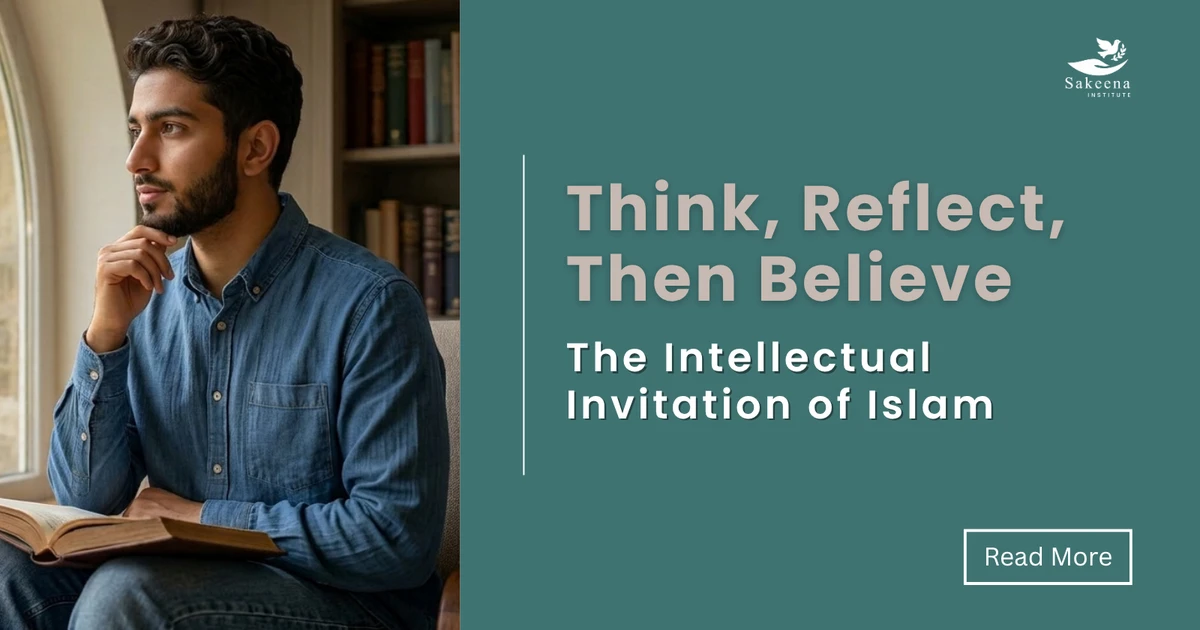

What if faith was never meant to be the opposite of thought?
We sometimes speak about belief as though it requires us to put our questions aside, silence our minds, and simply accept. As though the more deeply we believe, the less we should need to understand. Yet when we open the Qur’an, we encounter a very different picture. Revelation does not treat the human being as a creature who must stop thinking in order to believe. It repeatedly calls him to look, to listen, to observe, to remember, to consider, to reason, and to reflect. Again and again, the Qur’an turns our attention toward the world around us and the world within us, asking us not merely to exist inside creation, but to notice what creation is telling us.
“Then will you not reason?” (Qur’an 2:44)
“Then do they not reflect upon the Qur’an?” (Qur’an 47:24)
“And in yourselves, then will you not see?” (Qur’an 51:21)
There is something remarkable about these questions. Allah, who created the human intellect, does not ask us to abandon it at the door of faith. He addresses it directly. He challenges it. He awakens it. He asks us to use the very faculty through which we distinguish between truth and falsehood, meaning and meaninglessness, purpose and accident.
The Qur’an does not simply tell us to believe that the universe has a Creator. It repeatedly asks us to look at the universe itself. Look at the heavens. Look at the earth. Look at the alternation of night and day. Look at rain bringing dead land back to life. Look at the extraordinary reality of your own existence. Look at how life begins, develops, changes, and eventually returns to its Creator. The world around us is presented not merely as something beautiful to admire, but as something filled with ayat (signs).
Allah says, “Indeed, in the creation of the heavens and the earth and the alternation of the night and the day are signs for those of understanding.” (Qur’an 3:190).
The believer, then, is invited to become a person who knows how to read signs. A sunset is no longer merely a sunset. The order of creation is no longer simply an interesting fact. The human soul is no longer merely a collection of thoughts, emotions, desires, and memories. Everything begins to raise a deeper question: What does this tell me about the One who created it?
This is one of the most beautiful intellectual invitations of Islam. It does not ask us to stop at the surface of things. It teaches us to move from what we see to what it signifies. We see creation and ask about the Creator. We experience dependence and ask about the One upon whom everything depends. We discover that everything around us changes and ask why the human heart longs for something permanent. We encounter beauty, justice, love, consciousness, and meaning, and we begin to wonder why these things matter so deeply to us in the first place.
The Qur’an does not consider these questions meaningless distractions. It directs them toward Allah.
Even our own existence becomes an invitation to reflection. Allah says, “And in yourselves, then will you not see?” (Qur’an 51:21). How extraordinary that one of the places Allah directs us to look for His signs is ourselves. The human being can spend years studying the world and yet remain a mystery to himself. We carry within us an awareness that we exist, a longing to be loved, a fear of death, an instinctive desire for justice, a capacity for mercy, a conscience that can disturb our sleep, and a soul that can feel empty even after obtaining something it once desperately wanted.
Why are we like this? Why do we search for meaning? Why can a human being possess so much and still feel that something is missing?
Why does the heart continue searching even after it has reached the things it thought would finally satisfy it?
Islam does not answer these questions by telling us that the human being is simply a biological accident trying to manufacture meaning for himself. It tells us that we were created with purpose, that our hearts were created for their Lord, and that there is a reason our deepest longings cannot be permanently satisfied by the temporary things of this world.
This is where thinking becomes more than an intellectual exercise. In Islam, reflection is meant to change the person who reflects. The Qur’an uses the word tadabbur, a form of deep contemplation that moves beyond simply understanding the words to considering their implications and allowing them to reach the heart. Allah asks, “Then do they not reflect upon the Qur’an?” (Qur’an 4:82).
There is a difference between knowing what a verse says and allowing yourself to be confronted by what it says.
You can know that Allah is Ar-Razzaq, the Provider, and still spend your life terrified that you will never have enough. You can know that Allah is Al-Ghafur, the Forgiving, and still believe that your past makes you unworthy of returning to Him. You can know that Allah is Al-Hakim, the Wise, and still assume that every unanswered question must mean that something has gone wrong. Knowledge becomes transformative when we allow what we know about Allah to reshape the way we understand our lives.
This is why Islamic thinking is not merely about accumulating arguments. A person may possess an enormous amount of information and still remain unchanged. He may know the terminology, memorize the evidence, win arguments, and speak confidently, while his heart remains untouched by what he knows. The Qur’an calls us toward something deeper than intellectual accumulation. It wants knowledge to produce basirah, a kind of clear-sightedness through which a person begins to see reality differently.
And this intellectual journey requires humility.
Islam encourages us to think deeply, but it never teaches us that the human intellect is limitless. Allah says, “And mankind have not been given of knowledge except a little.” (Qur’an 17:85). There is freedom in acknowledging this. We do not need to understand everything in order to trust Allah. We do not need to have an answer to every mystery before we can believe that the One who created us is Wise. In fact, sincere reflection often produces the opposite of arrogance. The more we learn, the more we become aware of how much remains beyond us.
There is a profound difference between saying, “I refuse to believe what I cannot fully understand,” and saying, “I do not fully understand this, but I trust the One whose knowledge exceeds mine.” The first places the human intellect at the center of reality. The second recognizes its proper place. Islam does not ask us to abandon reason, but neither does it ask us to make our limited reason the ultimate measure of truth.
This balance is particularly beautiful because revelation itself repeatedly encourages us to ask questions while teaching us how to approach them. We are not encouraged to question merely for the pleasure of questioning, nor to turn doubt into an identity. We are encouraged to seek truth sincerely. There is a difference between a person who asks, “Show me the truth so that I may follow it,” and someone who asks only so that he can find another reason to reject it. The first is searching. The second may already have decided what he wants to believe.
Sincerity matters because the heart can interfere with the intellect just as easily as the intellect can illuminate the heart. A person may recognize something as true and still reject it because accepting it would require him to change. Iblis knew his Lord existed. His problem was not a lack of information. His problem was arrogance and refusal to submit. This reminds us that the greatest barrier between a person and truth is not always ignorance. Sometimes it is the unwillingness to surrender what the truth demands.
That is why the Qur’anic invitation to think is ultimately an invitation to become honest with ourselves.
What do I believe because I have genuinely considered it, and what do I believe simply because I inherited it? What do I reject because I have found it false, and what do I reject because accepting it would inconvenience me? When revelation challenges something I have become attached to, am I willing to reconsider? When Allah asks me to change, am I looking for truth or looking for an escape from it?
These questions are uncomfortable precisely because they bring thought into the realm of transformation. They do not allow us to remain spectators.
And perhaps this is what makes Islam's invitation to reflection so beautiful. It does not end with the mind reaching a conclusion. It continues with the heart responding to what the mind has recognized. We look at creation and recognize the Creator. We contemplate our dependence and recognize our need for Him. We reflect upon death and recognize that this life cannot be the whole story. We read revelation and recognize a call that reaches beyond information into surrender.
The journey therefore moves naturally from thinking to reflecting, from reflecting to recognizing, and from recognizing to believing.
Not because Islam is asking us to switch off our minds, but because it is asking us to use them fully.
Perhaps that is why the Qur’an repeatedly calls the people who reflect “ulul-albab”, people of understanding, people who possess a sound inner intellect. In describing them, Allah says that they remember Him while standing, sitting, and lying on their sides, and they contemplate the creation of the heavens and the earth, saying:
“Our Lord, You did not create this aimlessly; exalted are You.” (Qur’an 3:191)
Notice where reflection takes them. They look at creation and arrive at purpose. They think deeply and their thinking leads them to Allah. Their intellect does not make them less humble; it makes them more aware of the greatness of the One they are contemplating.
Perhaps this is the kind of thinking we have lost in a world overflowing with information. We are constantly consuming, scrolling, listening, watching, and receiving, yet receiving information is not the same as reflecting upon it. We can know thousands of things without allowing any of them to transform our understanding of life. The Qur’an calls us to something slower and deeper: to pause long enough for knowledge to become insight, and for insight to become a changed way of living.
Islam is therefore not a religion that asks you to believe instead of thinking. It is a religion that repeatedly asks you to think toward belief. Look carefully. Ask honestly. Reflect deeply. Examine yourself. Observe creation. Consider where you came from and where you are going. Allow your questions to be sincere, your search to be humble, and your heart to remain open to the possibility that the truth may ask something of you.
Because the destination of this journey is not simply becoming intellectually convinced that God exists. It is something far more intimate: coming to recognize Allah, to know Him, to trust Him, and ultimately to worship Him.
The mind begins by asking, “Why am I here?” The heart eventually discovers that the answer was never merely a concept. It was a meeting with its Creator.
And perhaps that is the intellectual invitation of Islam at its deepest level: not to stop thinking when you believe, but to keep thinking until what you believe becomes something you see, something you understand, something you live, and something that brings your heart closer to Allah.