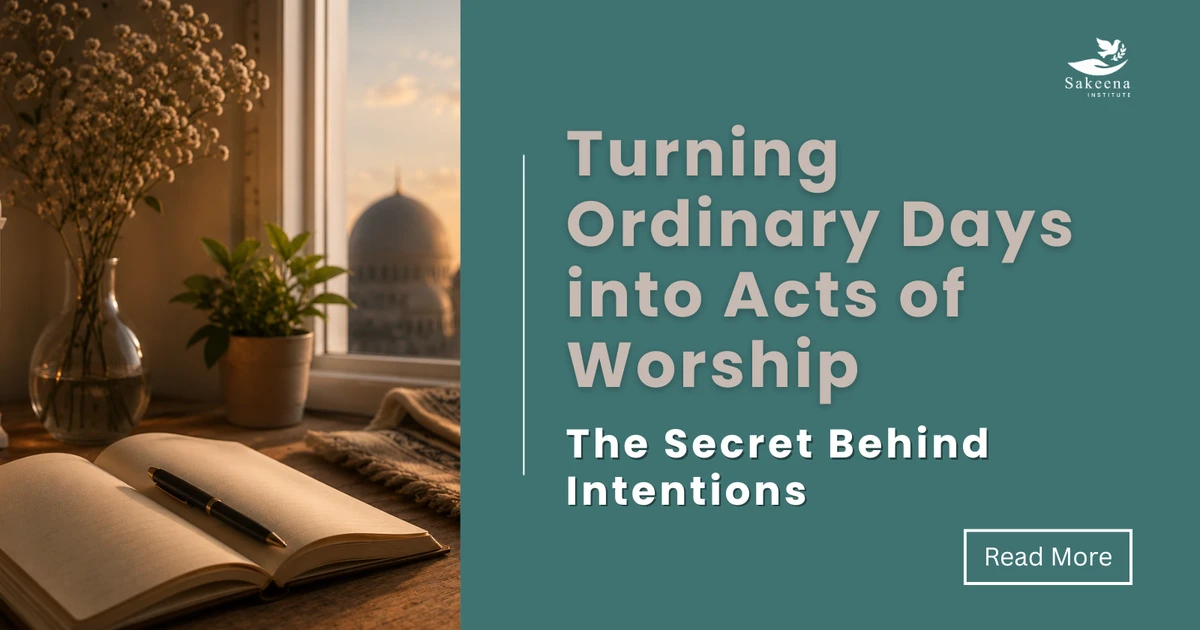

You’d be surprised how creative you can get with your intentions. Pouring someone a cup of water, when done for the sake of Allah, grants you good deeds and paradise.
Something as simple as placing intentions when you sleep, or cook, or exercise, changes your whole day from being mundane to being full of worship and getting closer to Allah.
Being aware of your intentions and how this specific act can increase your faith changes your viewpoint and perspective on life.
Take exercising for example. A muslim would not exercise for the sake of exercising. Not at all. A muslim places intentions and makes that specific workout for Allah, through taking care of their body and strengthening their muscles so worship and being of service to others is easier.
This makes Muslims live a purposeful life full of so much light and faith and conviction that every deed they do is not gone to waste in the sight of Allah.
And purpose is something many people are missing in this day and age. Everyone seems to be walking around with absolutely no purpose they get to live for.
Purpose has become one of the greatest struggles of modern life. People wake up, rush through work, scroll endlessly, sleep, and repeat the cycle the next day. There is a constant feeling that something is missing, even when life appears full from the outside. We are more connected than ever, yet many people quietly carry a deep sense of emptiness. They ask themselves, What am I actually living for?
Islam answers that question in a way that is both profound and practical. It does not reserve purpose for extraordinary moments. It does not tell you that your life only matters when you achieve something impressive, become famous, or change the world. Instead, Allah gives you the ability to transform ordinary moments into extraordinary ones simply through what is in your heart.
The Prophet ﷺ said:
إِنَّمَا الْأَعْمَالُ بِالنِّيَّاتِ، وَإِنَّمَا لِكُلِّ امْرِئٍ مَا نَوَى
"Actions are judged by intentions, and every person will have what they intended." (Authentic: Sahih al-Bukhari and Sahih Muslim)
This hadith completely changes the way you look at your day. Suddenly, your life is no longer divided into "religious" moments and "worldly" moments. Everything has the potential to become worship.
Going to work becomes worship when you intend to earn a halal income that allows you to provide for yourself or your family without depending on others. Studying becomes worship when you seek knowledge that will benefit people. Cooking dinner becomes worship when you prepare food to nourish those Allah has entrusted to your care. Even resting becomes worship when you sleep with the intention of waking up stronger for Fajr or having more energy to worship Allah and serve His creation.
Nothing has physically changed. The same tasks remain exactly as they were. Yet spiritually, they become completely different.
This is one of the most beautiful gifts Allah has given this ummah. He did not make worship something limited to the mosque or the prayer mat. He made the entire earth a place where His servants can earn reward.
Think about how merciful that is.
Allah knows we cannot spend every hour praying or reading Quran. We have responsibilities. We have jobs, studies, families, errands, chores, and moments where we simply need to rest. Rather than separating those moments from our relationship with Him, Allah allows them to become part of it.
Every single day becomes an opportunity. Every ordinary moment becomes an invitation. Even the things you already have to do become ways of drawing closer to Him.
Psychologically, this changes something deep within us.
One of the biggest causes of burnout today is feeling that our efforts disappear into nothing. We spend hours cleaning the house only for it to become messy again. We answer emails that are forgotten tomorrow. We complete projects that are quickly replaced by new ones. We invest energy into things that often feel temporary.
Over time, this can make life feel repetitive and meaningless.
But the believer carries a different perspective.
They know that Allah sees every effort. Every difficult morning. Every act of patience. Every smile they force when they feel exhausted. Every meal they prepare. Every kilometer they drive. Every kind word they choose instead of an angry one.
None of it disappears. Even if no human being notices it, Allah does.
That awareness creates a kind of peace that is difficult to describe. You stop measuring your life only by visible results because you know that the greatest reward is often the one you cannot yet see.
Imagine two people doing exactly the same task. They both wake up at six in the morning and both commute through traffic. They both work eight hours and return home tired.
Outwardly, their days look almost identical. But inwardly, they are worlds apart.
One feels like they are simply surviving another day.
The other begins the morning by saying, "O Allah, I am doing this to earn halal provision, to avoid what You have forbidden, to support those I love, and to become someone who benefits Your creation." The work itself may be the same. But one day feels empty, whilst the other becomes an act of worship.
This is the power of intention.
Intentions also remind us that success is not only measured by outcomes.
Sometimes you intend something beautiful, but circumstances prevent it from happening.
You wanted to visit someone who was sick, but you became ill yourself. You planned to give charity but unexpectedly faced financial difficulty. You hoped to pray extra at night but your body genuinely needed rest.
Allah, in His mercy, knows what was in your heart before He looks at what your hands managed to do. He rewards sincerity even when circumstances change. This teaches us that Allah is not looking for perfection. He is looking at the heart that continues trying to return to Him.
Perhaps this is why intention is such a powerful form of worship. No one can truly see it except Allah. People can watch you pray, fast, or give charity. But only Allah knows why you did it.
Only He knows the conversations happening inside your heart.
That private relationship between you and your Creator is something no one can take away from you.
It also protects us from constantly seeking validation from people. When your intention is for Allah, praise becomes less intoxicating and criticism becomes less crushing. You are no longer living for applause because your audience has always been One.
Perhaps that is one of the greatest differences between a life lived for Allah and a life lived only for this world. Nothing is wasted.
Not your tears, exhaustion, sacrifices, or unseen acts of kindness. Not even the good you intended but never managed to complete.
Allah records it all with perfect justice and infinite mercy.
The next time you wake up, pause for just a few seconds before your feet touch the floor. Renew your intention for the day ahead.
Tell Allah that every meeting, every task, every workout, every meal, every conversation, every challenge, and every moment of patience is for Him.
You may not notice the difference immediately.
Your schedule will probably stay the same. Your responsibilities will still be there. Your chores will still need to be done. But your heart will begin to change because the ordinary will start to feel sacred and any repetition will start becoming meaningful.
And the life that once felt like a collection of random tasks will slowly reveal itself for what it truly is: countless opportunities to draw closer to the One who sees every intention, rewards every sincere effort, and never allows even the smallest good deed to go to waste.