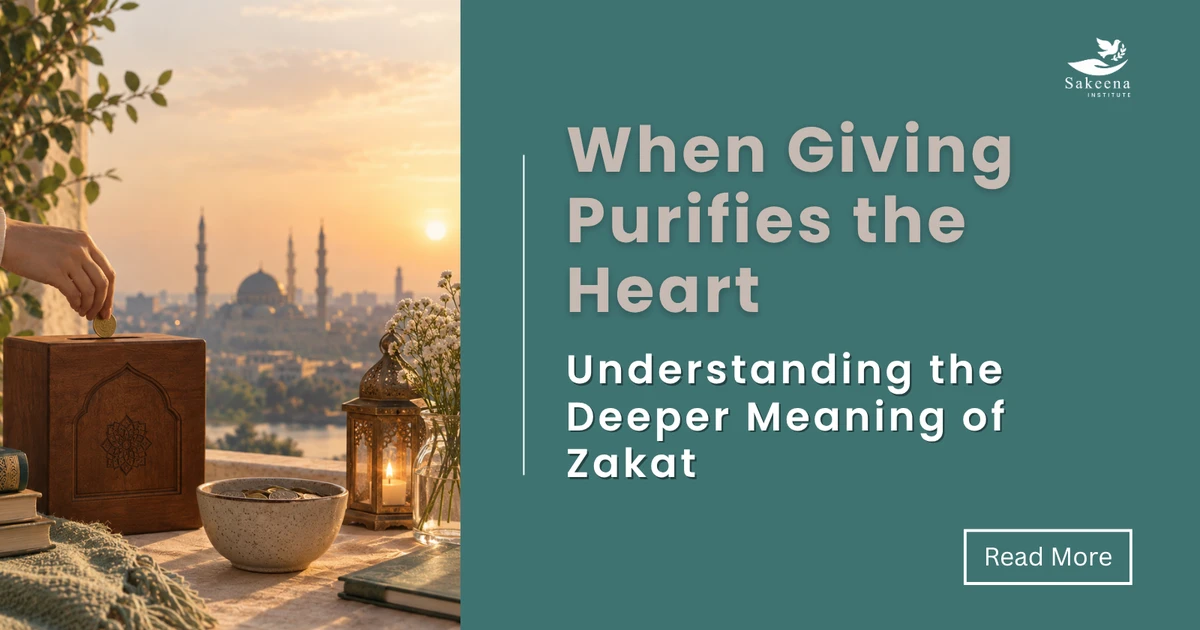

We often think of wealth as something that belongs entirely to us. We work for it, save it, organise it, protect it, and make plans around it. Over time, it can quietly become intertwined with our sense of security. We may tell ourselves that having more will make us feel safer, that saving enough will finally allow us to rest, or that holding tightly to what we have will protect us from an uncertain future. Yet Islam invites us to look at wealth differently. Wealth is not simply something we possess; it is an amanah, a trust from Allah, and one of the ways we are tested in this life. Among the most beautiful expressions of this understanding is Zakat, an act of worship that purifies wealth, disciplines the heart, and reminds us that what Allah has given us was never meant to become the centre of our lives.
Allah says, “Take, [O Muhammad], from their wealth a charity by which you purify them and purify them.” (Qur’an 9:103). The wording of this verse reveals something profound about Zakat. Allah does not describe giving only as a financial transaction. He connects it to purification. The wealth is purified, but so is the person giving it. There is something within the human heart that can become attached to what it owns, and Zakat gently loosens that attachment. It teaches us that we can possess something without allowing it to possess us.
This is one of the reasons Zakat occupies such an important position in Islam. It is one of the Five Pillars, mentioned repeatedly alongside prayer in the Qur’an. Prayer turns the servant towards Allah through worship, while Zakat teaches the servant how to relate to what Allah has placed in their hands. One concerns the heart standing before its Creator, and the other concerns the heart standing before the world and the people within it. Together, they teach us that our relationship with Allah cannot be separated from the way we use what He has entrusted to us.
Zakat also challenges one of the deepest instincts of the human being: the instinct to hold on. We naturally want to preserve what we have, particularly when we are afraid that we may not have enough in the future. Sometimes the difficulty of giving is not really about the amount itself. It is about what that amount represents. Money can represent safety, independence, comfort, future plans, or protection from uncertainty. When Allah asks us to give a portion of our wealth, we are being taught to place our ultimate security somewhere beyond the wealth itself.
This does not mean that Islam asks us to reject wealth or feel guilty for having it. Islam does not condemn prosperity, nor does it ask a person to neglect their responsibilities in the name of generosity. Rather, it teaches us to put wealth in its proper place. The believer may own wealth, build a home, provide for their family, save for the future, and enjoy the blessings Allah has given them, while still remembering that none of these things are the source of their ultimate provision. Allah is.
This distinction is deeply important for our emotional and spiritual wellbeing. When we begin to believe that our security depends entirely upon what we can accumulate, the heart can become trapped in an endless cycle of fear. There is always another amount to reach, another expense to prepare for, another possibility to protect ourselves against. Even abundance can begin to feel like scarcity when the heart is constantly afraid of losing it. Zakat interrupts this cycle by reminding us, through a tangible act of worship, that provision does not come from our ability to control everything. It comes from Allah.
Allah says, “And whatever thing you spend [in His cause] – He will compensate it; and He is the best of providers.” (Qur’an 34:39). This does not mean that every amount we give will return to us in the same form or at the same time. Rather, it teaches us to trust the One from whom all provision ultimately comes. Giving becomes an act of tawakkul. We release something from our hands while believing that our sustenance remains with Allah.
There is also something deeply human about Zakat because it draws our attention beyond ourselves. Wealth can easily narrow our world. We begin thinking about our own needs, our own plans, our own family, and our own future. Zakat opens that circle. It reminds us that the community around us contains people whose circumstances may be completely different from our own. Someone may be carrying debts that nobody sees. Someone may be struggling to provide food for their family. Someone may have lost their income, become displaced, or simply be living with a financial difficulty that they are too dignified to announce.
The Qur’an therefore establishes specific categories of people who are entitled to Zakat, including the poor, the needy, those in debt, and others specified in Qur’an 9:60. This is not charity based merely on emotion or impulse. It is a structured system of responsibility within the Muslim community. Zakat teaches us that the wellbeing of others is not irrelevant to us simply because their circumstances are different from ours.
Perhaps this is why Zakat can transform the way we see both wealth and people. Instead of asking only, “How much do I have?” we begin asking, “What has Allah entrusted me with, and how can I fulfil the right that others have upon it?” Instead of seeing our possessions exclusively as things to consume, we begin seeing them as opportunities to worship. A portion of our wealth can become food for someone who is hungry, relief for someone overwhelmed by debt, or dignity restored to someone who has been struggling quietly.
There is a beautiful balance here. Zakat does not merely teach the wealthy to give to the poor; it teaches every believer that whatever they have is ultimately from Allah. The person giving Zakat is not doing the recipient a favour in the way the ego may sometimes imagine. They are fulfilling an obligation that Allah placed upon their wealth. The recipient is not simply receiving from another human being; they are receiving a right that Allah has legislated for them.
This understanding protects generosity from becoming a source of pride. When we give, the heart can sometimes secretly begin to admire itself for being generous. We may remember how much we gave, who benefited from it, or how much better off someone became because of us. But Zakat calls us back to sincerity. Allah gave us the wealth in the first place. He commanded us to give from it. He gave us the ability to fulfil that command. Even the opportunity to give is itself a blessing.
This is why Zakat is ultimately about more than money. It is about the heart's relationship with possession, security, gratitude, responsibility, and trust. It teaches us that abundance is not measured only by how much we can keep. Sometimes abundance is found in the ability to give without feeling that giving has made us poorer. Sometimes freedom is not found in accumulating more, but in becoming less emotionally dependent upon what we accumulate.
And perhaps this is one of the greatest gifts of Zakat: it teaches the heart that it can let go.
We live in a world that constantly tells us to acquire, protect, upgrade, save, and accumulate. Islam does not ask us to abandon responsible financial planning, but it reminds us that there is a danger in allowing accumulation to become the purpose of our lives. Zakat places a boundary around that attachment. It says, in essence, that your wealth is yours to use, but it is not yours to worship. Your possessions can serve you, but they must never become your master.
When we give Zakat, we are therefore doing something much deeper than transferring a portion of our wealth. We are practising gratitude. We are strengthening our trust in Allah. We are fulfilling an obligation. We are caring for the vulnerable. We are resisting the tendency of the heart to cling. We are reminding ourselves that what is in our hands today could be gone tomorrow, while what we spend for Allah is never truly lost.
The Prophet ﷺ said, “Charity does not decrease wealth.” (Sahih Muslim 2588). This hadith captures a reality that the heart often needs to relearn. From a purely worldly perspective, giving appears to mean having less. Yet revelation teaches us to see beyond the immediate calculation. Wealth is not diminished simply because a portion leaves our hands. What matters is what that wealth becomes when it is spent for the sake of Allah.
May Allah make us among those who are grateful for what they have, generous with what they are given, and humble before the One who gave it. May He purify our wealth and purify our hearts, protect us from becoming attached to what was only ever entrusted to us, and allow what passes through our hands to become a means of mercy for others and a source of reward for us. And may we always remember that the greatest security is not found in how much we manage to keep, but in knowing that whatever we entrust to Allah is never wasted.