
Back to Courses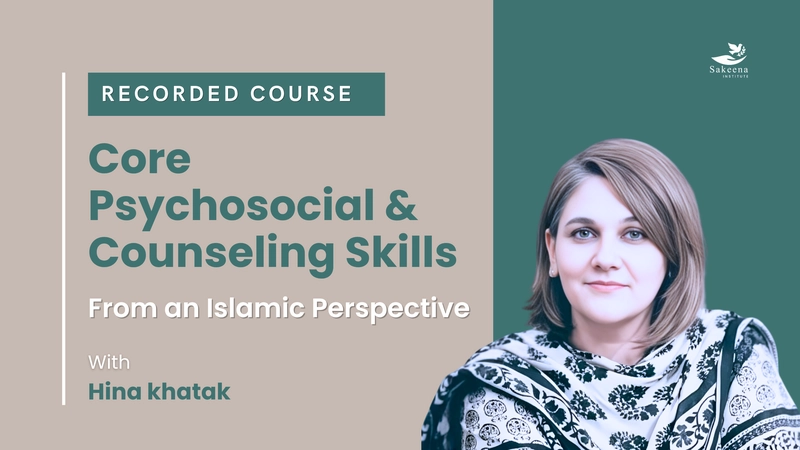
Unlock Your
Apply nowJoin Community Chat
Core Psychosocial & Counseling Skills from an Islamic Perspective
Included in your membership
Course Curriculum
16 lessons • 4 weeks
Module 1
2 lessons • 0 min
Module 1
2 lessons • 0 min
Foundations – Niyyah and the Role of the Helper - Recording
PDF
Foundations – Niyyah and the Role of the Helper - PPT
Module 2
2 lessons • 0 min
Module 2
2 lessons • 0 min
Building Trust – Emotional Safety & Amanah -Recording
PDF
Building Trust – Emotional Safety & Amanah - PPT
Module 3
2 lessons • 0 min
Module 3
2 lessons • 0 min
Active Listening (Husn al-Istima‘) - Recording
PDF
Active Listening (Husn al-Istima‘) - PPT
Module 4
2 lessons • 0 min
Module 4
2 lessons • 0 min
Empathy & Emotional Validation (Rahmah) - Recording
PDF
Empathy & Emotional Validation (Rahmah) - PPT
Module 5
2 lessons • 0 min
Module 5
2 lessons • 0 min
Emotional Regulation & Sabr -Recording
PDF
Emotional Regulation & Sabr - PPT
Module 6
2 lessons • 0 min
Module 6
2 lessons • 0 min
Instilling Hope – Raja’ & Meaning-Making : Recording
PDF
Instilling Hope – Raja’ & Meaning-Making : PPT
Module 7
2 lessons • 0 min
Module 7
2 lessons • 0 min
Guidance with Wisdom – Naseeha & Boundaries : Recording
PDF
Guidance with Wisdom – Naseeha & Boundaries : PPT
Module 8
2 lessons • 0 min
Module 8
2 lessons • 0 min
Self-Awareness & Tazkiyah of the Helper : Recording
PDF
Self-Awareness & Tazkiyah of the Helper : PPT
Core Psychosocial & Counseling Skills from an Islamic Perspective course begins live on Zoom on May 04, 2026, with lifetime access to all recorded sessions after each class.
Course Description
This course provides a focused introduction to essential counseling and psychosocial skills grounded in both contemporary psychology and Islamic teachings. Across eight lectures, participants will develop practical helping skills while exploring their roots in the Qur'an and Sunnah. Emphasis is placed on application, ethical awareness, and spiritual depth in helping relationships.
Course Objectives
- Apply foundational counseling skills in real-life interactions
- Demonstrate active listening, empathy, and emotional validation
- Integrate Islamic values into psychosocial support
- Maintain ethical boundaries in helping roles
- Develop self-awareness as a helper
Course Outline (8 Lectures)
Lecture 1: Foundations – Niyyah and the Role of the Helper
Core Skill: Intentional and ethical presence
- Understanding the role of a helper in Islam and psychology
- Niyyah (intention) as the foundation of helping
- Iḥsān as quality of presence
- Practice: Setting intention and role clarity
Lecture 2: Building Trust – Emotional Safety & Amanah
Core Skill: Creating a safe relational space
- Psychological safety and trust
- Amanah (trust) and confidentiality
- Non-judgmental presence
- What breaks trust (e.g., shame, dismissal)
- Practice: Safe language
Lecture 3: Active Listening (Ḥusn al-Istimāʿ)
Core Skill: Deep listening and presence
- Hearing vs. listening
- Reflective listening skills
- Avoiding interruption and premature advice
- Listening as an act of worship
- Practice: Paraphrasing and reflecting feelings
Lecture 4: Empathy & Emotional Validation (Raḥmah)
Core Skill: Understanding and validating emotions
- Emotional validation as a core counseling skill
- Raḥmah in human interactions
- Validating feelings without endorsing harmful actions
- Practice: Naming and validating emotions
Lecture 5: Emotional Regulation & Ṣabr
Core Skill: Managing emotions (self & others)
- Emotional regulation vs. suppression
- Ṣabr as active emotional control
- Responding vs. reacting
- Supporting others in distress
- Practice: Grounding techniques (breathing, dhikr)
Lecture 6: Instilling Hope – Rajāʾ & Meaning-Making
Core Skill: Building hope and resilience
- The psychology of hope
- Rajāʾ (hope in Allah) and avoiding despair
- Meaning-making in hardship
- Avoiding toxic positivity
- Practice: Reframing with balance
Lecture 7: Guidance with Wisdom – Naṣīḥah & Boundaries
Core Skill: Ethical advising and limit-setting
- When to advise vs. when to listen
- Ādāb of naṣīḥah
- Boundaries in helping relationships
- Recognizing limits and referring
- Practice: Giving advice appropriately
Lecture 8: Self-Awareness & Tazkiyah of the Helper
Core Skill: Reflective and ethical self-development
- Self-awareness in counseling
- Personal bias and reactions
- Tazkiyah as ongoing inner work
- Avoiding burnout and over-identification
- Practice: Reflective journaling and self-check-ins
Optional Add-On (if extended)
Integrate the session with case studies
Teaching Approach
- Short lectures + practical exercises
- Real-life scenarios
- Reflection questions each session
- Qur'an & Sunnah integration throughout
Suggested Flow Per Lecture
- Concept explanation (psychology)
- Islamic grounding (Qur'an & Sunnah)
- Real-life examples
- Skill demonstration
- Practice activity
Student Reviews
N/A(0 reviews)
No reviews yet. Be the first to write one.
Unlock Your
Professional Certificate
Complete all course modules to earn your verified certificate and showcase your achievement.
Sign in to apply for this scholarship
Create a free account or log in to submit your application for Core Psychosocial & Counseling Skills from an Islamic Perspective.
Recorded
Core Psychosocial & Counseling Skills from an Islamic Perspective
$40.00One-time payment
Included in your membership
You have access to this course
Go to courseCommunity Chat
Active nowA space to ask questions, share reflections, and connect with others going through the same course alongside your instructor.
Community Chat
Course Details
- Level
- beginner
- Duration
- 8.00 hours (4 weeks)
- Hours per Session
- 1.00 hrs
- Lessons
- 16
- Modules
- 8
- Category
- Islamic Psychology
- Status
- Recorded
Instructor
Hina Khatak
Faith-Based Coach · background in Clinical Psychology
Hina Khatak is a clinical psychologist certified in ACCTS, CCTS-I, and EMDR. She specializes in trauma, mood disorders, and developmental challenges, using evidence-based methods alongside faith-based healing. She's also a Training of Trainers facilitator, conducting workshops on mental health and personal development. Her work helps clients build resilience and navigate difficult experiences with practical tools and compassionate support. Awards & Recognition • Certified ACCTS, CCTS-I, and EMDR Practitioner • Training of Trainers (TOT) facilitator • Expert in trauma therapy and mood disorders
Related Courses
islamic psychology
Mental Health & Wellbeing from a Psychological and Islamic Perspective
by Diveena Nair
$40.00recorded