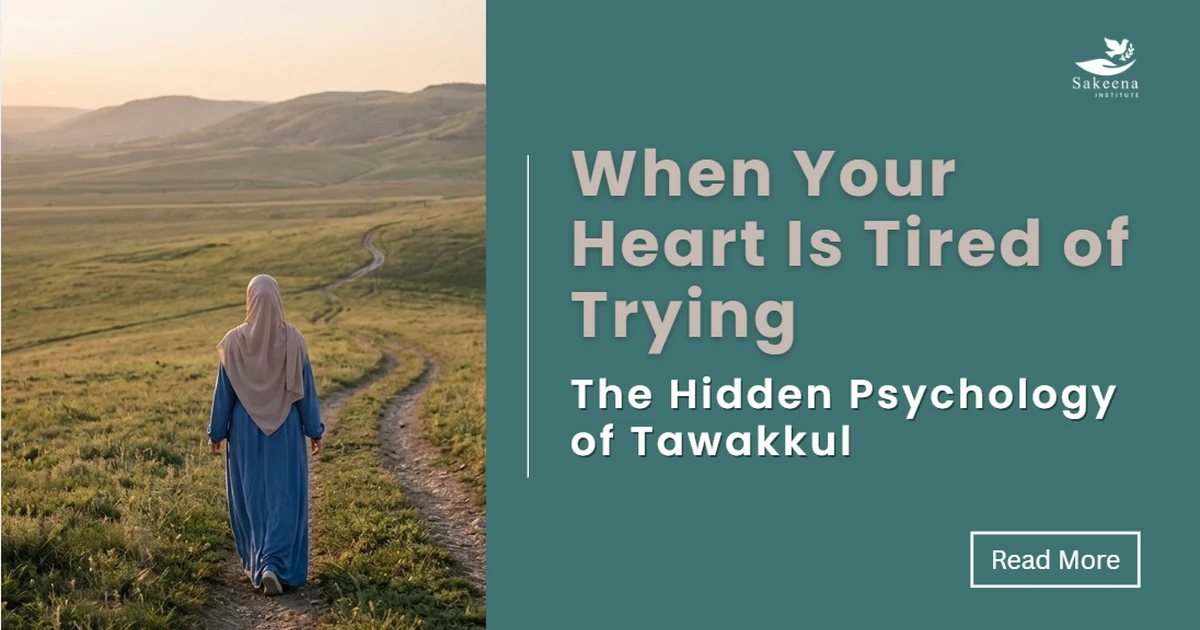

There is a kind of exhaustion that does not necessarily come from having too much to do. Sometimes, the body has rested, the responsibilities are manageable, and yet the heart still feels completely drained. It is the exhaustion that comes from constantly trying to make things happen, trying to anticipate what could go wrong, trying to make the right decision, trying to understand what other people are thinking, and trying to secure a future that has not yet arrived. You may find yourself replaying conversations, researching every possibility, planning for every outcome, or repeatedly asking yourself whether you have done enough. Beneath all of this effort, there is often a deeper desire: the desire to feel certain that everything will be okay.
This is where tawakkul offers something much deeper than the simple instruction to “trust Allah.” Tawakkul is not about becoming careless, passive, or indifferent to what happens in your life. It is about learning how to distinguish between what Allah has entrusted to you and what He has reserved for Himself. You are responsible for your choices, your effort, your intentions, and the means that are available to you, but you were never asked to control the consequences of those efforts. Allah says, “And whoever relies upon Allah, then He is sufficient for him” (Qur’an 65:3). The verse does not promise that the person who relies upon Allah will never experience disappointment, uncertainty, loss, or difficulty. Rather, it reminds us that even when the outcome is beyond our understanding, the believer is never without Allah’s care and sufficiency.
One of the reasons anxiety can become so exhausting is that the human mind often tries to create safety by creating control. When something matters deeply to us, we naturally want to know what will happen and how we can prevent anything from going wrong. We may think through every possible scenario because we believe that if we think about something enough, we can somehow protect ourselves from it. We revisit decisions because we wonder whether there was a better choice, and we replay conversations because perhaps there was something we could have said differently. While planning and reflection can be beneficial, they become exhausting when we begin carrying responsibility for things that were never within our control in the first place.
Islam gives us a beautiful boundary between effort and control. Allah does not ask us to abandon the means available to us; He asks us to use them while recognizing that the result belongs to Him. This is why the Qur’an says, “And consult them in the matter. Then when you have decided, put your trust in Allah” (Qur’an 3:159). There is consultation, thought, and decision-making before tawakkul. The believer does not sit back and call inaction “trust.” Instead, they make the best decision they can with the knowledge they have, take the appropriate means, and then entrust the outcome to Allah.
The Prophet ﷺ illustrated this meaning beautifully when a man asked him whether he should leave his camel untied and rely upon Allah. The Prophet ﷺ told him, “Tie it and rely upon Allah” (Jami‘ al-Tirmidhi). The instruction contains a profound balance. Tying the camel represents taking responsibility and using the means available to you, while relying upon Allah represents recognizing that even after you have done everything you reasonably can, the final outcome is still not yours to command. You can lock the door, but you cannot guarantee that nothing unexpected will ever happen. You can prepare carefully for an exam, but you cannot guarantee the exact result. You can communicate sincerely with someone, but you cannot control how they will respond. You can work diligently, but you cannot force provision to arrive according to your preferred timeline. Your responsibility is to tie the camel; what happens afterward belongs to Allah.
This distinction becomes particularly important when effort quietly turns into an attempt to control destiny. There is a difference between saying, “I will do everything I reasonably can and then trust Allah with the result,” and feeling, “I have to do enough to guarantee that nothing goes wrong.” The first is responsibility; the second is a burden no human being was created to carry. Sometimes what looks like excessive responsibility is actually fear wearing the clothing of productivity. We convince ourselves that if we think harder, plan more carefully, ask more people, or analyze the situation one more time, we will finally reach the certainty we are looking for. Yet some forms of uncertainty cannot be solved by more thinking because they belong to the unseen, and the unseen belongs to Allah.
Allah reminds us, “And no soul perceives what it will earn tomorrow” (Qur’an 31:34). There is something deeply comforting about this verse because Allah is not telling us that we simply need to try harder until we become capable of knowing tomorrow. He is reminding us that tomorrow was never placed within our knowledge. We are not deficient because we cannot see what is coming. We are human. Allah knows what we do not know, and part of our servitude to Him is accepting the limits He has placed upon our knowledge.
This does not mean that a person with tawakkul never worries. It is easy to imagine that genuine reliance upon Allah should make a believer completely calm at all times, but the lives of the Prophets show us otherwise. Ya‘qub عليه السلام experienced profound grief over the loss of Yusuf عليه السلام, and Ayyub عليه السلام endured tremendous suffering. The Prophet ﷺ himself experienced grief, rejection, loss, and uncertainty. Tawakkul therefore should not be understood as the absence of difficult emotions. Rather, it is the way we carry those emotions. A person can feel afraid while turning to Allah, feel disappointed while remaining hopeful in Allah, and experience uncertainty while knowing that Allah’s knowledge encompasses what they cannot see.
This is also why tawakkul changes the way we understand disappointment. Without tawakkul, an unwanted outcome can easily become a judgment about ourselves or even about Allah’s care for us. If something does not work out, we may immediately conclude that we made the wrong decision, that we were not good enough, or that perhaps Allah has abandoned us. But when a person understands that their responsibility lies in sincere effort rather than controlling the outcome, disappointment does not have to become a verdict on their worth. They can acknowledge that something hurts while still believing that Allah’s wisdom is greater than their understanding. They can look honestly at what happened, learn from their mistakes if there were mistakes, make changes where necessary, and then continue moving forward without endlessly punishing themselves for an outcome they could never completely control.
This understanding is especially important when we make du‘a for something we deeply desire. Sometimes we unintentionally attach our tawakkul to a specific answer. We tell ourselves that we trust Allah because we believe He will give us exactly what we have asked for, in exactly the way we have imagined it. But that is not the deepest form of reliance. True tawakkul means trusting Allah even when we do not know what He will choose. We can desperately want something and still leave its outcome to Him. We can ask Allah repeatedly for a particular blessing while knowing that His knowledge of what is good for us is greater than our own. The believer does not have to choose between making a heartfelt request and surrendering to Allah’s decree. Both can exist together.
In fact, there is something beautiful about continuing to make du‘a without demanding that Allah answer it according to our timetable. We ask because Allah loves that we ask, because He is the One who possesses what we need, and because turning to Him is itself an act of worship. At the same time, we allow Him to determine the form, timing, and consequences of His response. This protects the heart from making an idol out of an outcome. We want the blessing, but we want Allah’s choice more. We hope for what we are asking for, but we know that the One who created us understands our lives in a way that we never could.
This is where tawakkul becomes deeply relevant to our psychological well-being. A mind that believes it must constantly anticipate every possible problem remains trapped in a cycle of vigilance. It keeps scanning, calculating, replaying, and searching for certainty. Tawakkul gives the heart another place to direct that energy. Instead of asking endlessly, “How can I make sure this turns out the way I want?” the believer begins asking, “What is Allah asking me to do with what I have been given today?” That question brings the heart back from an uncontrollable future into the responsibility of the present.
Perhaps you have already done everything that is reasonably within your ability, yet you are still mentally carrying the situation as though thinking about it one hundred more times will change the outcome. This is where you can gently remind yourself that continuing to worry is not the same as continuing to care. You can care deeply without constantly carrying something in your mind. You can make your decision without reopening it every night. You can prepare without assuming responsibility for every possible consequence. You can make du‘a without searching for constant signs that the answer is coming. At some point, worship means allowing yourself to stop holding what Allah never asked you to hold.
Tawakkul, then, is not the promise that everything will happen according to your plan. It is something much more profound: the certainty that whatever happens is already known to Allah, that He is never unaware of your circumstances, and that your responsibility is not to control your entire life but to walk through it as His servant. You take the means because Islam teaches you to act responsibly, you make du‘a because Allah has invited you to call upon Him, and you strive because your effort matters. But once you have done what you can, you do not need to become exhausted trying to do what only Allah can do.
Perhaps the peace we are searching for does not come from finally knowing how everything will turn out. Perhaps it comes from accepting that we were never meant to know. Allah knows what tomorrow contains, what every decision will lead to, what every closed door is protecting us from, what every delay is preparing us for, and what every unanswered question will eventually mean. Our task is not to possess that knowledge. Our task is to trust the One who does.
Allah says, “And whoever relies upon Allah, then He is sufficient for him” (Qur’an 65:3). Tawakkul is learning to live with the unanswered questions while knowing that the One who holds their answers also holds you. It is taking the means without worshipping the means, making plans without believing that plans control destiny, and pursuing what you love without believing that your happiness depends upon getting exactly what you want. It is the gradual realization that you can stop fighting for control over what was never yours and instead place your trust in the One to whom it always belonged.