
There are moments in life when loneliness feels particularly heavy. It is not necessarily the absence of people around us, but the feeling that we are carrying something nobody else can fully understand. Sometimes it is a fear we cannot express, a hardship we cannot share, or an emotional burden that seems too personal for anyone else to carry with us.
The Qur’an introduces us to women who experienced precisely these kinds of moments. Women who, despite their extraordinary faith and closeness to Allah, experienced fear, desperation, uncertainty and profound emotional pain.
Maryam عليه السلام was alone during her labour pains. Hajar عليها السلام was alone when she desperately searched for water for her infant son. Asiya عليها السلام was alone in her private faith while living in the household of Pharaoh. And the mother of Musa عليه السلام experienced the anguish of a mother separated from her baby, unsure of what would happen to him.
Their stories are remarkably different, but they share a beautiful reminder: being alone does not mean being abandoned by Allah.
Maryam: Alone During Her Labour Pains
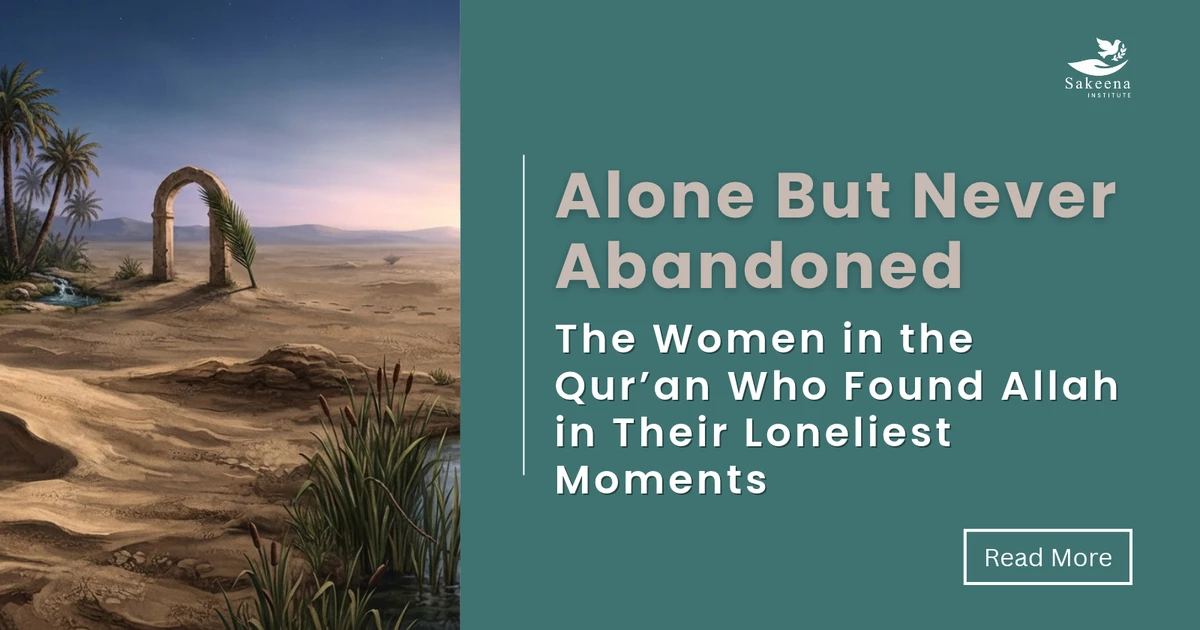
Perhaps one of the most moving moments in the Qur’an is the story of Maryam عليها السلام when she withdrew from her people and eventually found herself facing childbirth alone.
Maryam was a woman whom Allah had chosen and purified. She was given the extraordinary miracle of carrying Isa عليه السلام without a husband, yet this blessing came with an incredibly difficult human experience. She knew that people would question her, misunderstand her and struggle to comprehend what had happened.
When the pains of childbirth came upon her, she withdrew to the trunk of a palm tree. In that moment of physical pain and emotional distress, she uttered words that reveal just how overwhelmed she had become:
يَا لَيْتَنِي مِتُّ قَبْلَ هَٰذَا وَكُنتُ نَسْيًا مَّنسِيًّا
"Oh, I wish I had died before this and was in oblivion, forgotten." (Qur'an 19:23)
It is remarkable that Allah chose to preserve these words in the Qur’an. Maryam was among the most righteous women to have ever lived, yet she experienced a moment of such overwhelming distress that she wished she could disappear.
Her story teaches us something important about faith: experiencing emotional pain does not make someone less righteous. Feeling overwhelmed does not mean that a person's relationship with Allah is weak. Even the most beloved servants of Allah experienced moments of vulnerability.
But what happened next is equally beautiful. Allah reassured her:
أَلَّا تَحْزَنِي قَدْ جَعَلَ رَبُّكِ تَحْتَكِ سَرِيًّا
"Do not grieve; your Lord has provided beneath you a stream." (Qur'an 19:24)
She was also instructed to shake the trunk of the palm tree so that fresh dates would fall upon her.
Notice how Allah addressed her distress. He provided her with water, food and reassurance. Her circumstances were not invisible to Him, even though she was physically alone.
Maryam's story reminds us that Allah knows the pain we experience in private. There are struggles that nobody witnesses, tears that nobody sees and moments that we cannot adequately explain. Yet none of them escape His knowledge.
Hajar: Alone in a Desert, Searching for Water
The story of Hajar عليها السلام is one of the most extraordinary examples of tawakkul in Islamic history.
Ibrahim عليه السلام brought Hajar and their infant son Ismail to a barren valley, where there was no cultivation and no apparent source of water. He left them there with a small supply of dates and water.
Imagine being a mother in that situation. No neighbours, no family, no community and no visible means of securing your child's future.
When Ibrahim began walking away, Hajar followed him and asked why he was leaving them in such a place. Eventually, she asked whether Allah had commanded him to do so. When he confirmed that He had, she responded with words that have become an extraordinary expression of trust:
إِذًا لَا يُضَيِّعُنَا
"Then He will not abandon us."
This account is narrated in Sahih al-Bukhari.
But Hajar's tawakkul did not mean that she stopped acting. When their water ran out and her infant son became distressed from thirst, she began running between Safa and Marwah, searching for help. She repeated this journey seven times.
Allah eventually sent Jibril عليه السلام, and the water of Zamzam emerged.
There is something deeply moving about this story. Hajar did not know that the barren valley would one day become Makkah. She did not know that the place where she desperately searched for water would become the location of an act of worship performed by millions of Muslims.
She was simply a mother trying to save her child.
Yet Allah preserved her efforts for generations. Every year, pilgrims performing Hajj and Umrah repeat the journey between Safa and Marwah, remembering the footsteps of a mother who refused to give up.
Sometimes the moments that feel like the loneliest chapters of our lives become the very chapters through which Allah leaves a lasting legacy.
Hajar teaches us that tawakkul is not the absence of fear or desperation. It is continuing to trust Allah while doing everything within our ability.
Asiya: Alone in Her Faith, Surrounded by People
Unlike Maryam and Hajar, Asiya عليها السلام was not physically isolated in a desert or during childbirth. She lived in a palace, surrounded by wealth, servants and worldly comfort.
Yet her circumstances reveal another kind of loneliness: the loneliness of holding onto faith when the people closest to you do not share it.
Asiya was the wife of Pharaoh, a man who committed some of the greatest acts of oppression and claimed an authority that belonged only to Allah. While living in his household, she believed in Allah and recognised the truth brought by Musa عليه السلام.
Her faith placed her in direct opposition to the environment in which she lived. The palace that appeared to represent the height of worldly luxury was not where she wanted her ultimate home to be.
Allah preserves her beautiful supplication:
رَبِّ ابْنِ لِي عِندَكَ بَيْتًا فِي الْجَنَّةِ
"My Lord, build for me near You a house in Paradise." (Qur'an 66:11)
Consider the depth of this du'a. She did not ask for a better palace, greater wealth or a more comfortable life. She asked for a home near Allah.
The words عِندَكَ, meaning "near You", are particularly beautiful. Her greatest desire was not simply to escape her circumstances, but to attain closeness to her Lord.
Asiya teaches us that loneliness is not always about being physically alone. Sometimes it is about being surrounded by people yet feeling that your deepest convictions, values and aspirations are not understood.
A person can have everything that the world considers desirable and still long for something infinitely greater: closeness to Allah.
Her story reminds us that the approval of people is not the measure of our success. Sometimes remaining faithful to Allah means standing apart from the very environment in which we live.
The Mother of Musa: Alone With the Anguish of a Mother
The mother of Musa عليه السلام experienced a different kind of emotional hardship. She gave birth to a child during a time when Pharaoh was ordering the killing of newborn boys from the Children of Israel.
Imagine the fear of bringing a child into a world where his very existence placed him in danger.
Allah inspired her with a remarkable instruction:
أَنْ أَرْضِعِيهِ فَإِذَا خِفْتِ عَلَيْهِ فَأَلْقِيهِ فِي الْيَمِّ وَلَا تَخَافِي وَلَا تَحْزَنِي
"Nurse him, but when you fear for him, then cast him into the river and do not fear and do not grieve." (Qur'an 28:7)
She was instructed to place her own baby in a basket and release him into the river.
For a mother, this is an extraordinary test. Everything within her would naturally want to hold onto her child, protect him and keep him close. Yet she was asked to entrust him to Allah in a way she could never have imagined.
Allah then tells us:
وَأَصْبَحَ فُؤَادُ أُمِّ مُوسَىٰ فَارِغًا
"And the heart of the mother of Moses became empty..." (Qur'an 28:10)
Her heart was overwhelmed with anguish. She was struggling with the separation from her baby, and Allah describes the intensity of her emotional state.
But the same Allah who instructed her to release her child had already promised:
إِنَّا رَادُّوهُ إِلَيْكِ وَجَاعِلُوهُ مِنَ الْمُرْسَلِينَ
"Indeed, We will return him to you and make him one of the messengers." (Qur'an 28:7)
And Allah fulfilled His promise. Musa was returned to his mother, and she was able to nurse him.
What appeared to be the beginning of a devastating separation became the means through which Allah protected both the child and his mother.
Her story reminds us that sometimes tawakkul means placing what we love most in the care of the One who loves us more than we can comprehend.
What These Four Women Teach Us About Loneliness
Although their circumstances were different, these four women teach us several profound lessons.
1. Being righteous does not mean being emotionally unaffected.
Maryam experienced overwhelming distress. Hajar experienced desperation. The mother of Musa was overcome with anguish. Their emotions did not diminish their righteousness or their closeness to Allah.
We sometimes mistakenly assume that a person with strong iman should never feel lonely, frightened or overwhelmed. Their stories challenge this assumption. Faith does not require us to stop being human.
2. Allah sees what nobody else sees.
There are moments when we feel that our struggles are invisible. We may be unable to explain what we are going through, or we may find ourselves carrying burdens that others cannot understand.
But Allah knows. He knows the private tears, the silent supplications, the fears we never express and the efforts nobody acknowledges.
3. Tawakkul does not mean doing nothing.
Hajar ran between Safa and Marwah. Maryam was instructed to shake the palm tree. The mother of Musa followed Allah's instructions despite the emotional difficulty.
They trusted Allah while taking the means available to them. Their stories teach us that relying upon Allah and making an effort are not contradictory.
4. A difficult chapter does not determine the ending.
Maryam could not have imagined the honour Allah would give her and her son. Hajar could not have imagined what Makkah would become. The mother of Musa could not have imagined that her baby would grow into one of Allah's greatest messengers.
We often judge our circumstances based on what we can see in the present. But our knowledge is limited, while Allah's knowledge encompasses what has happened, what is happening and what is yet to come.
Alone But Never Abandoned
Perhaps one of the most comforting reminders we can take from these stories is that Allah does not promise His servants a life without loneliness, hardship or emotional pain. But He reminds us that He is always aware of their circumstances.
Allah says:
وَهُوَ مَعَكُمْ أَيْنَ مَا كُنتُمْ
"And He is with you wherever you are." (Qur'an 57:4)
And He says:
أَلَيْسَ اللَّهُ بِكَافٍ عَبْدَهُ
"Is not Allah sufficient for His servant?" (Qur'an 39:36)
These verses remind us that the absence of people does not mean the absence of Allah's care, knowledge or mercy.
There is no need to pretend that loneliness does not hurt. We were created to need companionship, affection and support. Seeking comfort from others is not a failure of tawakkul. But we must never allow the absence of human reassurance to convince us that we have been forgotten by our Creator.
Maryam was alone beneath a palm tree. Hajar was alone between two mountains. Asiya held onto her faith within Pharaoh's palace. The mother of Musa watched her baby disappear into the river.
Their circumstances were different, but their stories have been preserved as reminders for every generation.
Perhaps the person reading this is also experiencing a chapter that feels lonely. Perhaps there are days when nobody fully understands what is happening inside their heart. Perhaps the future feels uncertain, and the answers seem far away.
Remember these women.
Remember that their difficult moments were not the entirety of their stories. Remember that Allah saw them, heard them and knew exactly what they needed.
And remember the beautiful supplication of Asiya:
رَبِّ ابْنِ لِي عِندَكَ بَيْتًا فِي الْجَنَّةِ
"My Lord, build for me near You a house in Paradise."
May Allah grant us hearts that remain attached to Him in times of ease and hardship, and may He make us among those who recognise His nearness even in their loneliest moments. Ameen.