
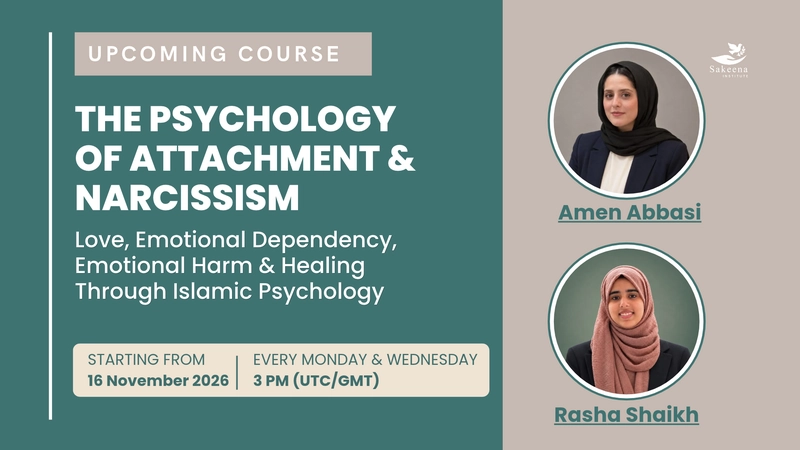
Your instructor
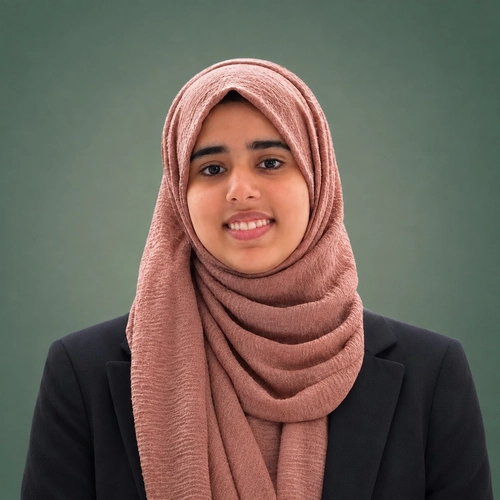 Your instructorRasha ShaikhLicensed Professional Counselor
Rasha Shaikh is a Licensed Professional Counselor (LPC) in Ohio and a mental health professional based in Saudi Arabia. She holds a Master’s degree in Counselor Education, specializing in Clinical Mental Health Counseling, and a Bachelor’s degree in Psychology, both from the University of Toledo, Ohio, USA. Her experience spans university counseling and community mental health settings in the United States, as well as digital mental health and wellbeing. She has worked with diverse populations and a range of mental health concerns, drawing on approaches such as cognitive behavioral therapy (CBT), person-centered therapy, and strengths-based practices.
View profileThis course includes
- Duration
- 10 hours (10 weeks)
- Lessons
- 0 in 10 modules
- Start date
- Nov 16, 2026
- Category
- Mental Health
- Discussion forum
- Opens after you enrollJoin the discussion
The Psychology of Attachment and Narcissism
Love, Emotional Dependency, Emotional Harm and Healing Through Islamic Psychology
Course Outline
0 lessons • 10 weeks
Why Do We Get Attached? The Psychology of Love and Emotional Connection
Module 1 • 0 lessons
Why Do We Get Attached? The Psychology of Love and Emotional Connection
Module 1 • 0 lessons
Content will be revealed soon
Why Do We Love the Way We Do? Understanding Your Attachment Style
Module 2 • 0 lessons
Why Do We Love the Way We Do? Understanding Your Attachment Style
Module 2 • 0 lessons
Content will be revealed soon
When Love Becomes Dependency: Why Is It So Hard to Let Go?
Module 3 • 0 lessons
When Love Becomes Dependency: Why Is It So Hard to Let Go?
Module 3 • 0 lessons
Content will be revealed soon
Understanding Narcissism: When Everything Is About Them
Module 4 • 0 lessons
Understanding Narcissism: When Everything Is About Them
Module 4 • 0 lessons
Content will be revealed soon
The Hidden Games of Emotional Manipulation: Gaslighting, Control and Self-Doubt
Module 5 • 0 lessons
The Hidden Games of Emotional Manipulation: Gaslighting, Control and Self-Doubt
Module 5 • 0 lessons
Content will be revealed soon
Why Do We Stay with People Who Hurt Us? Toxic Attachment and Trauma Bonds
Module 6 • 0 lessons
Why Do We Stay with People Who Hurt Us? Toxic Attachment and Trauma Bonds
Module 6 • 0 lessons
Content will be revealed soon
The Invisible Wounds: How Emotional Harm Affects Your Mind, Heart and Self-Worth
Module 7 • 0 lessons
The Invisible Wounds: How Emotional Harm Affects Your Mind, Heart and Self-Worth
Module 7 • 0 lessons
Content will be revealed soon
Narcissism Through an Islamic Lens: Arrogance, Injustice and the Rights of Others
Module 8 • 0 lessons
Narcissism Through an Islamic Lens: Arrogance, Injustice and the Rights of Others
Module 8 • 0 lessons
Content will be revealed soon
Breaking Free from Unhealthy Attachment: Boundaries, Self-Worth and Tawakkul
Module 9 • 0 lessons
Breaking Free from Unhealthy Attachment: Boundaries, Self-Worth and Tawakkul
Module 9 • 0 lessons
Content will be revealed soon
From Emotional Pain to Inner Peace: Healing and Building Healthy Islamic Relationships
Module 10 • 0 lessons
From Emotional Pain to Inner Peace: Healing and Building Healthy Islamic Relationships
Module 10 • 0 lessons
Content will be revealed soon
About this course
The Psychology of Attachment & Narcissism
Love, Emotional Dependency, Emotional Harm & Healing Through Islamic Psychology
10-Module Course | Sakeena Institute | Two instructors | Mon & Wed, 3:00 PM UTC
Understand Your Attachment. Recognize Emotional Harm. Break Unhealthy Patterns. Reclaim Your Peace.
Course Overview
"And among His signs is that He created for you spouses from among yourselves that you may find tranquillity in them, and He placed between you affection and mercy." (Qurʾān 30:21)
The heart was designed to bond, and for many Muslims this bond has caused turmoil. A heart that won't take no for an answer. A bond that is difficult to break even after it has been hurtful. A situation that leaves you constantly questioning what you did wrong. A pain that no one can see from the outside and is in silence Islam does not ask us to harden our hearts or diminish our compassion. It places love where it belongs; it provides the injured dignity, language and a way forward. The Psychology of Attachment & Narcissism is a 10-module live course designed to explore the journey from understanding attachment styles and identifying narcissistic patterns to recognizing emotional harm, rebuilding inner strength, and fostering healthier relationships through Islamic psychology.
Each module brings together two complementary perspectives: modern psychological understanding and Islamic teachings. Psychology helps explain how emotional bonds are formed, how they can become unhealthy, and how they can be restored. Islamic principles offer deeper guidance through the Qur'anic teachings of justice, kindness, mercy, mutual rights, and the exemplary character of the Prophet Muhammad ﷺ in his relationships with family and companions.
The course focuses on understanding behavioral patterns and their emotional consequences rather than labelling, blaming, or diagnosing individuals. It approaches the subject with compassion for those experiencing emotional pain while emphasizing accountability, self-awareness, and responsibility for the harm caused.
How the Course Works
Two instructors, Amen Abbasi and Rasha Shaikh, each teach five modules. Sessions run on Mondays and Wednesdays at 3:00 PM UTC over five weeks. Every module follows the same clear structure:
Part | What it covers |
|---|---|
What you will learn | The psychology of the topic, taught clearly |
The faith | Guidance from the Qurʾān and the Sunnah |
Practical takeaway | A reflection or tool you can use the same day |
Each module in this document also sets out learning objectives, main topics, Islamic references, psychological evidence, expected outcomes, key takeaways and its links to the modules around it, so that both instructors prepare within one shared framework.
Instructor | Focus | Modules |
|---|---|---|
Amen Abbasi | Love and connection, emotional dependency, patterns of manipulation, the inner effects of emotional harm, and rebuilding through boundaries, self-worth and tawakkul | 1, 3, 5, 7 and 9 |
Rasha Shaikh | Attachment styles, the psychology of narcissism, trauma bonds, the Islamic understanding of arrogance and injustice, and healing into healthy relationships | 2, 4, 6, 8 and 10 |
One home for each idea. To keep the modules from repeating one another, every major idea is taught in one module only. Other modules refer to it and build on it.
Idea | Taught in |
|---|---|
Why humans bond; the biology and meaning of love | Module 1 |
Attachment styles and where they come from | Module 2 |
Emotional dependency; the grief of letting go | Module 3 |
Narcissistic traits, the spectrum and the mask behind them | Module 4 |
Manipulation tactics and the erosion of self-trust | Module 5 |
Why harmful bonds hold: intermittent reinforcement and trauma bonds | Module 6 |
The effects of emotional harm on mind, heart, body and worship | Module 7 |
Arrogance, injustice and the rights of others in Islamic ethics; self-examination | Module 8 |
Boundaries, self-worth and tawakkul in action | Module 9 |
Healing, forgiveness and building healthy relationships | Module 10 |
Shared terminology used by both instructors:
Term | Meaning in this programme |
|---|---|
Attachment | The emotional bond that draws a person to seek closeness, comfort and safety with particular people |
Attachment style | A person's usual way of approaching closeness, shaped by early experience and open to change |
Emotional dependency | Reliance on another person for one's mood, worth or sense of safety to the point that separation feels unbearable |
Narcissism | A spectrum of personality traits including self-importance, need for admiration and limited empathy. Narcissistic personality disorder is a clinical diagnosis made only by a qualified clinician |
Emotional manipulation | Influencing another person's feelings or choices through pressure, deception or guilt instead of honesty and respect |
Gaslighting | Repeatedly denying or distorting a person's experience until they doubt their own memory or judgement |
Trauma bond | A strong attachment formed to a person who is at once a source of hurt and a source of comfort |
Emotional harm | Lasting injury to a person's mind, heart and sense of worth caused by repeated mistreatment that leaves no physical mark |
Boundary | A clear limit on what one will accept, expressed with kindness and kept with consistency |
Mawadda wa raḥma | Affection and mercy, the Qurʾān's description of the bond between spouses (30:21) |
Ẓulm | Wrongdoing and injustice; in the classical definition, putting a thing where it does not belong, including violating the rights of others |
Kibr | Arrogance: rejecting the truth and looking down on people (Muslim 91) |
Tawakkul | Doing one's part and entrusting the outcome to Allah |
Course Modules
Module 1: Why Do We Get Attached? The Psychology of Love and Emotional Connection
Date and time | Week 1, Monday, 3:00 PM UTC |
Instructor | Amen Abbasi |
Case scenario | "When they go quiet for a day, my whole mind goes with them. I know it is only a day, so why does it feel as if the ground has moved?" |
What you will learn | Why human beings are built to bond, how the brain and body make closeness feel like safety, the difference between attraction, love and attachment, and what a healthy bond gives a person: comfort, a secure base and the courage to face the world. |
The faith | Love is part of the fiṭra and one of Allah's signs. The Prophet ﷺ spoke of love openly and without embarrassment. Yet the Qurʾān places every love in order, with the love of Allah above all others. |
Practical takeaway | A "circle of closeness" map: the people nearest your heart, what each one gives you, and the one need that only Allah can meet. |
Learning objectives
Explain the human need to belong and why bonding is part of our design. Describe, in simple terms, the attachment system and the idea of a secure base. Distinguish attraction, love, companionship and attachment. Identify what each close relationship gives you. State the Islamic order of love.
Main topics
Why no one is meant to live alone. How closeness calms the body: touch, voice, presence and the stress response. The attachment system as a built-in way of seeking safety, and the secure base that makes exploration possible. The components of love: intimacy, passion and commitment. Romantic, family, friendship and community bonds, each with its own shape. What the brain's reward system and bonding hormones do, and what they do not explain. The heart in Islamic psychology as the seat of love, and the fiṭra that inclines people toward one another. Love for the sake of Allah and the ranking of loves.
Islamic references
Qurʾān 30:21 (mawadda and raḥma, introduced in the programme overview and developed here); 3:14; 2:165. The Prophet's ﷺ words about Khadījah, "I was granted her love" (Muslim 2435). His answer that ʿĀʾisha was the most beloved to him (al-Bukhārī 3662, Muslim 2384). The three qualities that bring the sweetness of faith, including loving a person only for Allah's sake (al-Bukhārī 16, Muslim 43). Al-Ghazālī, Iḥyāʾ ʿUlūm ad-Dīn, on love as a natural inclination of the heart.
Psychology and evidence
Baumeister and Leary (1995) on the need to belong. Bowlby's attachment theory: the attachment behavioural system, proximity seeking and the secure base. Hazan and Shaver (1987) on romantic love as an attachment process. Sternberg's triangular theory of love (1986). Coan, Schaefer and Davidson (2006) on how a trusted person's presence lowers the brain's threat response. Aron and colleagues (2005) on the brain's reward activity in intense romantic love. Oxytocin presented as one part of a wider system, not a "love chemical".
Expected outcomes
Participants understand that their need for closeness is natural and not a weakness, can name what their closest bonds give them, and hold a shared picture of healthy attachment against which the rest of the programme is measured.
Key takeaways
Bonding is part of how Allah made us. A secure bond steadies a person rather than consuming them. Love has an order: every human love sits below the love of Allah.
Links to other modules
Opens the programme. Module 2 asks why people love in such different ways, and Module 3 looks at what happens when this natural need loses its balance.
Module 2: Why Do We Love the Way We Do? Understanding Your Attachment Style
Date and time | Week 1, Wednesday, 3:00 PM UTC |
Instructor | Rasha Shaikh |
Case scenario | "With one person I hold on too tightly. With another, closeness makes me want to step back. It is the same heart, so where did I learn this?" |
What you will learn | How early experiences of care shape what we expect from closeness, the four attachment styles as tendencies and not labels, how each style appears in marriage, friendship, family and work, and how a person moves toward greater security. |
The faith | Every child is born upon the fiṭra, and the surroundings that raise a child shape the heart. The Prophet ﷺ modelled tenderness toward children, and the Qurʾān honours parents. Understanding how we were formed is not disrespect to anyone. |
Practical takeaway | A pattern reflection: what I do when I fear losing closeness, what I do when closeness feels like too much, and the need underneath each. |
Learning objectives
Describe how early caregiving shapes adult expectations of closeness. Distinguish secure, anxious, avoidant and fearful-avoidant tendencies. Recognise their own most common pattern and the situations that bring it out. Explain why styles can change. Reflect on upbringing with understanding and without blame.
Main topics
The early years as the first lesson in closeness. The two dimensions beneath the styles: anxiety about being left and discomfort with closeness. The secure style and what it actually looks like. The anxious style and the pursuit of reassurance. The avoidant style and the retreat into self-reliance. The fearful-avoidant style, where the wish for closeness and the fear of it pull in opposite directions. How styles meet in couples, and why certain pairings feel so familiar. Styles are not fixed: other relationships, life events and deliberate effort can lead to earned security. Understanding one's upbringing while honouring one's parents.
Islamic references
The fiṭra and the influence of upbringing (al-Bukhārī 1385, Muslim 2658). The Prophet's ﷺ kiss for al-Ḥasan and his reply, "He who shows no mercy will not be shown mercy" (al-Bukhārī 5997, Muslim 2318). Carrying Umāmah in prayer (al-Bukhārī 516, Muslim 543) and shortening the prayer at a child's cry (al-Bukhārī 707, Muslim 470). Qurʾān 17:23-24 and 31:14 on honouring parents, including the prayer "My Lord, have mercy on them as they raised me when I was small."
Psychology and evidence
Bowlby's attachment theory. Ainsworth and colleagues (1978) on the Strange Situation and the secure, anxious and avoidant patterns. Main and Solomon (1986) on disorganised attachment. Hazan and Shaver (1987) on adult attachment styles. Bartholomew and Horowitz (1991) on the four-category model. Fraley and Shaver (2000) and Mikulincer and Shaver (2007) on the anxiety and avoidance dimensions. Fraley (2002) on moderate stability of attachment over time. Roisman and colleagues (2002) on earned security. The Experiences in Close Relationships scale is shown for reflection only and is not used to diagnose.
Expected outcomes
Participants can describe their own attachment tendencies with curiosity rather than shame, understand that these patterns were learned and can be relearned, and see that understanding their past does not require blaming those who raised them.
Key takeaways
An attachment style is a learned way of seeking safety, not a verdict on a person. Most people show different patterns with different people. Security can be built at any age.
Links to other modules
Builds on the attachment system introduced in Module 1. Module 3 shows how an anxious pattern can deepen into dependency, and Module 6 returns to styles to explain why some people are drawn to harmful bonds.
Module 3: When Love Becomes Dependency: Why Is It So Hard to Let Go?
Date and time | Week 2, Monday, 3:00 PM UTC |
Instructor | Amen Abbasi |
Case scenario | "We are no longer together, yet my day still begins and ends with them. I do not know who I am without them." |
What you will learn | The difference between healthy closeness and emotional dependency, the signs that a person has handed their mood, worth or decisions to someone else, why separation hurts as it does, and why the heart keeps returning to what it has lost. |
The faith | The heart was made to depend on Allah, and it suffers when another person takes that place. Islam honours grief and also teaches where the heart's weight belongs. The Prophet ﷺ taught that help is sought from Allah. |
Practical takeaway | A dependency inventory: what I hand to this person, one small step to take it back, and one act that turns that need toward Allah. |
Learning objectives
Distinguish interdependence from emotional dependency. Identify the main signs of dependency in themselves or others. Explain why separation causes real distress in mind and body. Describe the normal course of grief after a relationship ends. Apply the Islamic teaching on where the heart's reliance belongs.
Main topics
Healthy interdependence: needing one another without losing oneself. Dependency in practice: mood that rises and falls with another person's attention, decisions that wait for their approval, a sense of worth that is lent by them, fear of being alone. Why letting go hurts: separation distress, craving, rumination and the loss of the self that was built around the other person. Grief after a relationship ends, including when no one has died. Why hope and memory keep the bond alive. The classical Islamic reading of the heart's attachment (taʿalluq) and passionate love (ʿishq) as a condition that arises when the heart is emptied of what should fill it. Returning the heart's reliance to Allah without cutting off human love.
Islamic references
Qurʾān 2:165 and 79:40-41 on the love that outranks all others and the restraint of the soul's desire. Qurʾān 12:84-86, Yaʿqūb's grief and his words, "I only complain of my suffering and grief to Allah." At-Tirmidhī 2516, "If you ask, ask Allah; if you seek help, seek help from Allah." The account of Barīrah and Mughīth (al-Bukhārī 5283): Mughīth followed her in tears, and when the Prophet ﷺ spoke to her on his behalf and she asked whether it was a command, he said it was only an intercession, and he respected her choice. Ibn al-Qayyim, Rawdat al-Muḥibbīn and al-Jawāb al-Kāfī, presented as scholarly analysis. At-Tirmidhī graded narration 2516 ḥasan ṣaḥīḥ; all other narrations cited here are in al-Bukhārī or Muslim.
Psychology and evidence
Hirschfeld and colleagues (1977) and Bornstein (1992) on interpersonal dependency. Bowlby's phases of protest, despair and detachment after separation. Eisenberger, Lieberman and Williams (2003) and Kross and colleagues (2011) on the overlap between social and physical pain. Fisher, Brown, Aron and colleagues (2010) on the brain's reward and craving systems after rejection in love. Slotter, Gardner and Finkel (2010) on the loss of self-concept after a break-up. Stroebe and Schut's dual process model of coping with loss. Dependency is treated as a pattern to understand, not a defect of character.
Expected outcomes
Participants can name what they have placed in another person's hands, understand why letting go is painful rather than a failure of willpower, and take a first small step toward steadiness that begins with turning to Allah.
Key takeaways
Attachment hurts to lose because it is real, not because something is wrong with you. Dependency begins when a person becomes the source of your mood and worth. The heart settles when its weight is placed with Allah and human love sits beside it.
Links to other modules
Builds on the secure base of Module 1 and the anxious pattern of Module 2. Module 6 deals with bonds that hold because of harm, and Module 9 gives the practical steps for stepping back.
Module 4: Understanding Narcissism: When Everything Is About Them
Date and time | Week 2, Wednesday, 3:00 PM UTC |
Instructor | Rasha Shaikh |
Case scenario | "At the start they were the most charming person I had met. Now every conversation turns back to them, and my feelings are always an inconvenience." |
What you will learn | What narcissism is and is not, the spectrum from healthy self-confidence to a clinical disorder, the grandiose and vulnerable presentations, the fragile self-worth beneath the confident surface, why such people can be so attractive at first, and how to describe harmful behaviour without labelling or diagnosing anyone. |
The faith | The Qurʾān asks for justice in speech and caution in judgement, even toward people who have troubled us. The Prophet ﷺ corrected behaviour without exposing individuals. This module aims at understanding, not at labelling. |
Practical takeaway | "Describe the behaviour, not the person": rewrite a painful experience as what was said or done, how often, and its effect on you. |
Learning objectives
Define narcissism as a spectrum of traits. Distinguish healthy self-esteem, narcissistic traits and narcissistic personality disorder. Describe the grandiose and vulnerable presentations. Explain the early charm and the later pattern. Describe behaviour factually and without diagnosing.
Main topics
Why the word is overused, and why precision matters. Self-confidence versus self-importance. The core features: entitlement, need for admiration, sensitivity to criticism and difficulty staying with another person's feelings. Grandiose and vulnerable presentations, and the shared insecurity beneath both. How a self-image is protected and why criticism feels like a threat. Why charm, confidence and attention draw people in. How narcissistic patterns appear in marriage, parenting, friendship, the workplace and community life. Contributing factors, including temperament and upbringing. What this module will not do: diagnose a person from a description, or encourage people to label those who have hurt them.
Islamic references
Qurʾān 49:12 (avoiding suspicion and assumptions), 5:8 (justice toward those we dislike) and 6:152 (justice in speech, even about a relative). Beware of suspicion, "for suspicion is the most false of speech" (al-Bukhārī 6064, Muslim 2563). The Prophet's ﷺ practice of correcting a wrong without naming a person, such as "What is wrong with people who stipulate conditions that are not in Allah's Book?" (al-Bukhārī 456, Muslim 1504). All narration numbers have been verified against the standard numbering of al-Bukhārī and Muslim.
Psychology and evidence
DSM-5-TR criteria for narcissistic personality disorder, introduced for recognition and not for self-diagnosis or diagnosis of others. Pincus and Lukowitsky (2010) on pathological narcissism. Miller and colleagues (2011) on grandiose and vulnerable narcissism. Morf and Rhodewalt (2001) on how the narcissistic self is regulated. Back, Schmukle and Egloff (2010) on first impressions. Campbell, Foster and Finkel (2002) on narcissism in romantic relationships. Ritter and colleagues (2011) on empathy. Brummelman and colleagues (2015) on the origins of narcissism in childhood. Malkin (2015) on narcissism as a spectrum.
Expected outcomes
Participants can describe narcissistic patterns accurately and fairly, understand why a charming start and a painful later pattern can belong to the same person, and speak about their experience in terms of behaviour and effect.
Key takeaways
Narcissism is a spectrum, and only a qualified clinician can diagnose it. Beneath the confidence is often a fragile sense of worth. Describing what happened is clearer, fairer and safer than attaching a label.
Links to other modules
Builds on the attachment patterns of Module 2. Module 5 examines the tactics through which these traits cause harm, and Module 8 views the same traits through the Islamic concepts of arrogance and injustice.
Module 5: The Hidden Games of Emotional Manipulation: Gaslighting, Control and Self-Doubt
Date and time | Week 3, Monday, 3:00 PM UTC |
Instructor | Amen Abbasi |
Case scenario | "I was sure of what they said last week. Now they tell me it never happened, and somehow I am the one apologising for remembering it." |
What you will learn | How emotional manipulation differs from honest disagreement, the common tactics (gaslighting, blame-shifting, guilt, minimising, silent treatment, triangulation and the use of religious language as pressure), how repeated invalidation wears down self-trust, and how a person begins to trust their own perception again. |
The faith | Islam places truthfulness at the centre of character and condemns deceit. Sincere advice (naṣīḥa) is offered for the good of the other person. Pressure presented as advice is a different thing. |
Practical takeaway | A fact log (what was said, when, and how it felt) and a "check with one trusted person" habit, so that your memory and judgement have somewhere steady to stand. |
Learning objectives
Tell manipulation from honest disagreement and ordinary mistakes. Recognise the main tactics by their effect on the person. Explain how repeated invalidation produces self-doubt. Distinguish sincere advice from pressure. Use simple records and a trusted person to restore confidence in their own perception.
Main topics
What manipulation is: influence that bypasses honesty and respect. Gaslighting and the slow loss of confidence in one's own memory. Blame-shifting, DARVO (deny, attack, reverse victim and offender), guilt-tripping and minimising. Moving the goalposts. The silent treatment and withdrawal as pressure. Triangulation through third parties and the gradual isolation of a person from their supports. Religious language used to silence or shame. Why capable, intelligent people are affected: manipulation works on goodwill, loyalty and the wish to keep the peace. A fair caution: not every disagreement or faulty memory is manipulation, and the focus here is on repeated patterns.
Islamic references
Qurʾān 2:42 (do not mix truth with falsehood or hide the truth) and 9:119 (be with the truthful). "Whoever deceives us is not of us" (Muslim 101). The signs of hypocrisy: lying when speaking, breaking promises and betraying a trust (al-Bukhārī 33, Muslim 59). "Truthfulness leads to righteousness" (al-Bukhārī 6094, Muslim 2607). "The religion is sincere advice" (Muslim 55), taught with the difference between advice given for the other's good and pressure applied for one's own.
Psychology and evidence
Abramson (2014) and Sweet (2019) on gaslighting as a pattern and its social setting. Stark (2007) on coercive control. Harsey, Zurbriggen and Freyd (2017) on DARVO. Gottman's research on stonewalling and contempt in relationships. Williams (2007) on the effects of ostracism and the silent treatment. Gaslighting is a popular term and is used here descriptively, not as a diagnosis.
Expected outcomes
Participants can name the tactics that have affected them without needing to prove another person's intention, understand why self-doubt followed, and have a practical way of steadying their own perception.
Key takeaways
The effect of a pattern is real even when the person causing it denies it. Self-doubt is something that was produced in you, not a flaw you were born with. Honest advice leaves a person freer, and manipulation leaves them smaller.
Links to other modules
Takes the traits of Module 4 into daily behaviour. Module 6 explains why people stay within these patterns, and Module 7 describes the toll they take.
Module 6: Why Do We Stay with People Who Hurt Us? Toxic Attachment and Trauma Bonds
Date and time | Week 3, Wednesday, 3:00 PM UTC |
Instructor | Rasha Shaikh |
Case scenario | "I know how it feels when they are cruel. But when they are kind, I think I have the person I first fell for, and I cannot walk away from that." |
What you will learn | Why people remain in relationships that harm them: alternating warmth and hurt, hope and the weight of what has already been invested, the mind's need to explain painful behaviour, fear, shame and isolation, and the pressures of family and community. How a trauma bond forms, and how to tell a difficult relationship from a harmful one. |
The faith | The Qurʾān does not ask a believer to be held in harm. It sets kindness and the avoidance of harm as the standard in every bond. The believer's heart, however, belongs to Allah and not to any person who has power over them. |
Practical takeaway | A "pull and cost" ledger: what keeps me connected, what it costs me, and three facts I can hold on to when the pull is strongest. |
Learning objectives
Explain how alternating kindness and hurt creates a strong bond. Describe the roles of hope, sunk cost, cognitive dissonance, fear and shame in staying. Identify practical, family and community pressures that keep people in place. Distinguish a difficult relationship from a harmful one. Know where to turn for safety support.
Main topics
Why the "good days" hold so strongly: intermittent reinforcement and the brain's anticipation of reward. The mind's need to make sense of someone who is both loving and hurtful. Hope for the person they were at the beginning. The weight of years, children, reputation and money. How earlier attachment patterns can make the familiar feel safer than the safe. Shame and the fear of what others will say. Isolation as both a cause and a result. Trauma bonding as an understandable response to a painful situation and not a personal failing. Difficult versus harmful: ordinary conflict, repeated unkindness, and patterns that threaten safety. A clear note that any risk of physical danger calls for immediate professional and emergency support, and that the programme does not assess individual situations.
Islamic references
Qurʾān 4:19 (live with one another in kindness), 2:231 (do not hold on to a person in order to harm them) and 65:2 (to keep in kindness or to part in kindness). Qurʾān 3:175 on being afraid of people and not of Allah. "A believer is not bitten twice from the same hole" (al-Bukhārī 6133, Muslim 2998), taught as the value of learning from experience. Āsiyah in Qurʾān 66:11, whose heart stayed with Allah while she lived under Firʿawn's power, and who asked Him for rescue. Rulings that concern marriage, separation or family ties are referred to qualified scholars and are not given in the programme.
Psychology and evidence
Dutton and Painter (1993) on traumatic bonding. Intermittent reinforcement in behavioural psychology. Festinger (1957) on cognitive dissonance. Freyd (1996) on betrayal trauma and dependence on the person who harms. Rusbult and Martz (1995) on the investment model and why people remain in harmful relationships. Mikulincer and Shaver (2007) on attachment insecurity in adult relationships. Herman (1992) on bonds formed under coercion.
Expected outcomes
Participants understand that staying is explained by real psychological forces and not by weakness, can see the pattern in their own situation or that of someone they love, and know that help is available.
Key takeaways
A bond can be strong and still be harmful. The good days are part of how the bond holds. Hope belongs with Allah, and no person has a claim on your heart that Allah does not.
Links to other modules
Applies the dependency of Module 3 and the patterns of Module 2 to harmful relationships, and the tactics of Module 5 to the question of why they work. Module 7 describes what staying costs, and Module 9 gives the steps toward freedom.
Module 7: The Invisible Wounds: How Emotional Harm Affects Your Mind, Heart and Self-Worth
Date and time | Week 4, Monday, 3:00 PM UTC |
Instructor | Amen Abbasi |
Case scenario | "Nothing they did left a mark that anyone could see. So why am I exhausted, anxious and unsure of my own worth, and why does it feel as if I am not allowed to say so?" |
What you will learn | How repeated emotional harm affects the mind, body and sense of self: anxiety, low mood, constant alertness, self-blame, shame, difficulty trusting and a blurred sense of who you are. How harm can also touch a person's worship and their view of Allah's mercy, and why naming the harm is the first step toward healing. |
The faith | Allah hears the complaint of the one who is wronged, honours the dignity of every human being, and permits the wronged person to speak of the wrong in a proper way. Grief and tears are not a lack of faith. |
Practical takeaway | An "impact map" across mind, body, heart, relationships and worship, with a single sentence for each beginning "What happened to me is real, and it affected me by..." |
Learning objectives
Describe the common effects of emotional harm on thoughts, feelings, body and behaviour. Explain how self-blame and shame develop. Recognise how harm affects self-worth and sense of identity. Identify effects on worship and on a person's relationship with Allah. Understand that speaking about harm in a proper way is permitted and healthy.
Main topics
Why emotional harm is called invisible and why it is often minimised, including by the person who has experienced it. The effects on the mind: anxiety, low mood, intrusive replaying of events, difficulty concentrating. The effects on the body: poor sleep, tension, fatigue. Self-blame, shame and the belief "I must be the problem." Erosion of self-worth and of a clear sense of who one is. Difficulty trusting others and one's own judgement. Emotional numbness and withdrawal. Effects on worship: distance from prayer, doubts about Allah's mercy, the feeling of being unworthy to ask. Why speaking about harm matters and how to do it without slander. When these effects call for professional support.
Islamic references
Qurʾān 17:70 ("We have honoured the children of Ādam"), 58:1 (Allah hears the one who complains), 4:148 (the wronged may speak of the wrong) and 42:41 (the one who defends themselves after being wronged is not blamed). The Prophet's ﷺ words at the death of his son: "The eyes shed tears and the heart grieves, and we say only what pleases our Lord" (al-Bukhārī 1303, Muslim 2315). The heart as the centre of a person's condition (al-Bukhārī 52, Muslim 1599). Abu Zayd al-Balkhī on sadness and anger in Maṣāliḥ al-Abdān wal-Anfus, as analysed by Awaad and Ali.
Psychology and evidence
Spinazzola and colleagues (2014) on the effects of psychological maltreatment. Campbell and colleagues (1996) on self-concept clarity. Herman (1992) on the effects of prolonged coercive relationships, and ICD-11's recognition of complex post-traumatic stress disorder. Research linking emotional abuse with anxiety, depression and sleep difficulty. The role of shame and self-blame in keeping distress in place. Effects are described for recognition and are not diagnosed in the programme.
Expected outcomes
Participants can name how they have been affected without minimising it, understand that these effects are understandable responses to real harm, and feel permitted to seek support.
Key takeaways
Emotional harm is real harm. What you feel is a response to what happened. Your dignity as a human being was never lost, and Allah heard you throughout.
Links to other modules
Follows the tactics of Module 5 and the staying of Module 6 with their cost. Module 9 begins the work of recovery with boundaries, and Module 10 carries it into long-term healing.
Module 8: Narcissism Through an Islamic Lens: Arrogance, Injustice and the Rights of Others
Date and time | Week 4, Wednesday, 3:00 PM UTC |
Instructor | Rasha Shaikh |
Case scenario | "They pray, they fast and they speak well about Islam. Yet at home they never admit a fault, never ask forgiveness and treat my feelings as nothing. How can both be true?" |
What you will learn | How the behaviours described in Module 4 are addressed in Islamic ethics under kibr (arrogance), ʿujb (self-admiration) and ẓulm (injustice), why worship does not cancel the rights people hold over one another, the Qurʾānic portraits of arrogance, the Prophetic model of humility, and the believer's own duty of self-examination. |
The faith | The Qurʾān and the Sunnah describe arrogance as rejecting the truth and looking down on people, and injustice as one of the gravest harms. They also teach that Allah alone knows hearts. We address conduct and its harm, and we leave judgement of a person's heart to Allah. |
Practical takeaway | A self-examination (muḥāsabah) in two parts: "Where am I wronged?" and "Where might I be the one who wrongs?", each answered with honesty and mercy. |
Learning objectives
Define kibr, ʿujb and ẓulm and relate them to patterns of behaviour from Module 4. Explain the concept of ḥuqūq al-ʿibād and why prayer and fasting do not replace it. Describe the Qurʾānic portraits of Iblīs, Firʿawn and Qārūn. Describe the Prophet's ﷺ humility in daily life. Practise self-examination alongside the understanding of others.
Main topics
Arrogance in Islamic ethics: rejecting the truth and belittling people. Self-admiration as the root: the inability to see one's own faults. The Qurʾānic portraits: Iblīs ("I am better than him"), Firʿawn, who exalted himself and divided people, and Qārūn, who credited his success to himself. Ẓulm as putting a thing where it does not belong, and the rights of people (ḥuqūq al-ʿibād) that remain even for the devout. Why a person can be punctual in worship and still harmful at home, and what the Prophet ﷺ said about the one who prays and fasts but wrongs others. The Prophet's ﷺ humility in his own household. The duty to restrain wrongdoing with wisdom and gentleness. The limits of judgement: we describe behaviour and harm and do not pronounce on a person's heart or their final end. Self-examination: every person has a share of pride and can purify it. Apology and repair as the sign of humility.
Islamic references
Qurʾān 7:12 and 38:76 (Iblīs), 28:4 and 79:24 (Firʿawn), 28:76-82 (Qārūn), 31:18 and 25:63 (humility in how one walks and speaks), 16:90 and 4:135 (justice and good conduct), 12:53, 75:2 and 91:9-10 (the soul that commands evil, the self-reproaching soul and the soul that is purified). Arrogance is "rejecting the truth and looking down on people" (Muslim 91). "Allah has revealed to me that you should be humble, so that none transgresses against another" (Muslim 2865). The sacred saying, "I have forbidden injustice for Myself and made it forbidden among you" (Muslim 2577), and "Beware of injustice, for injustice is darkness on the Day of Resurrection" (Muslim 2578). The bankrupt person of the community, who comes with prayer, fasting and zakat but has wronged others (Muslim 2581). "Help your brother, whether he is the wrongdoer or the wronged", by restraining the wrongdoer (al-Bukhārī 2444). The Prophet ﷺ serving his family at home (al-Bukhārī 676). Nothing weighs heavier in the scale than good character (Abū Dāwūd 4799, at-Tirmidhī 2002). "Did you split open his heart?" (Muslim 96). Al-Ghazālī, Iḥyāʾ ʿUlūm ad-Dīn, on pride and self-admiration, and Ibn al-Qayyim, Madārij as-Sālikīn, presented as scholarly analysis. All narration numbers have been verified against the standard editions; the narration on good character (Abū Dāwūd 4799, at-Tirmidhī 2002) is graded ṣaḥīḥ.
Psychology and evidence
Campbell and colleagues (2004) on psychological entitlement and its effect on relationships. Exline and colleagues (2004) on how entitlement stands in the way of apology and forgiveness. Tangney (2000) on humility. Lazare (2004) on the elements of a genuine apology. This module sets the Islamic concepts beside the psychology of Module 4 and does not claim that the two vocabularies are identical.
Expected outcomes
Participants understand how Islam names and addresses arrogance and injustice, see that religious practice and harm to others are judged together, and are equipped to examine their own conduct as well as to understand the conduct of others.
Key takeaways
Worship is not a cover for wronging people. The rights of people are not waived by acts of devotion. Humility, honest apology and repair are the marks of a healthy heart, and every one of us needs to work at them.
Links to other modules
Relates the psychology of Module 4 to the Islamic tradition, and gives faith-based meaning to the harm described in Modules 5 to 7. Module 9 turns to what the person who has been hurt can do.
Module 9: Breaking Free from Unhealthy Attachment: Boundaries, Self-Worth and Tawakkul
Date and time | Week 5, Monday, 3:00 PM UTC |
Instructor | Amen Abbasi |
Case scenario | "I have decided to respond differently. But each time I say no, I feel guilty, and the guilt feels like proof that I am the one who is wrong." |
What you will learn | What boundaries are and are not, the main kinds (emotional, time, digital, financial and physical), how to set one that is clear, kind and consistent, how to tell guilt from genuine responsibility, how to meet push-back, and how self-worth is rebuilt on values and worship. Tawakkul is taught as acting wisely and then entrusting the result to Allah. |
The faith | The Prophet ﷺ taught that the self has a right over us, and that there is to be neither harm nor retaliation in harm. The Prophets set limits with gentleness. Tawakkul means taking the means and then trusting Allah, and it never means passive endurance of harm. |
Practical takeaway | "One boundary, three sentences": the need, the limit, and what I will do to keep it. Then a tawakkul step: act, say the duʿāʾ and hand the outcome to Allah. |
Learning objectives
Define a boundary and distinguish it from punishment or control. Identify which kinds of boundary they need. Draft and practise a clear, kind boundary. Distinguish guilt from responsibility. Describe a range of responses from adjusting contact to stepping back, and know that decisions about marriage and family ties are made with qualified scholars and professionals. Apply tawakkul together with action.
Main topics
What a boundary is: a statement of what I will do, not an order to someone else. Kinds of boundary and how to start with the smallest. Saying it clearly, kindly and calmly. Guilt after saying no, and why it is not evidence of wrongdoing. Meeting push-back, anger or promises to change. A range of responses: adjust, limit, step back or end contact, depending on the safety and the nature of the relationship, and the place of qualified scholarly and professional guidance in the larger decisions. Keeping family ties without enduring harm. Self-worth drawn from values, character and worship in place of another person's approval. Building a support network and a basic safety plan. Tawakkul: doing everything within one's means and then letting go of the outcome.
Islamic references
"Your self has a right over you, your Lord has a right over you and your family has a right over you, so give each its due" (al-Bukhārī 1968). "There is no harm and no reciprocating harm" (Ibn Mājah 2340; an-Nawawī, Forty Hadīth, no. 32). Ibrāhīm's farewell to his father, "Peace be upon you; I will ask forgiveness for you" (Qurʾān 19:47), and the gentle speech of Mūsā and Hārūn (Qurʾān 20:44). Qurʾān 2:216, 3:159 and 65:3. "The strong believer is better and more beloved to Allah than the weak believer… Strive for what benefits you, seek Allah's help and do not give up" (Muslim 2664). "Tie it, and trust in Allah" (at-Tirmidhī 2517). If you relied on Allah as He should be relied upon, He would provide for you as He provides for the birds (at-Tirmidhī 2344). Gradings: Ibn Mājah 2340 is ḥasan and was adopted by an-Nawawī in his Forty; at-Tirmidhī 2517 is ḥasan; at-Tirmidhī 2344 is graded ḥasan ṣaḥīḥ. That maintaining family ties does not require enduring harm is an established scholarly position; individual rulings remain with qualified scholars.
Psychology and evidence
Alberti and Emmons on assertiveness. The interpersonal effectiveness skills of dialectical behaviour therapy (Linehan). Crocker and Wolfe (2001) on contingencies of self-worth. Deci and Ryan (2000) on autonomy and relatedness. Gollwitzer (1999) on if-then planning for keeping a decision. Cohen and Wills (1985) on social support as a buffer against stress. The programme does not provide individual counselling, legal advice or safety planning, and refers participants to qualified services.
Expected outcomes
Participants have one boundary they can state and keep, a clearer view of the range of responses open to them, a source of self-worth that does not depend on another person, and a practice of taking steps and then trusting Allah with the result.
Key takeaways
A boundary is an act of care for yourself and for the relationship. Guilt is not proof of wrongdoing. Tawakkul is acting with wisdom and then entrusting the result to Allah.
Links to other modules
Gives the response to the patterns of Modules 3, 5 and 6, and to the harm of Module 7. Module 10 turns to healing and to building relationships that are healthy from the start.
Module 10: From Emotional Pain to Inner Peace: Healing and Building Healthy Islamic Relationships
Date and time | Week 5, Wednesday, 3:00 PM UTC |
Instructor | Rasha Shaikh |
Case scenario | "I am no longer in that situation. But I am afraid that I will never trust again, or that I will choose the same way again." |
What you will learn | The stages of recovery from emotional harm, the practices of worship that steady the heart, self-compassion within Allah's mercy, the difference between forgiveness, trust and reconciliation, and the qualities of a healthy relationship. The programme closes with the building of secure bonds and a personal plan for lasting peace. |
The faith | Pain is seen and valued by Allah, and relief is promised to the patient. Islam encourages pardon and also protects the right to safety. The Prophet ﷺ is the model of a person who was gentle and respectful in his own home. |
Practical takeaway | A one-page "peace plan": my early warning signs, my boundaries, my supports, my daily anchors and my duʿāʾ. A closing circle: one boundary to keep, one bond to nurture and one hurt to hand to Allah. |
Learning objectives
Describe the stages of recovery after emotional harm. Apply practices of ṣabr, dhikr, ṣalāh and duʿāʾ to emotional healing. Distinguish forgiveness, trust and reconciliation. Describe the qualities of a healthy relationship and a healthy companion. Write a personal plan to protect their peace.
Main topics
Recovery as a direction and not a finish line. The three broad stages: restoring safety, grieving what happened and what was lost, and reconnecting with life and people. The healing power of worship: ṣalāh as an anchor, dhikr for calm, duʿāʾ as speaking honestly to Allah. Self-compassion within Islam, where mercy is the character of the Lord. Forgiveness as releasing resentment and entrusting justice to Allah, which does not require contact, denial or trust. Growth after hardship. Learning to trust again, slowly and with discernment. What a healthy relationship looks like: affection and mercy, mutual respect, consultation, honest repair after conflict and freedom to disagree. Choosing companions and seeking guidance through consultation and istikhārah. Earned security as the long-term result of healing. Becoming a source of safety for others.
Islamic references
Qurʾān 42:40 and 42:43 (the reward of the one who pardons and is patient) and 24:22 ("Do you not love that Allah should forgive you?"). Qurʾān 3:139 and 57:22-23 on not growing weak or grieving over loss. No hardship, anxiety or sorrow reaches a believer, not even a thorn, without Allah removing some of their sins because of it (al-Bukhārī 5641, Muslim 2573). Qurʾān 42:38 (affairs decided by consultation) and 25:74 (the duʿāʾ for spouses and children who are a comfort to the eyes). "The best of you are the best to their families, and I am the best to my family" (at-Tirmidhī 3895). The Prophet ﷺ never struck anyone with his hand (Muslim 2328). The company we keep (al-Bukhārī 2101, Muslim 2628; Abū Dāwūd 4833). The istikhārah prayer (al-Bukhārī 1162). Gradings: at-Tirmidhī 3895 is ṣaḥīḥ and Abū Dāwūd 4833 is ḥasan.
Psychology and evidence
Herman (1992) on the stages of recovery. Tedeschi and Calhoun (1996) on post-traumatic growth. Neff (2003) on self-compassion, evaluated against the Islamic concept of mercy. Worthington (2006) on forgiveness and its separation from reconciliation. Gottman and Silver (1999) on repair and the features of stable relationships. Johnson (2008) on emotionally focused therapy and secure bonding. Roisman and colleagues (2002) on earned security. Holt-Lunstad, Smith and Layton (2010) on the protective effect of supportive relationships.
Expected outcomes
Participants leave with a written plan, a realistic picture of healing as a gradual process, a clear idea of what safe and loving relationships involve, and hearts settled in the knowledge that Allah is near to the one who has been hurt.
Key takeaways
Healing is gradual, and it is real. Forgiveness releases the heart and does not require a return to harm. Healthy love is gentle, honest and safe, and it is the love the Qurʾān describes.
Links to other modules
Closes the programme by drawing on Modules 1 to 9, returning to the secure bond of Module 1 and the earned security of Module 2.
What You Will Gain
• A clear understanding of why we attach, how attachment styles form and how they shape the way we love.
• The ability to tell healthy closeness from emotional dependency, and to understand why letting go is so hard.
• Fair, accurate language for narcissistic patterns and manipulation, based on behaviour and not on labels.
• An understanding of why people stay in harmful bonds, and of how emotional harm affects mind, heart and self-worth.
• The Islamic understanding of arrogance, injustice and the rights of others, and of the believer's own duty of self-examination.
• Practical tools for boundaries, self-worth and tawakkul.
• A personal plan for healing and for building healthy relationships, anchored in worship and hope.
Who Is This Programme For?
Anyone who wants to understand their relationships more deeply, recover from emotional hurt, or build healthier bonds with faith at the centre. It is also valuable for family members, teachers, imams, coaches and counsellors who support others. It is for you if you have ever thought:
• "I give everything to my relationships and still feel it is never enough."
• "I cannot stop thinking about someone, even though I know I should let go."
• "I am always the one apologising, and I no longer trust my own memory of what happened."
• "Someone I love is in a relationship that is hurting them, and I do not know how to help."
This is an educational programme. It explains, equips and directs; it does not assess, diagnose or treat, and it does not label any individual. Rulings on marriage, separation and family ties are given by qualified scholars, and the instructors direct participants to them for their individual circumstances. Anyone who is in danger, or in crisis, or at risk of harm should contact local emergency services immediately.
Certification
Attend the live sessions, or watch all recordings in the student dashboard, to receive a CPD-accredited Certificate of Completion from Sakeena Institute. The certificate records your Continuing Professional Development (CPD) hours and can be added to your professional portfolio.
Begin Your Journey
"Allah is the Ally of those who believe. He brings them out from darkness into the light." (Qurʾān 2:257)
Understand your attachment. Recognize emotional harm. Break unhealthy patterns. Reclaim your peace.
Reviews
Earn a certificate when you finish
Complete the course to receive a certificate you can share with employers, add to your CV or keep for yourself.
Membership students can unlock their certificate for 80% of the course price.Learn more
Complete all 0 lessons
Related courses
Towards Healing: Healing the Heart, Mind, and Body through Faith
by Elzahraa Hassane
Understanding the Delays in Your Life (Healing the Hidden Blocks Through Faith & Tawakkul)
by Elzahraa Hassane
How to Manage Anxiety through Anxiety Treatment Program
by Rabia Ashraf
How to Reach Mental Health With Dr.Elzahraa Hassane
by Elzahraa Hassane